Category: Redefining Every Stage Investments (RESI)
The Redefining Every Stage Investments (RESI) Conference is an ongoing conference series that provides an international venue for life science companies across Biotech, Medtech, Diagnostics and Healthcare IT and to source investors from around the globe, create relationships, and eventually, secure funding.
RESI Europe in Paris will feature two tracks of investor panels that include specialized topics relevant to current industry trends, such as Seed Funds, Big Pharma, AI in Healthcare and Oncology Innovation. RESI Panels are focused on an audience of entrepreneurs seeking to raise funding and make strategic relationships. LSN recruits panelists from our extensive network of investors in different categories, who are actively looking to make investments in early-stage life science and healthcare sectors. The panelists will have advice to share with startup CEOs on how to get through the process, get into dialogue, and secure funding or make a deal.
If you’re interested in hearing and meeting active industry experts, it’s not too late to register now!
Here are some of the panelists who will be joining our panels at RESI Europe in Paris:
Alexandra Bause
Partner Apollo Health Ventures
Alizée Cres
Principal BD & Strategy MITG EMEA Medtronic
Yuwen Liu
Founding Partner BOHE Angel Fund
Benedikt Luhmann
Principal – Healthcare VI Partners
Chris Church
Manager, Search & Evaluation, CVRM AstraZeneca
Corinne Venot
Sr. Director, BD Beigene
Diana Saraceni
Founder, Managing Director Panakes Partners
Guillermo Yudowski
Principal Investigator, EPIU Biogen
Jonas Jendi
Investment Manager Industrifonden
Katherine Cohen
Venture Partner Panacea Ventures
Kevin Johnson
Founding Partner Medicxi Ventures
Martin Pfister
Sr. Investment Manager: Life Sciences High-Tech Gründerfonds
Murali Gopalakrishnan
Sr. Director, Head Search & Evaluation Neuroscience AbbVie
Olaf Koenig
Director, International Bd Amgen
Olivier Nosjean
Research Scientific Director Servier
Paolo Pio
Managing Director Joyance Partners
Sofia Ioannidou
Partner Andera Partners
Stefan Luzi
Partner Gilde Healthcare Partners
Thibaut Roulon
Investment Director (Bioam & InnoBio) bpifrance
Thierry Laugel
Managing Partner Kurma Partners
Tom Willis
Partner Illumina Ventures
Victor Tong
Partner Decheng Capital
Walter Stockinger
Managing Partner Hadean Ventures
Wieger Vos
Corporate Strategy, Healthcare KPN Ventures
By Dennis Ford, Founder & CEO, Life Science Nation; Creator of RESI Conference Series
LSN business development teams spend a lot of time at various bio clusters and technology hubs around the world. In the last week, my team visited two hubs in the Netherlands to deliver our free Fundraising Bootcamp, and we are planning more visits to Europe tech hubs soon.
The more I travel around the planet the more similarities I see in the approach tech hubs take with their early stage company training strategy. I see that unanimously they are focused on getting a rational business plan to present to partners and investors. In order to accomplish this task they have hired Entrepreneurs In Residence and developed training programs. We have written before about the LSN training program fundraising training program Focus on Cures (FOC) and where it fits in the early stage of identifying potential partners and teaching how to reach out. LSN has found that FOC is augmenting and complementary with almost all of the tech hub strategies for partnering. You can learn more about how FOC is different here.
In many aspects getting a business plan around early stage technology assets is a great challenge. A company needs to be thorough and in context in a fast changing arena on many different levels. LSN offers training in a complementary skillset: the LSN mantra is to find all the folks you should be in dialogue with and start that dialogue no matter where you are at in the development cycle from idea to clinical stages. When you start a dialogue and begin relationships, the data elements needed for the business plan will fall out of the relationship.
LSN is the early view of talking about your company’s technology and team. It is not about market segments and reimbursement strategies – those will happen immediately after some validation with the existing programs already in place. LSN will posit that the partners in the early stage technology arena are more interested in trying to determine if the management team can be vetted and parsed for their ability to execute and move the technology forward. After the technology is vetted and partners surface around a table, that’s when formal business plans evolve.
– By Greg Mannix, VP of International Business Development, LSN
Greg Mannix
RESI has recently added an all-day pitch track in which entrepreneurs can deliver their short presentation to an investor audience and get instant feedback and questions from investors. In January at RESI SF, Altrix Bio was selected as one of the pitch session finalists. You can now apply to pitch at RESI Europe. You can also apply for a poster spot in the RESI Innovation Challenge.
Nancy Briefs, CEO of Altrix Bio
trategic business leader with extensive experience creating value, driving strategy and launching product commercialization in diverse life science companies. Deep general management and fundraising expertise having raised over $500 M in equity including IPO. Innovative, collaborative and entrepreneurial, strong communicator and tenacious. Energized by turning innovation into commercial reality, working with creative scientists, and communicating value to partners and investors.
Greg Mannix: Nancy, congratulations on being a finalist in the first ever Featured Company Pitch Session dedicated to women CEOs. What are your thoughts on this focus?
Nancy Briefs: I think it was timely and important. Especially being in California, one of the first places to really push for more diversity. I thought it was a refreshing change!
GM: What can be done to increase gender diversity in leadership roles at life sciences companies?
NB: I think a lot of women fall off the path between senior management positions and the C-suite, partly because of family commitments and other factors. Another thing might be the lack of role models to look up to when they are coming up the corporate ladder. And finally, it doesn’t help that the large majority of investors are also men, and are probably more prone to invest in people that look like them. Events like this RESI pitch session dedicated to women in CEO roles, which gives visibility to women role models and successful leaders, is a good thing. It is a fact that women make most of the healthcare decisions in their families, so it would seem to make sense that they play a more prominent role in healthcare companies.
GM: How did the Pitch Session go?
NB: It was well attended; I think there were 100 to 120 people in the auditorium. The moderator did a good job keeping everyone on schedule. It was a well run session.
GM: And how did you do in this new pitch format at RESI?
NB: Really well! I love to pitch and we got really positive feedback from several people. We got great visibility for the company and two of the investors in the audience reached out to me afterward. We are currently in conversations with them, so we are pleased with the result.
GM: Why do you think Altrix got traction with investors?
NB: I think Type 2 diabetes it is such a huge global problem, and our solution LuCI™ AJN 003 is an elegant drug without any systemic effects. That is important for the 50% of patients who do not reach glycemic control. And our experienced team really knows what it will take to get us through Phase II clinical trials. Also, Dennis Ford (Founder & CEO, Life Science Nation; Creator of RESI Conference Series), who we’ve been working with on our fundraise, really helped us focus our story. That made a difference as well.
GM: So you would pitch again at RESI?
NB: You bet!
AltrixBio has developed LuCI™, a novel substance that transiently coats the GI mucosa to block nutrient absorption, independent of the pH environment, temporarily mimicking the effects of Gastric Bypass (RYGB). LuCI is comprised of a sucrose octasulfate aluminum complex engineered into a complex coacervate formulation linked via pH-independent electrostatic interactions. When exposed to gastrointestinal fluid, LuCI forms a sticky paste that binds to the mucosa to form a coating on the site of GI tract. LuCI 1) can be orally administered, 2) rapidly binds to the luminal surface of the stomach, duodenum, and small intestine, 3) forms a continuous barrier coating to block nutrient contact, 4) has shown in vivo efficacy in a rodent model to significantly lower postprandial glucose response, and 5) has shown no systemic absorption or toxicity, thus minimizing the risk profile. Furthermore, by adjusting viscosity and dosing of the drug, we can alter duration of exposure, thus creating a family of drug formulations to coat the intestine and alter glucose homeostasis for different periods of time. The company is advancing AJN 003 for the treatment of type 2 Diabetes. Additionally, LuCI’s unique attributes may provide an ideal platform for delivery of drugs to the GI tract.
In addition to maintaining the LSN Investor Platform, LSN also provides access to the LSN Business Development platform, which tracks tens of thousands of early stage companies and new life science technologies all over the world. This platform includes a licensing deals dataset that provides crucial information on valuations, milestones, upfront payments, and everything else you’d need to build valuation comparators for your assets. By taking a look at all the 2019 data as a whole, we can reveal what’s really happening in pharma dealmaking.
We have recently expanded our deals records and due to the change in the way we compile this data, year-over-year comparisons are difficult. But here are the key facts that emerge from the 2019 deals data.
Partnering Starts Early
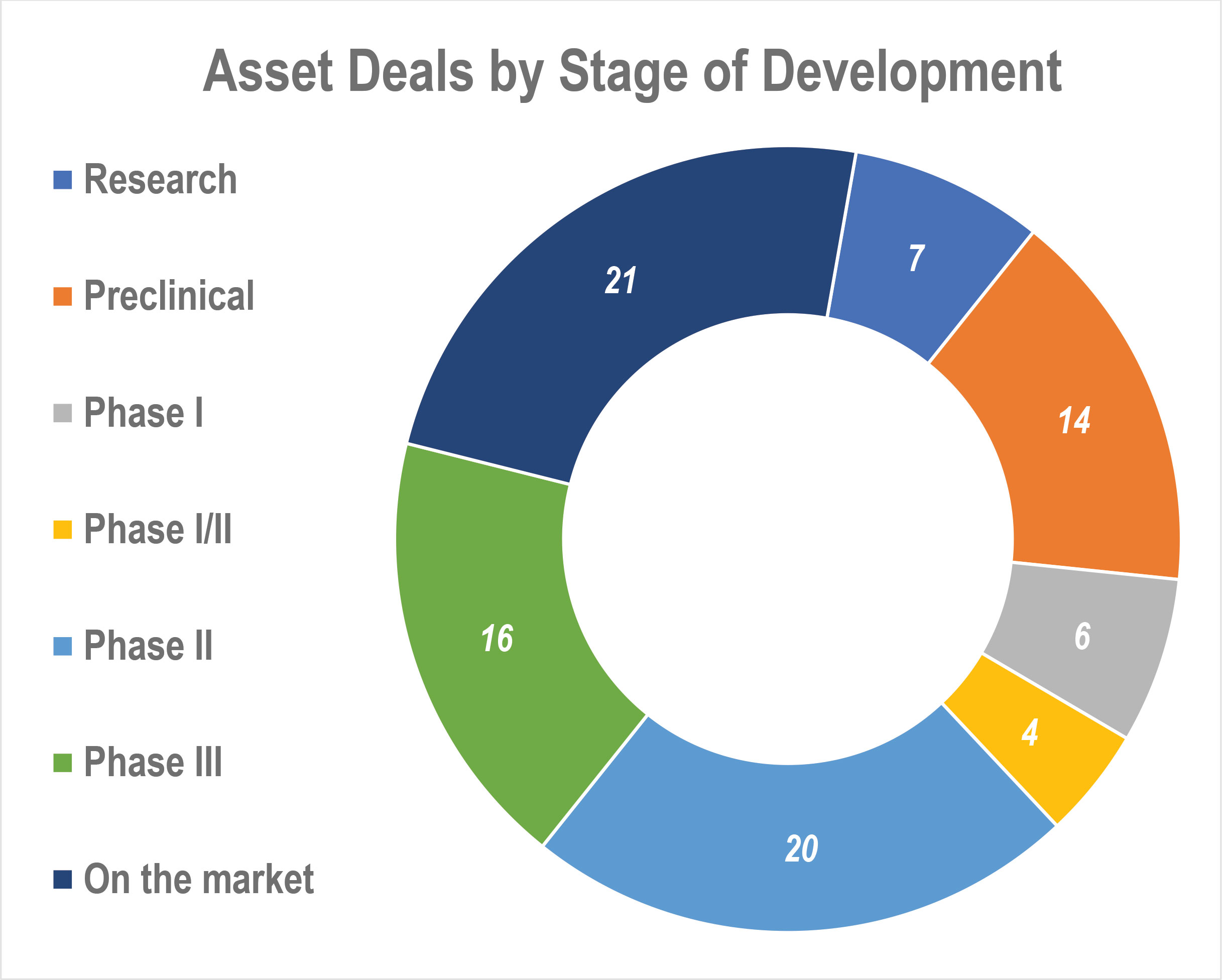
While 2019 saw a good deal of horse-trading of assets that were already on the market (including many deals for regional rights in Asia), we continue to see a lot of early stage companies locking in deals at the Research, Preclinical or Phase I stages. As you can see by the chart, about a third of 2019’s deals that pertained to a specific therapeutic asset happened prior to Phase II.
Click to View Full Size Image
Oncology, Oncology, Oncology
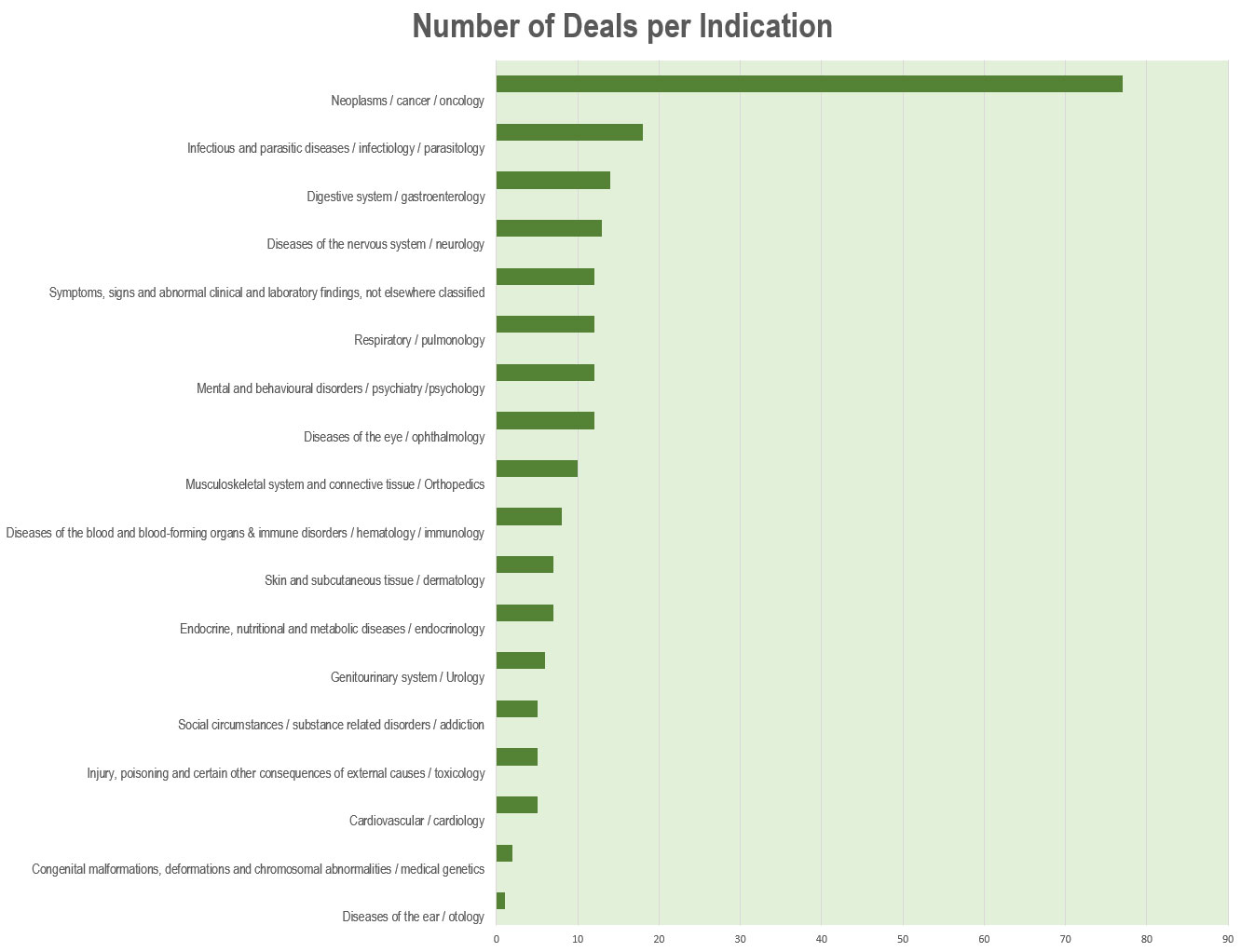
In 2019, dealmakers continued their hunt for new targets and treatments for cancer. Many assets were licensed that did not specify an indication or did not pertain to a specific disease area (this is often true of new drug platforms or delivery technologies), but among those that did, oncology continued to have an outsized presence. However, we saw an uptick in interest in infectious diseases and in gastroenterology. In the infectious space, there were several deals for HIV treatments, and in gastroenterology, there was interest in Crohn’s disease, NASH and IBS. Neurology also remained an active field for deals, with in-licensing efforts related to multiple sclerosis and epilepsy, among other disease areas.
Click to View Full Size Image
There are hundreds of potential licensees out there, and they have deep pockets
Every time we take a look into licensing deals data, we find deals being made with a huge variety of organizations all over the world. From traditional big pharmas and global conglomerates to rising biotechs and even philanthropic foundations that are making co-development deals with startups – there’s no shortage of dealmakers out there, and if you’re looking for a partner for your early stage asset you should spread your net wide. We captured a total of over 170 organisations that made an in-licensing deal in 2019. About half of all deals included a stated upfront payment, and over half also stated a milestone payment – sometimes in the billions of dollars.
While not all deals are made public, within our data set the most highly active dealmakers in 2019 were AstraZeneca and Gilead. We’ll keep our eyes peeled during 2020 for in-licensing activity from these firms and hundreds more.
By Dennis Ford, Founder & CEO, Life Science Nation; Creator of RESI Conference Series
Last week I wrote about why every entrepreneur needs to build a fundraising campaign that utilizes comprehensive marketing collateral and includes a strategy for getting in front of the right partners to help move your company forward. However, equally as important is an innovative technology, a compelling story and sufficient data to prove how effective your product is.
Early stage innovators need to get their products developed through prototyping for a target market, then get out of the building and go after that market (investors, end users, channel partners) with their product info and validating data. The key is emphasizing and differentiating their technology, proving why they are different and telling the story of what that difference will mean. You have to start telling the story early. Preclinical and IND stages are where you want to be talking about how your technology will impact the existing landscape, and you must deliver a prototype with data to prove it.
The lean company model, in which LSN believes, is to get your technology going and take it to the potential partners in your space (LSN can identify them) that would be interested, and build momentum and relationship value through early stage interaction. Attending RESI, which is held every few months, allows you to regularly meet your potential partners face to face and develop deeper relationships as the products iterate, instead of meeting once or twice a year. This is why RESI is so pivotal: because all the different but relevant players are at every RESI. LSN provides the tactical aspect of how to engage partners in discussion and where to find them.
Ultimately, a company cannot succeed without using all of these pieces to put together a complete picture: a product that continues to meet important milestones, a compelling story backed up by a complete marketing collateral package, and on-going relationships with investors and strategic partners to move it forward. However, the product and the validation data is the foundation on which everything stands, and it needs to be solid to avoid crashing to the ground.
By Claire Jeong, Director of Research, Asia BD, LSN
After finishing off our most successful RESI to date and recovering from JPM week, we are ramping up our preparations for the upcoming RESI Europe Conference, which will be at the Hyatt Regency Paris Étoile on Monday, March 23rd, 2020. We expanded into Europe for the first time last year, and it is super exciting to be able to go to Paris for our second European conference. We look forward to fostering valuable connections and relationships, as well as working with a lot of new companies and investors/strategic partners based in Europe.
We are anticipating over 200 investors to join us at the event from across the globe. Please take advantage of our Super Early Bird Rate by using our €100 discount code SUPEREBEU on our registration here (expires on Sunday, February 2nd). Hope to see you in Paris!
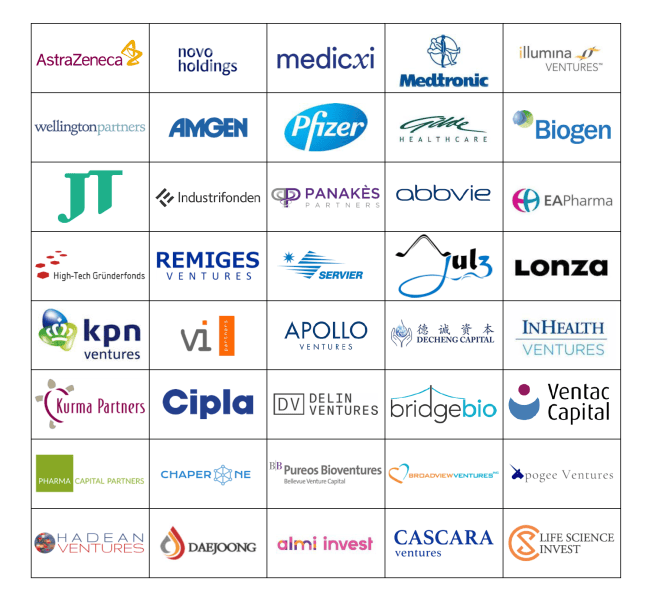
CONFIRMED RESI EUROPE INVESTORS AND STRATEGIC PARTNERS
By Dennis Ford, Founder & CEO, Life Science Nation; Creator of RESI Conference Series
All global incubators and accelerators will soon be up against an emerging global trend, where there are exponentially more fundable technology assets then investors and channel partners. I have been watching this develop over the 7 years I have been running RESI and in deep dialogue with the global investor market. I truly believe that ONLY the best prepared and packaged companies who are plugged into a global funding network will get the cash and partnerships needed to reach the market.
The LSN message, based on RESI, our dialogue with investors and strategic partners, and our training program, is to get early stage innovators in front of as many potential partners as possible (that are a fit) and that this interaction will create compelling relationships that can lead to capital allocations and licensing deals. LSN training programs are a bit different than then other entrepreneurial programs; essentially, the LSN theme is to take the scientist-entrepreneurs and teach them a small but gigantically important portion of basic sales, marketing and business development 101. We know they will not turn into sales experts, but we can get them some basic sales, marketing, and business development knowledge. Below are some of the main differentiators that LSN offers:
How to get a list of partners that are a fit for your stage of development and product set. LSN Investor Platform has 5K global profiles
How to define your competitive landscape. LSN Business Development Platform has 55K profiles
How to set up a CRM to “manage and curate that list” of potential partners that are a fit and you need to reach as part of an ongoing campaign
How to create and execute an email and phone canvassing. Yes, we teach how to write an intro email and how to pick up phone and make a call in our training labs
How to do follow up calls, and then teach how to make the 2 to 20 follow up calls that need to be made
How to use the RESI partnering system effectively to get as many meetings as possible
I think LSN has a bit of a different view and philosophy. All the branding and messaging LSN teaches is just to get partner meetings. That is it: essentially, how to organize your company’s branding and messaging to get in front of the right players and have that first meeting. I think the still commonly used broader, more sophisticated approach of figuring out the valuation and market size as part of their coaching is not where you want to spend a majority of your time. Predicting future sales and market size when you are preclinical, nascent startup is blindfolded forecasting. Rather, we teach PhDs to concentrate on getting the technology turned into a prototype with compelling proof of concept (data) that can be shown to the market players. Enter LSN, that connects the scientist-entrepreneur to the market player. The market players, if interested, will help determine value as the data and product takes shape and the relationship develops. LSN believes that if the fit is there, both parties will work together to achieve maximum success for the product and the market.