Archive | Redefining Every Stage Investments (RESI) RSS feed for this section

Are Chinese Life Science Parks a Good Entrepreneur Opportunity?

27 Jul

By James Huang, Research Analyst, LSN

james-wpIn 1988, Beijing Zhongguancun Science Park opened for operations. Ever since, science parks have become a go to strategy for Chinese cities who wish to develop specific technology industries. Science parks are zones containing various high-tech facilities such as labs, housing, medical facilities, etc. that are being built by the Chinese government to encourage the development of technology and industry.

At present, many new science parks are popping up in smaller cities across China. These institutions are looking for companies to move into their facilities. In fact, several of these science parks such as the Chengdu Tianfu International Bio-Town have been holding events in the USA to gauge how willing U.S. life science startups are to relocate to their new facilities in China. This poses the question then of whether relocating or opening a subsidiary would be worthwhile for a U.S. based life science company.

Here are some of the benefits that these science parks typically advertise:

  • Newly constructed facilities
  • Support from the government if accepted into the park
    • Many of these science parks are run by the local governments
  • Access to newly graduating talent from universities partnered with the parks
  • Infrastructure in place to allow easy access of larger cities (i.e. Shanghai, Beijing, etc.)
    • Many of these cities have built high speed train systems to allow for travel to major cities.
  • Easier access to Chinese investors
  • Partnership opportunities with other companies in the park

However, one should keep the potential difficulties in mind:

  • Relocating or creating a Chinese subsidiary isn’t a simple task
  • Many of these life science parks are in small cities, rather than major hubs like Beijing and Shanghai
  • Many Chinese investors are already active outside of China and can be reached with the right connections already.
  • Being fluent in Chinese is highly recommended
  • Cultural differences between China and U.S. might create difficulties

Of course, there are still many factors to consider before anyone can truly decide whether joining a science park program would be worth it. Furthermore, each individual park would have its own unique strengths and weaknesses which must be considered as well. Some science parks are still mostly concepts and have only been partially constructed! It’s important to do your due diligence if you’re considering an opportunity like this.

These science parks present an interesting opportunity for life science startups hoping to work in Chinese markets, but it’s important to remember that there are other ways to connect with investors and strategic players from China and the broader Asia region. LSN’s Investor Platform tracks over a hundred investors based in China, and many of these investors have created cross-border investment vehicles and regularly visit the US to participate in life science investment events, in which the RESI Conference has been leading the way by opening a North America-Asia Investment and Partnering track. While there may be advantages to joining a science park in China, you can make connections with China-based partners without the headaches of relocating.

Growth of An Early Stage Phenomenon: Four Years of RESI in Boston

20 Jul

By Natasha Eldridge, RESI Conference Manager, LSN

natasha-wp-newThe first RESI event ever was held in Boston in 2013, with the goal of bringing the startups and the investors that LSN already worked with together for face to face meetings between parties who would be a good fit for each other’s business. From that seed, RESI has grown beyond all our expectations. We quickly outgrew beyond the capacity of our original RESI venue at the State Room – and our next venue at Fenway Park! With RESI’s 4th anniversary approaching, we can show you how the previous RESI Boston events kept getting bigger and bigger – and we expect the September 26th event to be larger yet, with more opportunities to meet with investors and form key relationships that will get new healthcare products to market.

The sheer number of attendees at our annual RESI Boston fall event keeps climbing. Alongside the rise in total attendees, the number of investor attendees has also kept increasing to keep pace:

Not only that, but as the number of RESI participants increases, we’ve added more and more RESI Partnering spots to keep up with the increased need for bandwidth. We expect to have more one on one spots available than ever at our September event.

While raw numbers tell an impressive and continuing growth story, it’s also worth noting that RESI has continued to innovate in terms of content and spread our global reach. The addition of RESI’s newest track, Asia-North America Partnering & Investment, has brought a new constituency of investors to RESI to look for early stage equity investment opportunities and assets. Meanwhile, every time we have brought RESI to a new city – San Francisco, Houston, Toronto, San Diego – we have sourced new investors and startups to bring into the fold, and many of those players have followed RESI back to Boston.

We hope you will join us in September to be part of RESI’s ongoing story.

RESI San Diego: Family Office Investors Discuss Strategy and What Makes Them Different

20 Jul

By Cole Bunn, Senior Research Analyst, LSN

cole-wp

As the RESI San Diego event is now in the rearview mirror and we prepare to bring RESI home to Boston (Sept. 26th), we wanted to take a closer look at the Medtech Family Office panel session. Family offices are clearly a highly sought-after investor class and are not completely understood by a large portion of entrepreneurs. To that end, we’ve pulled out some of the most insightful points that were discussed and distilled the panel session into this summary video to help shed some light on how family offices evaluate early-stage investments, how to reach them and what differentiates them from VCs and other early-stage investors.

Family offices are not a silver bullet for your financing needs

A lot of entrepreneurs mistakenly believe that finding a family office will solve all their fundraising woes i.e. long-term investors with less rigid requirements. While it is true that family offices tend to be more patient capital and more flexible with terms and deal structures (a result of not having to answer to LPs), these groups are in fact looking for a return and typically will be active either at the board or management level to hit milestones and create value. Additionally, as your company grows and matures, the capital requirements and expertise required for the healthcare space oftentimes necessitate bringing in deep-pocketed institutional investors, who family offices maintain relationships with.

Family offices are purposefully low visibility

Given that family office investors have no mandate or timeline to allocate money, they can wait on the best deals and entrepreneurs to surface, therefore their deal sourcing channels are much different than a VC or another institutional investor. Further, these groups tend to be very much relationship-oriented. Networking is a must to uncover these investors and begin building a relationship, with some of the best events to attend being a part of universities and tech transfer offices as well as focused partnering conferences, such as the RESI conference.

Family offices are not homogenous

This point can’t be stressed enough. While there are some common themes among these groups (mostly dictated by structure or lack thereof), they are largely very different. Some may be more philanthropically motivated as they are looking to fund research/companies pursuing indications that have afflicted their family while others act more like an institutional fund with a focus on returns. It is essential to do as much research as possible on each specific family office to try and find mutual connections and the best way to approach them.

Moderated by Michael Quigley, VP of Investor Research, LSN, the panel includes the following speakers:

  • Sean Kearny, Managing Director, Three Leaf Ventures
  • Kyle Williams, President, Bootstrap Incubation
  • John Kinzell, Sr. Life Science Analyst, The McNair Group
  • Julia Belaya, Director – Corporate Partnerships, Plug & Play Tech Center

Regulatory “Fast Tracking” Could Spell Opportunity for Innovators and Investors in Digital health

20 Jul

By Michael Quigley, VP of Investor Research, LSN

mike-2

Earlier this year the FDA announced its plans to develop a Digital Health unit comprised of 13 engineers and experts in the digital health world, with the goal of restructuring the FDA’s assessment of digital health completely, making the process for approval more streamlined for new technologies. This announcement follows a trend of easing on regulations for medical software, as last summer the FDA announced that it would not be regulating fitness trackers and mobile apps.

Fitness apps are really just the tip of the iceberg. Things get much more difficult when you begin to evaluate the clinical validity of a constantly changing algorithm that sorts through streams of medical data to diagnose or recommend treatment options. Currently the FDA’s regulatory process is centered around consistency and reproducibility of results.  In order to accommodate these new technologies, the FDA too must adapt.

Bakul Patel, the associate center director for digital health at the FDA, will be building and heading the new unit. He envisions a new model for approvals similar to the TSA security line at the airport, where established veterans in the space can quickly pass through, while newer developers or those with less than stellar histories would still have to take off their shoes and get a full body scan (1).

It would appear as though that model is taking shape as just last month the FDA Commissioner Scott Gottlieb announced that the FDA would be launching a pilot program under which lower-risk digital health products could be marketed without FDA premarket review, and higher risk products could receive a streamlined review. According to Gottlieb, the pilot would help to certify whether a company “consistently and reliably engages in high quality software design and testing (validation) and ongoing maintenance of its software products. Employing a unique pre-certification program for software as a medical device (SaMD) could reduce the time and cost of market entry for digital health technologies.”(2).

This all is welcome news for innovators, investors, providers, payers, and patients who all stand to gain from the adoption of novel digital health technologies. It would also appear that investors have caught wind early of the FDA’s easing as funding for digital health companies was at an all-time high during the 1st half of 2017 with various research groups citing total numbers between $3.5-$6.5 billion(3). As the FDA solidifies its plans and programs for the review of medical software I would anticipate investment in the sector to remain strong. If the pilot streamlining process proposed by Gottlieb takes hold I could also see more and more large tech firms following in the footsteps of Google and IBM and getting into healthcare, as they have the resources available to qualify for streamlined review.

(1). MEDICINE IS GOING DIGITAL. THE FDA IS RACING TO CATCH UP

(2). FDA Pilot to Sign Off on Low-Risk Digital Health Products Without Premarket Review

(3). Rock Health: digital health funding hits $3.5B in first half of 2017


Must See Video—CEOs explain sourcing Family Offices, Working Your Pipeline and Cost of Campaigns – Tales from the Road at RESI

13 Jul

By Dennis Ford, Founder & CEO, Life Science Nation; Creator of RESI Conference Series

More frequently than not LSN captures content through its RESI panels that hits the nail on the head. The recent “Tales from the Road” Panel does just that. It’s 6 minutes long but worth a viewing it if you are a scientist-entrepreneur or fundraising CEO. The most vital take-aways include how to source potential investors (particularly family offices), the process of “working” your pipeline of investors, and the costs associated with conducting a successful campaign.

The panel brought together successful biotech and medtech entrepreneurs to tell their stories of successfully raising capital. These are seasoned entrepreneurs who have been there done that and collectively have raised numerous private financing rounds and have exited multiple companies, with combined total deals exceeding $750 MM. They came to RESI San Diego to share their wisdom to fellow fundraising executives and provide insight in order to help their peers succeed.

RESI Premier Partnering Plus – An In Depth Look At RESI’s New Enhanced Partnering Service

13 Jul

By Natasha Eldridge, RESI Conference Manager, LSN

natasha-wp-new

In last week’s Next Phase newsletter, LSN announced the new Premier Partnering Plus service for RESI attendees.  This week, we’d like to give you a more in depth look at how Premier Partnering Plus will take RESI Partnering to the next level, and show you an example of the extra information that will be available to attendees who opt for the Premier Partnering Plus pass.  RESI Early Bird rates end on Friday, so now is the time to sign up.

Premier Partnering Plus users will receive:

  • Detailed investment and deal mandate information to help dial in who they need to meet with based on fit
  • Include specifics on the sectors and subsectors
  • Indication interest, company and management team requirements
  • Contact information and best way to reach out to an investor

Below, you can take a look at an example of what Premier Partnering Plus attendees will be able to see once RESI Partnering launches.

This a first for integrating a world class investor & strategic data platform with a partnering application, and will make attendees who use the service much more selective, efficient and successful in their partnering activities.

(Click to watch LSN Investor Platform intro video)

RESI Boston 2017: Agenda Announced

6 Jul

By Lucy Parkinson, Director of Research, LSN

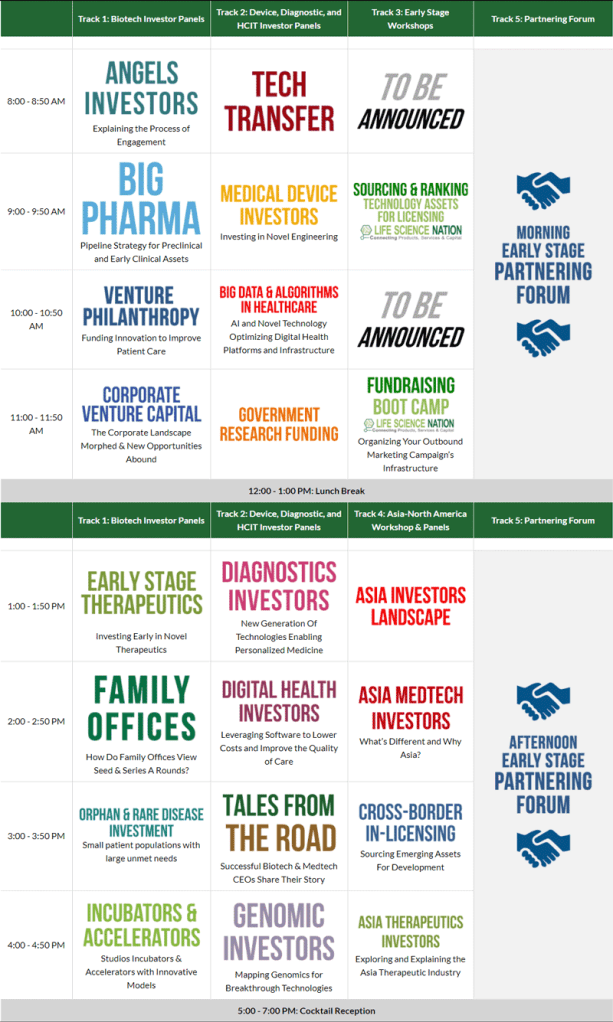
On September 26th, RESI will come home to Boston. In our year on the road, LSN has expanded our reach into new areas, and it’s time to lead the RESI Tribe back home – including many new investors and exciting emerging technology companies that we’ve met on our travels.

LSN would now like to announce the agenda for RESI Boston. The event will include 24 investor panels and entrepreneur workshops, including new panel content from our sponsors at the NIH, and a new session dedicated to Payers & Providers who invest in early stage technologies. RESI Boston will also feature an Asia-North America healthcare investment track. Check out the full content below. If you want to take part, don’t miss out on your opportunity to catch the early bird price by registering now.