Archive | Redefining Every Stage Investments (RESI) RSS feed for this section

The Road to Commercialization: Do Life Science Incubators Deliver on Their Promise?

21 May

By Dennis Ford, Founder & CEO, LSN

Dennis bookProviding shared space, services, equipment, and expertise to budget-conscious scientist-entrepreneurs who are looking to prove a hypothesis and launch a company is the mission of life science incubators. And they have helped many start-ups.

However, increasingly, scientist-entrepreneurs are disappointed with what they’re finding. LSN hears a lot of complaints because we are in dialogue with a lot of the firms that populate these incubators. They acknowledge that incubators are less expensive than going it alone. Still, they say the lab space is too expensive, the promise of seeding seasoned players who can augment the founding team often goes unfulfilled, and there’s little to no tactical fundraising support.

The last point is particularly important since the life science industry is poised at the entryway of a new golden age. However, this advancement will not happen without capital. The lack of fundraising support will stymie not only the technology of individual companies but also the growth of the industry.

“Packaging” a company is a core function that I-Banks and underwriters perform when preparing a firm for an IPO. They spend many months grooming and coaching the fundraising executive team, getting the story straight, developing the brand and message, and creating professional marketing collateral in order to have a successful road show. These key elements have not yet been incorporated into early stage fundraising, despite an obvious and compelling need to raise capital.

In addition, although many incubators profess to have strategic partner connections, in reality, these connections can fund only a limited number of opportunities.

Incubators are largely out of synch with new fundraising best practices. What incubators offer from a marketing perspective is “pie in the sky” strategy and “perfect pitch” role-playing scenarios, leaving the scientist-entrepreneurs generally clueless as to how to prepare for raising capital and unprepared for the reality of connecting with a partner in the marketplace. Everybody understands their marching orders, but hardly anybody has been given the training and tools to carry out the mission. LSN calls this void “the last three feet,” which involves understanding how to put a tactical fundraising campaign together that enables the vetting of target investor fits, meeting these investors, and securing allocations.

Of course, it’s easy to criticize and point out flaws, and most of the senior staff at the incubators I am familiar with are working overtime to improve overall efficiencies. The incubator executives genuinely want to help commercialize the technology of their constituents. And no one disagrees that there is more to do and a need for more compelling programs to facilitate commercialization. However, to have a profound impact, successful incubators must focus on tactical programs to help the scientist-entrepreneurs navigate “the last three feet” to get their products to market.


Tips for Getting an Investor’s Attention

21 May

By Michael Quigley, Research Manager, LSN

mike-2

LSN identifies and contacts new life science investors worldwide on a daily basis. Over time, the research team has developed several methods for getting a foot in the door when we don’t have a prior relationship. We’ve written previous articles about preparing introductory emails. However, this article describes techniques that can be used when those emails go unanswered.

In our experience, receiving a response to an investor email largely depends on three factors: investor fit, clarity of message, and a respect for the investor’s process. In other words, you need to find firms that are likely to have an interest in your opportunity and then reach out to the appropriate people with a lucid email. However, if you have done this and haven’t heard back, these tips may help stimulate a response.

The Second Attempt

Resending your initial email with “Second Attempt” at the beginning of the subject line has proved to be successful. This may sound forward or aggressive, however, investors are generally not offended. In fact, they often respect the persistence of an entrepreneur. Investors usually don’t have the capacity to read all of the emails they receive, which is why this approach can work. I’ve even been thanked for the reminder on occasion.

The Admin: A Secret Weapon

Administrative assistants are the gatekeepers of the investor world. As such, they have a tremendous amount of power and knowledge. They screen calls and emails, coordinate meetings, and often understand more about the interests of their firm than you might think.

When you have been unable to reach an investor, attempting to contact the admin with a request for help can often prove fruitful. Whenever speaking with an admin, be it by phone or email, it is crucial that you be courteous, as he or she will be passing your information up the chain and you want to give a positive impression. By having your verbal message or succinct email passed on by the admin, you are again demonstrating respect for the time and process of the investor, as well as showing persistence in a professional manner, something investors love to see in entrepreneurs.          

A Quick Question

When all else fails, send an email with the subject “Quick Question” (or something similar) and a clear, direct message that reads: “Is XYZ Ventures seeking new investments in the life science space? I have been trying to get in touch with the firm for some time but without success.” This can be effective because it is often an easy email for an investor to respond to. Then, when you have begun an email dialogue, you can easily introduce the investor to your opportunity with a brief email, pitch deck, and executive summary.

There are instances where this technique or the others won’t work. However, they will help you improve your odds. Good luck!

Save the Date for the Next RESI Conference: September 17, 2014

14 May

By Maximilian Klietmann, VP of Marketing, LSN

Max Smile 2

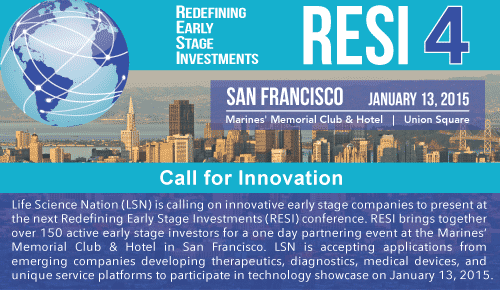
Join LSN for the next Redefining Early Stage Investments Conference at the iconic Fenway Park—home of the Boston Red Sox.

This conference will be the best one yet, attracting more scientist-entrepreneurs, investors, and strategic partners from around the world.

RESI was created to connect emerging biotech and medtech companies with active, early stage life science investors. The conference provides a venue for companies and investors to find each other, have a dialogue, begin a relationship, and determine if there is a compelling fit for both parties.

The RESI panels will feature 10 categories of life science investors who will provide insight into how they choose companies to invest in. If you are interested in attending, sponsoring, exhibiting, or receiving more information about RESI, click here to contact Tom Crosby, Conference Manager, or call 617.600.0668.

http://www.resiconference.com/

Follow us: #RESI3

Rules of Engagement: Keys to Effective Partnering Conferences

14 May

By Alejandro Zamorano, VP of Business Development, LSN

Alejandro 10*10

On the global life sciences conference circuit, events are usually divided into two categories: partnering and non-partnering conferences. Partnering conferences are different from the classic “fixed agenda plus networking reception” format in that they provide an online portal that allows attendees to identify one another in advance and schedule one-on-one meetings.

When it comes to raising funds for your emerging life science company, partnering conferences constitute the industry standard, offering a distinct advantage to savvy fundraising executives. However, because the quality of these conferences varies, it is important to understand how to successfully navigate the system and effectively connect with the right people.

The first key element is to determine how much work the conference provider has put into the partnering system. This can make or break your efficacy as a fundraising executive. All too often, the profiles in the partnering system are not populated, and the search ontology isn’t tailored to the attendee base, rendering the partnering system largely ineffective.

A matching platform is only as good as the data it contains, and there are only a handful of conferences that allow companies to import full profiles into their systems, and only one or two sponsors that manually curate the profiles to ensure completeness in advance of the event. These are the cream of the crop when it comes to partnering conferences, and they make it easy to identify fits quickly and efficiently.

However, because most partnering conferences are not hands-on when it comes to their databases, there is a significant amount of noise. This forces busy executives to manually research each prospect to see if a company is a fit. Most executives fail to do their homework simply because it is too labor intensive, resulting in an untargeted or shotgun approach when they send out meeting requests. This causes not only inefficiency but also leads to frustration on the part of investors who find themselves inundated.

A big pharma licensing executive recently remarked to BioWorld:“Many of the nation’s young biotechs ignore even the most fundamental rules of engagement by failing to do basic homework. More often than not, when we’re contacted by a potential partner, [the request] has nothing to do with our strategy.”

As the industry advances, more conference providers will increasingly recognize the importance of a well-curated partnering system. But what should a biotech entrepreneur do in the meantime? Fundamentally, it’s a question of doing some careful research and identifying a “short list” of key people you need to meet based on a clearly identifiable fit. This can be done well in advance of an event, and your partnering request messages can be carefully tailored to show you are a potential fit.

Rather than trying to send out 100-plus requests over the 48 hours before an event, a methodical approach during the 10 to 15 days prior allows you to carefully identify who is a fit. This will improve your ratio of accepted meeting requests and will provide you with a much more productive partnering experience.

Remember, investors and your potential partners are there to meet companies like you, so don’t be afraid to reach out, but do keep it targeted. One well-crafted message to a likely fit beats ten vague messages to unlikely fits any day.

What Should the Next Generation of Incubators Look Like?

14 May

By Jack Fuller, Business Development, LSN

Jack 2

If you reside in one of the many growing or established life science clusters around the U.S., you have probably encountered the growing plethora of incubators or accelerators that are emerging to support nascent and semi-virtual companies. Often, these incubators are funded by a combination of state grants, corporate partnerships, and revenue generated from renting space to emerging companies.

When giving a tour, incubators are quick to point out the pristine lab space and glass-walled conference rooms they provide to start-ups. However, they often have little knowledge about what it takes to fundraise in the life sciences: a tactical approach that requires expertise in branding, marketing, and cloud infrastructure.

Dennis Ford, CEO of LSN, often speaks about the need for emerging entrepreneurs and experienced fundraising executives alike to upgrade their approach to outbound marketing. Phone and email canvassing techniques require the same diligence and determination that even the most complex scientific experiments demand. If an emerging scientist-entrepreneur can perform 100 experiments and get one positive result, there may be hope to teach them how to make 100 phone calls to a targeted audience based on fit and get one great meeting.

LSN has spoken with hundreds of emerging life science companies, and we have realized that not everyone can take this step. If that is the case, incubators that integrate a team of marketers and business development experts should be in the future. Incubators could create an infrastructure of experts to market the companies, providing everything from branding and messaging support to website design and cloud infrastructure—even seasoned business development to aid in scheduling and running investor meetings. This is an enormous void in the current incubator environment. Early stage companies are slowly realizing that good science alone won’t get them funded. Providing that next level of tactical infrastructure will help streamline a company’s fundraising efforts and help them see the straightest line to cash.

In return, the incubator would take a transaction fee if capital was raised—a fee that could be re-invested into the incubator to provide additional staff, expertise, and infrastructure to further promote an evergreen approach to incubating companies to bring them to the next step.

Would this model work? Time will tell, but as we say here at LSN: you can walk a mile, but at the last three feet, you still need to reach across a desk and shake someone’s hand.

Filtering the Noise: How Life Science Investors Manage Prospects

6 May

By Maximilian Klietmann, VP of Marketing, LSN

Max Smile 2

In this newsletter, we often discuss how emerging life science entrepreneurs should think about their fundraising strategy. This week, we’re going to look at the fundraising process from the perspective of a couple of investors.

I called a corporate VC fund and a family office in the LSN network; each is actively making allocations and has a mandate to make at least five investments over the next year. I asked a simple question: What does your typical month look like?

The deal-sourcing executive at the corporate venture fund was quick to say, “We get a lot of referrals, but more often than not, they’re only generally targeted. There are a few people in my network who really understand what we are looking for. I trust their judgment, and they pass me more relevant leads. However, most of the referrals I get aren’t great fits for us.”

Entrepreneurs should keep this in mind. You may get referred, but that doesn’t mean you are going to get funded. You may even get a meeting, but very often it will be what we at LSN refer to as mercy meetings: investors agree to meet with you not because your technology is a fit but because they feel obliged because you were referred, or thought they’d do you a favor. Such meetings rarely lead to anything substantial and investors will not spend a lot of time on.

“On average, I probably get 30 to 50 business plan submissions a week,” remarked a manager at a California-based family office. “Some are referrals, but most are unsolicited emails.” That equates to about 1,500 to 2,500 business plan submissions in a year for an investor that is looking to make only five investments. “Simply put,” he said, “I can’t reasonably go through that much information. I have to make a decision whether or not to continue reading after the first few sentences.”

This underscores how important it is for entrepreneurs to succinctly communicate their value to investors. “I’m sure there’s some great technology I’ve passed on, but if the CEO can’t tell me why his company is special in the first page, I’m not interested in doing business,” noted the family office investor.

So how many meetings result from unsolicited submissions? Answers from the interviewees varied from 15 to 30 meetings a month. This is an average hit rate of one out of ten. However, only a fraction of these ever move into due diligence and ultimately get funded. At the end of the process, a typical ratio for these investors is approximately one allocation for every 300 potential deals they come across.

How do emerging scientist-entrepreneurs improve their odds then? An accurate and up-to-date global target list of relevant investors that are a fit is critical. However, it’s not productive if you can’t immediately communicate why you are a great fit for an investor. This requires crisp marketing collateral that clearly explains what sets you apart from the other 30 to 50 proposals an investor received that week. In addition, you should stay focused and get as much feedback as you can. If an investor passes, ask why—that might be all it takes to get them to take another look and agree to a meeting.

Pharma-Licensing Deal Trends in 2014

6 May

By Lucy Parkinson, Research Manager, LSN

lucy 10*10

LSN gathers data on early stage life science companies and investors worldwide, but we also track global licensing activity and trends through the LSN Deal Platform. We analyzed 20 pharma deals that were publicly announced from January through April and spotted three trends that offer a glimpse of what the industry may expect from pharma-licensing activity in 2014.

Orphan Diseases Are Hot

About 25% of the pharma-licensing deals so far this year involve an orphan or rare disease asset.  The accelerated approval pathway for these drugs is driving pharma strategies toward small biotechs that have cultivated expertise and assets in these rare diseases.

Discovery and Target Validation Platforms Are in High Demand 

As big pharma companies have trimmed their in-house R&D operations, they are increasingly turning to outside partnerships for very early stage drug discovery. Four months into 2014, about 40% of the licensing deals in our data set relate to discovery and target validation.

Collaboration Continues to Be a Popular Model

Traditionally, big pharma companies license assets and are wholly responsible for drug development. However, as BioAssociate observed regarding 2013 deals, collaboration models are becoming more popular, because pharma companies can de-risk their strategic investments: they license assets early and collaborate on the development. Of the deals in our platform that involve assets rather than a discovery platform, over one-third are known to be structured as collaborations.

What These Trends Mean for You

Big pharma’s interest in orphan diseases, partnerships for early stage drug discovery, and collaboration for drug development bode well for small biotech companies. A deal with a large industry player can provide a source of revenue and a stamp of approval, both of which are helpful if you’re looking for investment. Collaboration in particular means that you can retain more control and influence when it comes to your assets.

In addition to big pharma companies, an increasing number of virtual pharma investors are focusing heavily either on licensing or acquiring assets rather than simply investing in biotech companies. These are typically investors that specialize in putting assets through clinical trials and then exiting through a deal with a big pharma company. Partners such as these could provide another pathway for your company to reach the market.

Source: http://bio-associate.blogspot.com/2014/01/biotech-pharma-2013-licensing.html