Hot Investor Mandate 1: Family Office Seeks 510(k) Devices and Diagnostics

A Family Office based in the Southeast USA makes investments via 2 venture funds and a number of private capital accounts. The firm looks to make equity investments generally in series A and B rounds of approximately $1.0 – $1.5 million in rounds totaling $3-$7 million. The firm is open to investing into companies located throughout the United States and makes approximately 2-4 new investments per year.

Within life sciences, the firm is most interested in companies in the medical device and diagnostics space. The firm is looking for companies that have a 510k regulatory pathway with at least a working prototype of the product and preferably some in-human data. The firm is generally open to all indications with particular interested in oncology, rare cancers, diabetes, neurology, ophthalmology and cardiology. The firm is especially interested in CLIA lab diagnostics, software enabled devices, molecular diagnostics for rare cancers and diseases, and algorithms that interpret genetic information and recommend treatment options. The firm is also interested in nutraceuticals, expedited drug development, HIT and business to business technology companies although these areas are less of a focus.

The firm is looking for private companies with experienced management team and looks to take a board seat following investment. The firm looks to be a hands on investor and is willing to both lead and co-invest.

If you are interested in more information about this investor and other investors tracked by LSN, please email mandates@lifesciencenation.com

Hot Investor Mandate 2: Corporate VC Seeks Novel Antibiotics and Alternatives to Antibiotics

A Life Science focused investment fund based in China serves as an internal funding vehicle for a major medical group.  The firm primarily considers investments based in China or has a significant China nexus, for example, the company must have a principal market in China, or R&D/manufacturing/sales in China. The fund prefers to follow and take minority stakes. Investment size varies but typically ranges from US$1-4 million. The fund prefers business models that are marketing/sales oriented (vs. technology oriented). The fund is actively seeking new investment opportunities.

Currently the firm is looking for innovative antibiotics or alternatives to antibiotics in human health, animal health, and agriculture. For the stage of development, the fund seeks products that are able to enter the market within 2 years post investment.

The firm seeks an experienced management team that “has done it before.” The fund will consider US-based companies as long as the China nexus criteria is met. The firm seeks to make minority investment and typically requires China rights.

If you are interested in more information about this investor and other investors tracked by LSN, please email mandates@lifesciencenation.com

Hot Investor Mandate 3: Mid-Atlantic Investment Firm Seeks Healthcare IT, Therapeutics, Diagnostics, and Tools

A venture capital firm based in Virginia focuses on healthcare IT and diagnostics. The firm primarily invests in the growth stage at the series A or B round, though if investing early, the firm would be part of a syndicate. The firm typically invests around $1M-$15M into early companies, and $10M-$30M into growth stage companies. The firm seeks to make 10-15 new investments within the next year. The firm focuses on companies based in USA and Canada due to practical matters, though may be open to investments on a global level.

The firm has a primary focus in healthcare IT, particularly in EMR companies, analytics, and any next generation IT tools for enterprise or ambulatory settings. The firm is also focused in tools and diagnostics, specifically in 510K genomics diagnostics, though is open to any kind of new diagnostic tool or test. The firm is also now seeking therapeutic opportunities. The firm currently does not have interest in therapeutics or medical technology. The firm prefers companies with a commercialized product that is producing revenue, though does not have a revenue requirement and may be open to clinical stage products.

The firm primarily invests in growth stage companies where 80% of their invested companies have revenue with a product looking to expand in the market and 20% of invested companies at the pre-revenue, close to commercialization stage. The firm typically invests in pre-revenue companies when the technology is close to commercialization (i.e. steps away from approval) and/or when the company has a strong management team with members the firm has known from before. The firm does not have a management team requirement and will take a board seat depending on the size and ownership of the investment.

If you are interested in more information about this investor and other investors tracked by LSN, please email mandates@lifesciencenation.com

Hot Investor Mandate 4: Venture & Growth Capital Firm Invests in Healthcare IT & Medical Devices

A venture and growth capital firm provides expertise and funding to entrepreneurs and companies with global ambitions in life sciences and information technologies. The firm is based in Geneva, Switzerland, and focuses on early to growth and expansion stage including spin-offs and restarts. The firm is currently making new investments from a €250 million fund closed in 2016. The firm prefers to be the lead investor and possibly co-lead. The firm seeks to allocate €7-15 million (in equity) per company through subsequent rounds of investment. The firm seeks to invest in companies that are based in the US and Europe. The firm is actively seeking new investment opportunities.

In the life sciences, the firm seeks to invest in medical devices, and digital health. The firm is opportunistic in terms of subsectors and indications. Medical devices with a therapeutic focus are of high interest. The firm seeks growth stage companies with early sales or with products that, at minimum, have regulatory approval (CE mark) and compelling clinical data.

The firm requests a board seat in each portfolio company and generally holds a significant minority stake. The firm seeks a company with a strong management team or technical experts in the relevant technology.

If you are interested in more information about this investor and other investors tracked by LSN, please email mandates@lifesciencenation.com

It’s A Numbers Game: Why Some Folks Book Lots of Partnering Meetings and Others Don’t @ Investor Conferences

By Dennis Ford, Founder & CEO, LSN

dennis-websit

As the creator of the RESI conference series I am constantly getting and gathering both solicited and unsolicited feedback on how well the RESI Partnering apparatus is working. At RESI Boston we had 1400 meetings between investors and fundraising executives in one day. Make no mistake about it, people get funded through using RESI as a vehicle to get in front of the right investors that are a fit for their development stage and product or service offering.

I hear people tell me how great RESI is and how they met a bevy of investors and wound up getting funded. I also hear from some frustrated scientist entrepreneurs who catch up with me and complain they can’t get enough meetings or they wanted more. I usually reply “Send me a copy of the email you sent out – and tell me how many times you tried to connect with the investors you wanted to meet with.” When you have entered the fundraising arena you have officially entered the sales and marketing world. That means your personal view of what works can collide and not cross over into your new reality of sales and marketing.

Partnering is the backbone of RESI and of many other investment conferences. That means that in order to get the most out of attending these events, you need to figure out how best to get meetings with the investors who are a fit for your business. Here is the first fact of the sales and marketing universe: Fundraising is a numbers game. To prove this, we took a look at all our RESI Partnering data to find out how many requests it takes to get a meeting.

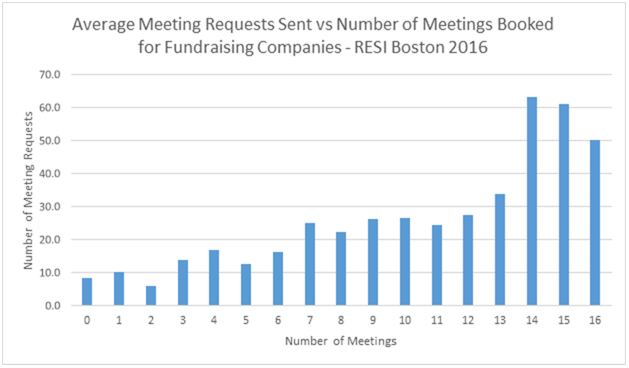
Here’s what we found: If your meeting requests are in the single-digits, odds are you will only get in front of one or two investors, if any. On the other end of the spectrum, companies who were able to connect with investors can have up to 16 meetings or more in a single day. What’s the trick to getting a lot of meetings? Companies that got 14, 15 or 16 meetings at RESI all sent out 40-60 invites. It’s a numbers game. Just take a look at the chart below.

c1

Many individuals fell in the middle, somewhere in the teens. There were indeed some premier companies who got a high hit rate with only a few requests, and of course a few less fortunate companies that did the work without seeing their desired yield. The positive relationship between request numbers and meetings, however, is clear. Just in case you were wondering, the median number of requests sent by fundraising entrepreneurs was 15, a number that might typically yield 3-6 meetings. There was one outlying individual who sent out a whopping 114 requests as well, and wasn’t counted in the final numbers. If that individual is reading this – kudos, I think you may have set a new RESI record…you get it!

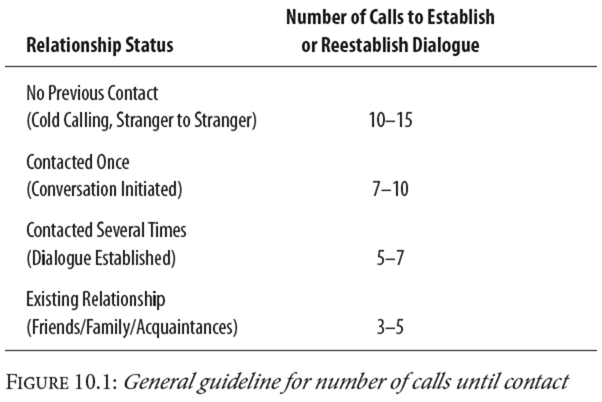
Now, this is not to say sheer numbers are the end-all-be-all. The importance of branding, messaging, and especially your intro email/ partnering message cannot be understated. In my book the Life Science Executives Fundraising Manifesto click here for a free PDF ebook Fundraising Manifesto we have this table that we compiled from our sales and research departments totaling around 15 professionals who make 20-40 calls a day attempting to reach out to our target clients and investors. Here are the facts of how many phone attempts it takes to get hold of someone. Many other studies have found similar results. This is the harsh reality of the sales and marketing world.

c2

Getting investor meetings is hard, tedious work and a lot of the work can be for naught. The rules of sales and marketing dictate higher yields of meetings when you go after investors who are a good fit for your company, and if you exercise persistence until you get a yes or a no.


Antibodies: A Look at an Accelerating Landscape

By Lucy Parkinson, Director of Research, LSN

The LSN Licensing Deals data platform logs all pharma licensing deals provided that financial information regarding on the deal has been announced. Taking a quick look at 2016’s announced deals thus far, we found that while many new technologies are making waves through pharma – such as T-cell technologies and RNA therapies – antibodies are currently the most wanted technology in pharma.

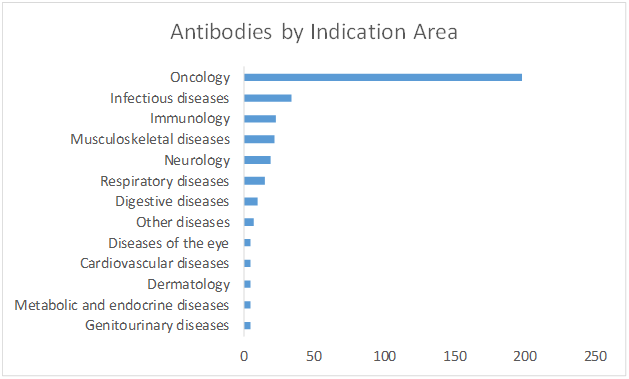
As over a quarter of the licensing deals logged in 2016 involve antibodies, we decided to take a look into the LSN Company Platform to find out what antibodies are currently being used for. For this article, we look at a sample of development-stage antibody products, ranging from preclinical-Phase III. We found that an overwhelming number – over half – of development-stage antibody drugs are in the oncology space. Other top indications for antibodies include infectious disease, musculoskeletal diseases and immune diseases, but oncological use of antibodies dwarfs all these.

l1

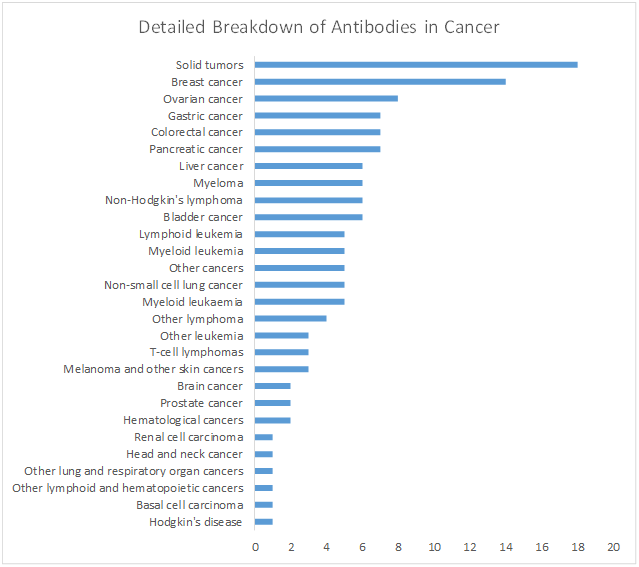
Within cancer, many of the antibodies in development are targeting a specific type of the disease. Here’s a closer look at which areas of cancer are seeing the most antibody innovation at present:

l2

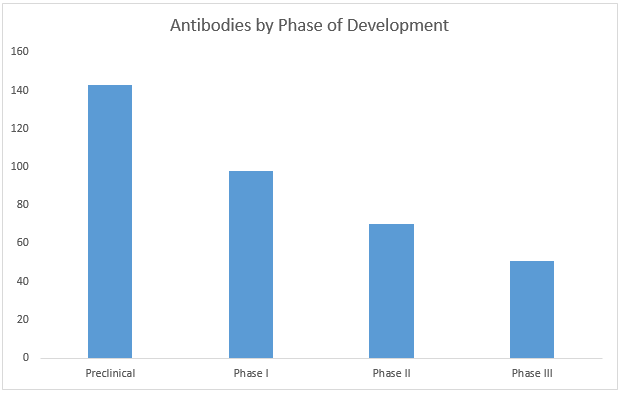
As is typical in drug development, we find that a plurality of the development-stage antibodies are still in the pre-clinical phase of development, with a drop-off occurring at each stage.

l3

While there’s a lot of excitement about new drug technologies such as gene and cell therapies, antibodies are still highly sought after by big pharma in 2016 and much innovation is taking place within the world of bispecific and monoclonal antibody development. The LSN Company Platform is keeping both LSN and our clients abreast of the latest new technologies out there, and how big pharma is driving demand.

RESI San Francisco 2017 Panel Announcement: Early Stage Therapeutics Investors

By Caitlin Kramer, Research Analyst, LSN

caitlin-wp

The critical early years of drug development after lead compound selection see pre-clinical studies, IND-filing, and the design and implementation of clinical trials. While navigating the regulatory needs of the FDA may seem enough of a challenge, entrepreneurs must also consider how their drug addresses the needs of investors. Capital intensity, endpoint selection, timelines to inflection points – these are just a few topics beyond the scientific data that LSN researchers have discussed the importance of with investors.

Understanding what investors are looking for in the deal and business plan structure can help entrepreneurs immensely in their approach to funding. LSN is pleased to announce the Early Stage Therapeutics Investors panel for RESI SF 2017, where five therapeutics investors will share their perspective on evaluating deals and answer audience questions.

Joining moderator Doug Fisher, Partner, InterWest Partners:

Check out these investors’ bios, and if you haven’t registered yet, do so here or get in touch with us by reaching out to the RESI team at RESI@lifesciencenation.com.

237521341025992000

resi-san-francisco-2017