Hot Life Science Investor Mandate 3: VC Looking for Therapeutics Devices and Tools

A Venture Capital company with offices in the US and Europe is currently looking to make investments out of its fourth fund. The firm is looking to make venture stage investment generally falling in the range of $2-$6 million though investments may fall outside of this range depending upon the opportunity. The firm also reserves additional capital for follow on rounds. The firm is most interested in companies based in the US although they are also open to investing in Eastern and Northern Europe, East Asia and Australia. The firm could make as many as 5-10 investments over the next year.

The firm is primarily interested in companies developing therapeutics and to a lesser extent medical devices and research tools. Within the Therapeutics space the firm has a slight preference for companies working with platform technologies although they are open to single asset companies as well. The firm is willing to invest in small molecules, biologics, and cell and gene therapy. The firm is willing to consider opportunities from preclinical through phase III of clinical trials though most of their investments will likely be allocated to later stage companies. The firm generally only considers pre-clinical stage companies if there is a clear path to exit in a shortened timeframe. The firm is highly interested in area of RNA therapeutics, Oncology, Structural Heart and Gene Therapy and is generally less interested in CNS disorders.  For medical device companies the firms looks for technologies that are into clinical trials with a working prototype and is agnostic in terms of technology type and indication.

The firm is looking for private or publically held companies, and has special interest in companies considering going public as well as secondary’s investments. The firm prefers to invest as a member of a syndicate and does not always require a board seat following investment. The firm looks to act as a value add investor helping companies expand their networks and filling in holes in existing management.

If you are interested in more information about this investor and other investors tracked by LSN, please email mandates@lifesciencenation.com

[Video] LSN Fundraising Boot Camp at the 10th Non-Dilutive Funding Summit

By Dennis Ford, Founder & CEO, LSN

I recently presented a Fundraising Boot Camp at the FreeMind Group’s 10th annual Non-Dilutive Funding Summit in San Francisco, to an audience comprised of scientist-entrepreneurs and fundraising CEOs. LSN’s Fundraising Boot Camp helps create context and understanding for these entrepreneurs around issues related to branding and messaging of their firms. The presentation also explains why organizing a global target list of investors that are a fit for your sector and stage is vital to an efficient fundraising process.  Last but not least, I discussed and debunked some of the myths around fundraising, what works, and what doesn’t work.
Check out the video to learn more.

RESI 4: A Recap

By Lucy Parkinson, Senior Research Manager, LSN

lucy 10*10In January, RESI came to San Francisco for the JP Morgan Healthcare Conference week.  LSN was thrilled that so many of you were able to join us there on January 13th; over 500 attendees registered for RESI –  our largest crowd to date.  RESI 4 provided four all-day content tracks outlined in the RESI 4 Program Guide. Even attendees may have missed out on some of the excitement; our video recap below can fill you in on the full scope of the event.


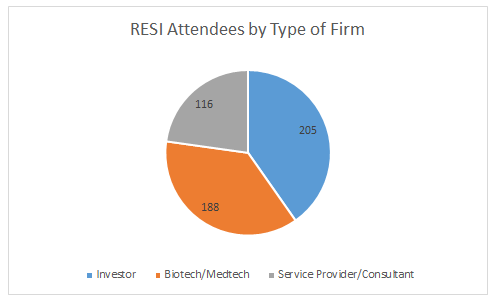
This audience provided a vibrant mix of life science industry executives. Figure 1 shows what type of firm each attendee represented:

Figure 1 | Data as of January 13, 2015

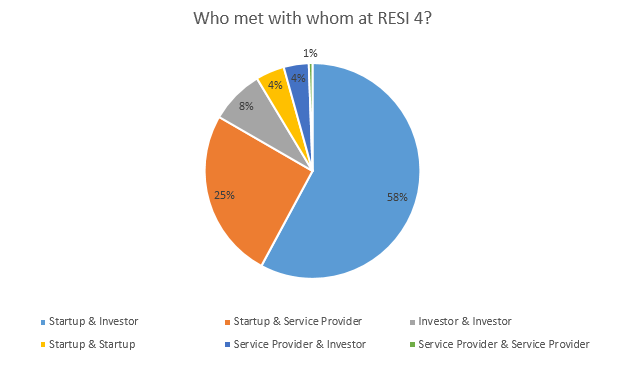
The most striking fact about this breakdown is that the investors outnumbered the attendees from biotech and medtech startups.  The pre-existing relationships with investors and strategics developed by LSN Research and Business Development staff garnered over 200 investor registrations at RESI 4.  These investors were keen to book meetings with entrepreneurs and assess their innovative technologies; almost 60% of the meetings booked on the RESI Partnering system were between investors and entrepreneurs.  Here’s a closer look at who took meetings with whom at RESI 4:

Figure 2 | Source: RESI Partnering Platform, Data as of January 13, 2015

Interestingly, investors booking meetings with fellow investors was the third most common meeting type.  This continues a trend we’ve noticed at previous RESI events: investors are interested in meeting with each other to discuss potential syndication or strategic opportunities, or possibilities for future collaboration.  RESI is a stellar venue to facilitate these meetings, given how many investors are present; RESI also offers investors the opportunity to use the RESI partnering platform to hone in on investors with common strategic interests in terms of indication area or stage of development focus.

RESI provides two core experiences; the opportunity to hear investors outline their mandates and methods of investment at RESI’s panels, and the opportunity to hold partnering meetings with fellow attendees.  By gathering so many luminaries in the early-stage life science world together under one roof, RESI creates an atmosphere that leads to a huge number of ad hoc meetings – more than we could count.  Whether it’s after a panel, at the reception, or in the exhibition hall viewing the RESI Innovation Challenge, LSN witnessed attendees engaging with each other in a highly productive environment throughout the day.  With more investors than early-stage entrepreneurs present, RESI 4 provided life science startups with an excellent opportunity to network with early-stage investors who are relevant to their fundraising campaigns.

RESI continues to innovate, with a new array of panels including a track devoted to medical technology investment.  LSN looks forward to bringing RESI to new venues in the future, and to returning to San Francisco in 2016.

A Guide to Researching Life Science Investors

By Michael Quigley, Director of Research, LSN

mike-2

For nearly 3 years the LSN research team has been identifying, profiling and interviewing early stage life science investors from around the globe. Throughout this time we have developed and honed a process for the identification and validation of investors in order to understand and qualify their investment interests. I recently held a “Researching Global Investors” workshop at our RESI 4 conference to shed light onto this process and share the tools and resources that we use, so that the entrepreneurs in the audience can take advantage of them as well. This article mirrors the workshop to further spread the message to our readership.

Tools for Identification:

Understanding where to look to find potential investors can seem like a daunting task given the vastness of the internet; however, by understanding the tools at your disposal, you can dramatically increase the effectiveness and efficiency of your research. Google search is often underutilized by those unaware of its capabilities. The chart below shows some basic “boolean” operators that can dramatically increase the precision of your searches.

m1

These functions can be entered into the Google’s search bar to make your searches are more targeted and fruitful. For example, by entering  (intitle:biotech AND “Invest” AND “Early Stage” –public) into Google, you can search the web for sites and articles that have “biotech” in the title, include the terms “early stage” and “Invest”, and do not include the word “public”. Boolean functions should be utilized in whatever way makes the most sense for your campaign; this could include looking for terms surrounding your indication, stage of development, geographic exposure, or other factors that define your opportunity. By executing a number these searches and diving through a few pages of results you are sure to come up with a size-able number of potential investors.

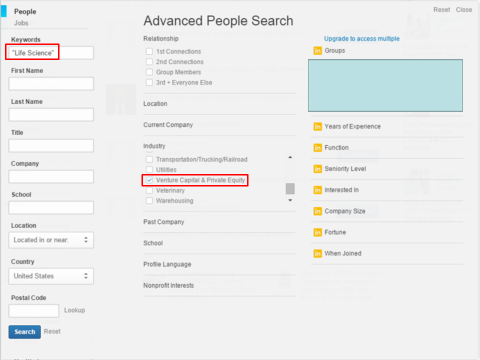
Another often underutilized tool is LinkedIn. Similar to Google, LinkedIn search is also compatible with boolean operators, so using these in the search can again improve effectiveness. LinkedIn also offers an Advanced People Search feature that includes keywords, company name, industry and location among other details, as seen below. An additional benefit of using LinkedIn is that investors and others who are active LinkedIn users with complete profiles are often more open to being approached with opportunities. As LinkedIn is a professional networking site, these individuals tend to be more open to new contacts, and may even be actively looking to expanding their networks and uncover new opportunities.

m2

Additional sources for new investor leads include life science investor conferences, and the websites of companies similar to your own. Investor conferences often list attending investors on their webpages, so even if you cannot attend an event, these can be great sources for identifying active investors. Much like investor leads found on LinkedIn, investors found on conference lists tend to be actively looking for new opportunities; this is generally their motivation for attending the conference. Now, visiting similar companies’ websites to find investors may seem like a stretch; however, many companies list their investors on their website, and if they are in a similar space and stage as your opportunity it is highly likely that those investors are a great fit. Also, many companies list their board of directors on their webpage as well; oftentimes members of the board are investors, as investors generally look to take a board seat following investment.

Validation:

Once you have identified a number of potential investors using the aforementioned methods, you must validate that these investors are a good fit for you opportunity. There are several variables you should consider, the first of which is determining if the investor is currently allocating. When attempting to determine if an investor is currently allocating you want to look for the most recent new investments that investor has made. These can be found either on the webpage of the investor or through using Google searches to find press releases or media articles relating to the investor’s recent deals. The more recently the investor has made a new investment, the more likely that they are still currently investing. Another means of identifying investor activity is to look at the most recent fund vintage. Funds generally have a 10 year lifecycle from closing until they need to return capital to their limited partners. As such, if your company requires 3-5 years to reach a potential exit, you will want to identify funds that have closed no more than 5 years ago. Funds generally reserve capital for follow-on investments, so it is highly likely that funds greater than 5 years old are no longer making new investments at all. They are instead reserving the fund’s remaining capital to support current portfolio companies.

Other variables that require validation include the investor’s preferred stage of development, industry sector, indication areas and geography. While many investors also list these criteria on their webpage, others are more reticent. For investors who do not list their criteria on their web page, the best place to look to find it would be in the firm’s previous investments. Have they invested in medical devices, or in therapeutics? Do they only invest locally, or will they look at opportunities globally? Do they invest in series A rounds, or are they only investing in later stage companies? Many of these questions can be answered by taking a look at previous investments the investor has made. Information on these previous investments is often available in press releases that can be found through searching the web.

The type of investor you are researching can also be a telling sign of the stage of investment they are looking for. The chart below provides a visual representation of the different stages of therapeutic development that different classes of investors are generally interested in.

m3

Having a validated list of potential investors is extremely valuable, and this process is usable by virtually any fundraising entrepreneur in the life science industry. The fact that investor and company fit is an extremely important precursor variable into building a successful relationship that could lead to an an allocation. is the reason why this process is valuable, and is a fact that LSN’s Research and Business Development staff have seen the value of fit proven in the marketplace time and time again. Through this process outlined above, the research team at LSN has been able to identify thousands of life science investors and our number of investor profiles is still growing.

If you wish to see the presentation slides, click here.

Hot Life Science Investor Mandate 1: Corporate VC Arm of International Healthcare Company Seeking Strategic Life Science Opportunities

The corporate venture arm of an international healthcare company is currently making equity investments out of a $200 million fund with allocations generally falling in the $3-$5 million range. The firm is looking in invest in companies who have previously or are currently in the process of securing investment from other institutional investors. The firm is willing to look globally for investment opportunities and plans to make approximately 2 new investments over the next 6-9 months.

The firm is primarily interested in companies that are of strategic interest to its parent company. These include innovative companies developing Therapeutics, Diagnostics, Medical Technology and Healthcare IT. In the therapeutics space the firm is highly interest in Gene therapy and is also open to companies working with small molecules and biologics. In the Medical Device Space the firm is generally open to all technology types including, Fluid Management Systems, Infusion Systems/IV Tubing, Software enabled devices, Home Care, Hospital Hardware and Drug Delivery Devices. For indications the firm is interested in areas of Oncology, Hematology, Immunology, Inflammation, and Pulmonology, Renal, Regenerative Medicine and Orphan Diseases. The firm is stage agnostic and will consider companies from the pre-clinical phase to those that already have products on the market. The firm is not interested in companies working with laboratory tools or technology that aids in the research/discovery process in the life science space.

The firm is looking for privately held companies and while they prefer companies to have a complete management team in place they are also open to working with companies to fill in gaps in management. The firm will lead investments although they generally prefer to co-invest as a member of a syndicate.

If you are interested in more information about this investor and other investors tracked by LSN, please email mandates@lifesciencenation.com


Hot Life Science Investor Mandate 2: Hedge Fund Seeking Range of Therapeutics Opportunities

A biotechnology-focused equity hedge fund based in Western US is looking to invest in therapeutics space. The investment size can vary greatly and the fund is very flexible depending on each company’s needs. The fund is geographically agnostic and looks to invest globally.

The firm is highly interested in biotech therapeutics. The fund is extremely opportunistic in terms of subsectors and indications and will consider companies at all stages of development. The fund recently invested in a European-based company developing small molecule therapeutics for CNS diseases and a US-based company developing therapeutics for oncology.

The firm seeks a company with a strong and experienced management team or technical experts in the relevant technology. The fund will require either a board seat or observer status.

If you are interested in more information about this investor and other investors tracked by LSN, please email mandates@lifesciencenation.com

Hot Life Science Investor Mandate 3: VC Fund Looking Opportunistically in the Life Sciences

A Venture Capital company formed in with offices in the Eastern and Western United States is looking to make equity investments ranging from approximately $3-$5 million initially and $10-$25 million over the investments lifetime. The firm looks for companies primarily in the United States, and some select opportunities in Europe. The firm plans to make between 1-5 investments over the next year.

The firm is interested in sectors of Biotech Therapeutics, Diagnostics, Medical Devices, Life Science Tools and Healthcare IT. In the Therapeutics space the firm is looking for both small molecule and biologics companies that are 1 year from entering clinical trials or later with a preference for companies that have in human data. The firm is generally open to all indications but is especially interested in areas of Oncology, Immunology and Orphan Diseases. For Medical Devices, Diagnostics and Life Science Tools the firm prefers to make later stage investments into companies that have significant in human data or have already been commercialized.

The firm is looking for experienced management teams and generally requires a board seat. The firm looks to take company through significant value inflection points acting as a very hand on investor. The firm almost always leads or co-leads investment rounds.

If you are interested in more information about this investor and other investors tracked by LSN, please email mandates@lifesciencenation.com