Tag Archives: Fundraising

Hot Life Science Investor Mandate 3: PE Group in Eastern US with Large AUM Looking for Life Science Opportunities – April 25, 2013

23 Apr

A private equity group based in the Eastern US currently has over $9 billion in assets under management, and is currently looking to deploy capital from its fifth fund – which raised over $2 billion – to life science companies.

The firm has no set timeframe to make allocations, but would invest within the next sixth months if a compelling opportunity were identified. The firm’s investments typically range from $30-50 million. The firm is most interested in biotech R&D service firms, and specifically is looking for contract manufacturing organizations (CMOs) and contract research organizations (CROs).

The firm provides firms with growth capital, and also does distressed equity transactions, and therefore is only looking for established firms. The PE has no preference as to where the firm is based, and plans to invest up to 49% of the fund’s assets in firms that are located outside of the US. The firm mainly invests in private companies but will consider public companies as well.

LSN Database Feature: Trends Suggest Oncology, Antibody & Early Stage Licensing Demand Increasing

17 Apr

By Dr. Karin Bakker, Managing Director, PharmaPlus Consultancy, B.V.

LSN’s deals database is a powerful tool for investors and corporate strategic groups looking to follow key trends in the area of licensing and product/technology specific transactions. This week, LSN takes a deeper look at three popular parts of the space with compelling activity in 2011 and 2012: These are oncology-focused therapeutics, antibodies, and early-stage products. The tables below explain the latest shifts in the space.

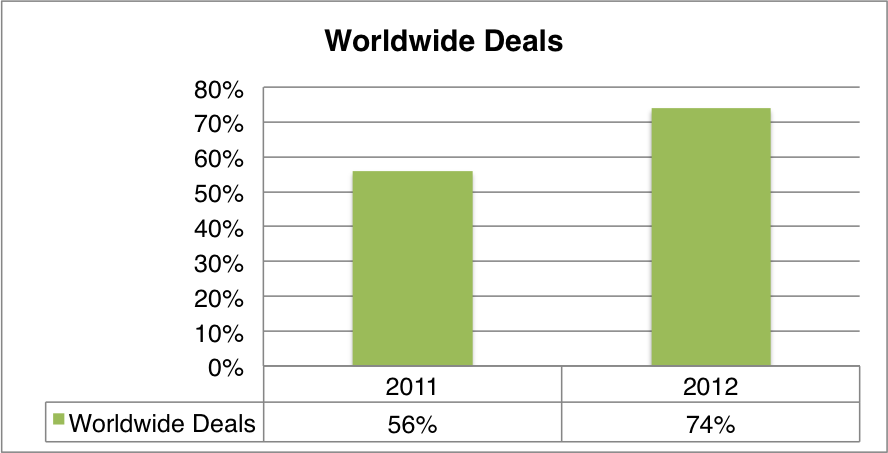
Worldwide deals increase dramatically: For oncology deals done between 2011 and 2012, there was a nearly 20% rise in deals that had worldwide licensing rights.

WorldWideDeals

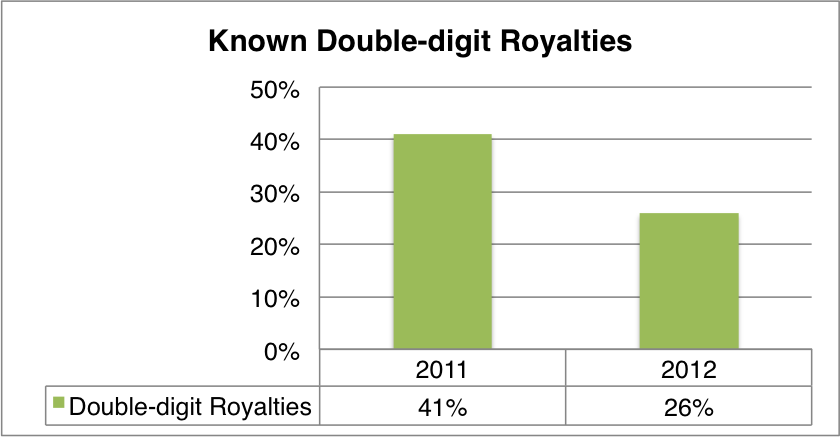
This means that the licensee has exclusive rights to research, develop, manufacture & commercialize, regardless of territory. Of these deals, at least 41% in 2011, and at least 26% in 2012, were reported to pay double-digit royalties to the licensor (10% or more.) It is important to note that this number tends to fluctuate positively, because royalty figures are not necessarily publicly disclosed in licensing deals.

DDRoyalties

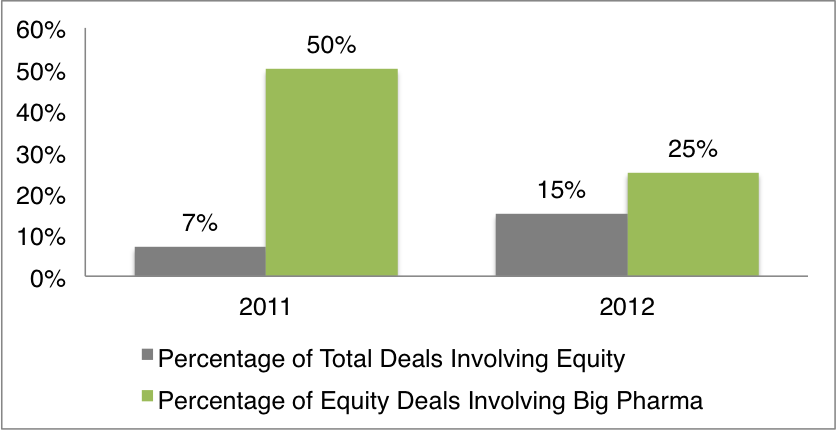
In at least 7% of the deals of 2011, and at least 15% of the deals in 2012, equity payments became publicly available in the database. In 50% of the deals with equity in 2011, the investor was a large pharmaceutical company. In 2012, this figure fell to 25%. This statistic highlights another trend – companies are licensing more to smaller private companies than to big pharma.

EquityDeals2

In terms of deals involving antibody-based therapeutics, there was a 2% rise (from 28% to 30%) between 2011 and 2012. It is important to note here that a majority of these are early stage deals – for example, deals with research alliances and companies in the preclinical stages.

AntibodyDeals

In summary, there is an increase in licensing activity surrounding oncology, antibody-based therapeutics, and among earlier stage products. This shift represents a positive trend for those emerging biotechs targeting this major indication area, who are considering early stage licensing as an alternative route to capital or exit.

Elucidating the Timeline to Capital

17 Apr

By Dennis Ford, CEO, LSN

LSN has written extensively on several facets of the capital-raising process, from the various new types of investors active in the space, to the technologies most actively being targeted by investors. However, we have not yet delved into the actual timeline required to raise money. This is the big question, as most emerging life sciences companies exist in a life-or-death situation. A misconceived notion of the required timeline to capital is the kiss of death for many; this article seeks to correctly define this critical period in the life of a company.

First things first: all of your collateral must be in order – this includes getting the business plan written along with the necessary investor presentation documents (powerpoint, executive summary, and website – yes, your website is an investor presentation tool!). This is a multifaceted process, which goes far beyond just explaining the science. Adroit entrepreneurs will know that as they write their plan, they are also creating a brand and a message that they are delivering to a marketplace of investors, and hopefully beyond. When writing the plan, keep in mind that the document you are creating is for distribution, and that it will be compared and contrasted with other companies that are going after the same capital as you are. If you take the time to present the data and create compelling facts & forecasts around your plan, then you have a leg up. Technology, market sizing and financial forecasting are all important elements, but don’t forget the most important one: your plan is your identity as a company! It can take anywhere from 6-8 weeks to develop and write a business plan, and then a considerable amount of ongoing time to hone and edit it as you move through the fundraising process.

The next step is compiling a global target list of investors that are likely candidates. You need to do your research and outline all of the likely candidate investors. This includes researching past investments in products like yours, groups targeting your specific disease area, and other relevant criteria that are major components of your company. This is why it is so important to have a cohesive understanding of who you are before seeking out investors. You will also want to research & target investors that have declared that they have a current or future mandate for investment in products that are like yours. This can be easy if you decide to buy an up-to-date database of investors, such as LSN’s. Alternatively, it can be incredibly time consuming if you decide to do this by vetting a list of likely investor fits through Internet research. Essentially, this is a process that can take a few clicks of your mouse with a good database, or over a month (or more) if researched manually. Here you must remember that accurate, current information on investors and investor contacts is paramount. Nothing creates thrashing like out-of-date data.

Then it is off to the outbound marketing campaign, and actually contacting investors – creating dialogue that turns into a relationship and, eventually, nets you an allocation. Contacting investors is a tedious, time consuming, and difficult process. It takes incredible tenacity to work your investor list and stay on the mission. Most of the time you spend will be doing referred outreach, cold calls, follow up, and more follow up. Most meetings involve multiple incantations and various follow-ups. This is because, realistically, it takes 2-6 weeks to regroup between follow-ups. What’s more, repeated meetings with various stakeholders can take months. All in all, the process of creating dialogue and developing a relationship takes a serious commitment of time and effort.

This is why it is important to know and understand the cycles of a fundraising campaign. Fundraising used to be more product-centric, but now a big part of the investment is vetting and building a relationship with the executive teams. Fundraising is a numbers game, and if you do get an investor on your radar screen, and the interest is really there, it is a still at most a one-in-four chance of getting through the due diligence, and an even smaller chance of being selected and funded after that. The fact is you really have to find, develop, and maintain an investor target list that includes hundreds of investors that are a fit to go after. If you understand this process, you will understand why it takes a dedicated commitment to raise capital, and therefore, why it takes so much time.

The last step, which is similarly time consuming and expensive, is to get you and your lawyer negotiating and closing the capital allocation down, and getting the cash into your account. Although there are no hard rules on this process, here are some of the things I’ve observed:

  • If you are fortunate enough to be in the right place at the right time with a compelling product or technology, you can raise your required capital in 3-6 months, but this represents a very small fraction of the players. Adding to this, angels, venture philanthropy, and patient investor groups can act swiftly, but they are a minority of investors. This is largely an issue of “passion versus risk” – meaning the venture philanthropy and patient groups move faster because of a sense of urgency in finding a cure.
  • From my firsthand accounts with fundraising clients, somewhere between 6 and 12 months is a reasonable timeline to raise capital, assuming investor climate is suitable and proper campaign execution is present.
  • The rest of the major categories of investors have firm “institutional” best practice investment processes. This means a stringent, time-consuming methodology and adhering to established protocols for the particular investment mandate. In other words, it takes time.
  • 2008 and 2011 drastically elongated fundraising timelines (for obvious reasons) to 9-18 months. This is beginning to soften now, but things can still be tough.
  • Investors are not going it alone anymore, so “herding” spells more time, as more players opt in.
  • Entrepreneurs can plan on spending around 1,000 hours (or about 9 months), which is at the top of the bell curve in my estimate. The 6-9 month point is when you will have a good idea of your funding potential in terms of investor’s feedback and interest. If it’s not working out, something needs to change.
  • A campaign is a living vehicle that needs to be honed and morphed as the investor reaction is calculated, which either enhances or delays your timeline.
  • Finding the right investor fit is critical. If you don’t achieve this, you’re looking at churn, churn and more churn – which can be expected today.

The State of Investment Banks in Early Stage Life Science Investing

17 Apr

By Max Klietmann, VP of Research, LSN

As LSN has been tracking the shift in the investor landscape over the past year or so, an interesting trend has emerged among some boutique investment banks in the space. Traditionally, investment banks in the life science arena were more focused on institutional transactions, and buy-side & sell-side activity. However, as family offices have begun to play a more significant role in the space, some tactically-minded I-banks have reoriented their businesses to focus on serving these constituents.

This is not a trend among the bulge bracket banks for several reasons: first, there is too much separation between the investment banking and private wealth business areas. This lack of communication makes it hard to consistently source direct investment opportunities for family office clients with specific interests. Secondly, family offices want industry specialists to serve as navigators in the space – they are not merely looking for an investment advisor. Finally, the family offices tend to prefer the personal touch gained by working with a smaller, more flexible boutique partner – it is simply the nature of this investor group to look for long-term relationship potential.

The boutique banks that are doing this effectively are maintaining a custom-tailored approach – they are taking a family office’s interest in a specific disease area, and enhancing their search with institutional quality deal sourcing, a high level of industry & sector expertise, and high quality due diligence processes. This yields superior results for family offices that typically have a genuine desire to make allocations, but lack the technical insight to navigate the space on their own.

So what does this mean for the space? Beyond investment banks having a new prospective client base in the life sciences space, there are some other very interesting considerations to make: Entrepreneurs targeting capital should consider boutique, industry-specific investment banks as a source of potential investors. Family offices looking to enter the space should evaluate whether one of these entities might be the right partner with which to approach direct investment in life sciences. The sands are shifting, and those that adapt to these trends first will have the upper hand.

Hot Life Science Investor Mandate 1: Venture Arm with Strong Backing Deploying Capital to Healthcare IT – April 18, 2013

17 Apr

A venture and expansion capital arm of a larger organization based in the Central US has around $300 million in total assets under management, and is currently deploying capital from its third fund, which closed at nearly $200 million. The firm is currently seeking opportunities in the life science sector, and while they have no strict timeline to make investments, they would invest in a new firm within the next 6-9 months if a compelling opportunity were identified. The firm’s equity investments range from $3-10 million, but are typically in the $8-10 million range.

Currently, this firm is most interested in the medtech, biotech diagnostics, and information providers spaces. Specifically, they are looking for healthcare IT firms within the information providers space. The firm is very opportunistic within the areas of biotech diagnostics and medtech, and would be willing to look at companies that fall within the full gamut of the medtech and diagnostics subsectors. The firm, however, will only consider US based firms within the venture and expansion capital space.

The firm is most interested in early stage companies, and is interested in pre-revenue firms. With that being said, they will look at firms that have products that are in-development, or firms that have a prototype of their product, but will not consider firms that have a device that is on the market.

Hot Life Science Investor Mandate 2: Eastern US Angel Group Targeting Orphan Indications – April 18, 2013

17 Apr

An angel group based in the Eastern US currently has around $15 million in total assets under management, and is currently deploying capital from its third fund. The firm is looking for new opportunities in the life science space, but has no set timeline to make allocations. The group typically allocates between $250,000 and $2 million per company.

Currently, the angel group is most interested in the biotech therapeutics and medtech space, but only those that are targeting orphan indications. The group will not consider therapeutics and diagnostics that are treating any other indications besides orphan diseases due to the current difficult FDA regulatory framework.

The group is looking for pre-revenue companies within this area. However, they would consider companies in the biotech therapeutics space that have products in the preclinical stage through phase III of development, and in the medtech space the firm is looking for companies that have a product in development, or have a prototype.

Hot Life Science Investor Mandate 3: Opportunistic PE Seeks CMO for New Allocations – April 18, 2013

17 Apr

A private equity group based in the Eastern US has around $200 million in assets, and has raised two funds. The firm is currently looking for new opportunities in the life sciences space, and although the firm has no set time frame to make allocations, they are always opportunistically looking to source new investments in the space.

The firm’s typical equity investment size ranges from $10-40 million. Currently, they are most interested in information providers as well as Biotech R&D services firms. In the information provider space, the group is seeking healthcare IT firms, and in the biotech R&D services space, the firm is looking for contract manufacturing organizations (CMOs). The firm solely invests in firms based in North America, and will consider companies headquartered in either the U.S. or Canada.

The firm is looking for companies that have $5-15 million in EBITDA, and $35-100 million in revenue, and $25-125 million in enterprise value, however EBITDA is the most important criteria in terms on the firms investment requirements. Accordingly, the firm does not invest in pre-revenue companies.