Tag Archives: issue

CRO Marketing 101: The Value of Email Campaigns

24 Apr

By Tom Crosby, Marketing Manager, LSN

A recent study found that among most small-medium sized businesses, approximately 15% of marketing budgets are allocated towards email marketing (by far the largest single line item). By comparison, SEO and social media budgets came in at 8% a piece, and the confidence levels in the effectiveness of each were dramatically lower than they were for email marketing. This may sound surprising, considering the hype that surrounds social media outlets, but the data clearly shows that new and flashy doesn’t necessarily mean effective. CROs marketing their services should be mindful of how to effectively approach this tool.

In the current state of CRO service marketing inbound leads are few and far between, and small & emerging biotech opportunities are hard to map out. In this environment there is no easier and more efficient outbound attempt that a marketing team can make than email. This is reflected in the findings of the study. Personally, I see the positive effects of our newsletter campaign every day at LSN – most notably is that the few inbound connections that we are able to establish often come directly from the newsletter.

Email marketing is definitely a sales tool. However, there is a right way and a wrong way to go about email marketing. Many marketing professionals make the mistake of believing that the wider your audience is, the better your chances are of making that connection. We’ve all seen the cold emails coming into our Outlook inboxes every morning from marketers at nameless list providers. However, the reality is that a clean and narrow list of good targets is infinitely better than a large, clunky list of cold contacts.

The key to an effective campaign is targeted, interesting content that is being sent to interested readership on a regular basis. You want to create a dialogue with customers so they feel engaged, rather than throwing things against a wall and seeing what sticks. Direct, sales-driven “pseudo-articles” will only cheapen your brand, and will likely put your domain name on the spam list. However, if your prospects feel engaged, you can bring the business to you by solidifying your firm’s position in the marketplace as a leader with niche expertise. In other words, show how your CRO is differentiated from the competition by highlighting the unique advantages you offer. Having created a dialogue with prospects, it will then also be easier for you to adapt as conditions shift.

The aforementioned study showed that one of the main concerns with email marketing was losing subscribers when sending out weekly mailings. In my mind, this is a good sign, because it means that our list is getting stronger, and that we’re not reaching out to people who aren’t a fit for our product. This comes with the added benefit of staying in good favor with the community at large. If somebody doesn’t want to receive emails from us anymore, it’s made quick and easy to just say ‘no thanks.’ This is a simple courtesy that has far-reaching implications in terms of your company’s image – nobody wants to be seen as an annoyance. More importantly, this helps to keep your list fluid and up-to-date, allowing for more targeted campaigns and more effective dialogue.

The key take-away is that email marketing requires planning, strategy, and consistent execution and follow-up. Marketers need to maintain a conversation with their prospect audiences, and make their mailings interesting and easy to read. The goal is to connect your brand with insight and expertise that no one else can offer. When successfully executed, this can be an incredibly powerful tool that enhances the efficacy of the business development team.
Hot Life Science Investor Mandate 1: PE Provides Secure Venture Debt Loans to Medtech – April 25, 2013

23 Apr

A private equity group based in Canada has around $500 million in assets, and is currently deploying capital from its fourth fund, which raised nearly $200 million. The firm is seeking greater exposure to the life sciences, and while they do not have a set timeframe to make allocations, the group would invest in a new firm within the next six months if a compelling opportunity were identified.

The PE provides secured venture debt loans ranging from $2-15 million and has the ability to syndicate loans as large as $30 million for public companies. They are most interested in medical technology firms that are developing medical devices. The firm will only consider medtech companies that have products that are currently on the market. The firm will consider both US- and Canadian-based firms. The firm only considers funds that have at least $5 million in revenue, and will consider both private and public firms.

Hot Life Science Investor Mandate 2: Mezzanine Debt Fund Looking to Invest Directly in Healthcare, Research Institutions – April 25, 2013

23 Apr

A mezzanine debt fund with offices across the US is currently focused on structured financings of commercialized biopharmaceutical products and medical technologies. The firm’s total AUM is approximately $400 Million. Collectively, the fund has completed more than 50 royalty transactions representing nearly $4 billion in capital over the past 15 years.

The fund is heavily invested in healthcare investing that focuses on IP investments in FDA-approved biopharmaceutical assets through royalty bonds, structured debt, revenue interests and traditional royalty monetization. Typically, they target investments between $20 and $200 million and work directly with leading healthcare companies and research institutions.

Typical financings are intended to healthcare organizations fund pipeline development, make acquisitions, and expand into new markets—all with an adaptable source of capital. The firm’s primary source of collateral is derived from commercialized products. 

Hot Life Science Investor Mandate 3: PE Group in Eastern US with Large AUM Looking for Life Science Opportunities – April 25, 2013

23 Apr

A private equity group based in the Eastern US currently has over $9 billion in assets under management, and is currently looking to deploy capital from its fifth fund – which raised over $2 billion – to life science companies.

The firm has no set timeframe to make allocations, but would invest within the next sixth months if a compelling opportunity were identified. The firm’s investments typically range from $30-50 million. The firm is most interested in biotech R&D service firms, and specifically is looking for contract manufacturing organizations (CMOs) and contract research organizations (CROs).

The firm provides firms with growth capital, and also does distressed equity transactions, and therefore is only looking for established firms. The PE has no preference as to where the firm is based, and plans to invest up to 49% of the fund’s assets in firms that are located outside of the US. The firm mainly invests in private companies but will consider public companies as well.

LSN Database Feature: Trends Suggest Oncology, Antibody & Early Stage Licensing Demand Increasing

17 Apr

By Dr. Karin Bakker, Managing Director, PharmaPlus Consultancy, B.V.

LSN’s deals database is a powerful tool for investors and corporate strategic groups looking to follow key trends in the area of licensing and product/technology specific transactions. This week, LSN takes a deeper look at three popular parts of the space with compelling activity in 2011 and 2012: These are oncology-focused therapeutics, antibodies, and early-stage products. The tables below explain the latest shifts in the space.

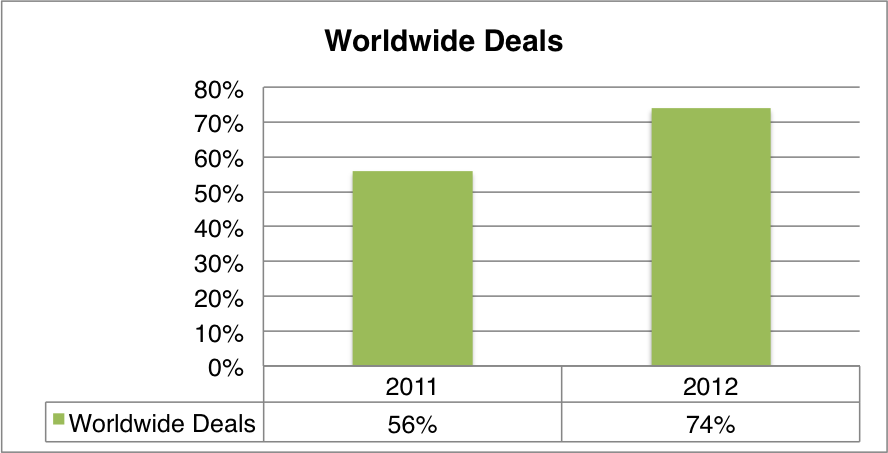
Worldwide deals increase dramatically: For oncology deals done between 2011 and 2012, there was a nearly 20% rise in deals that had worldwide licensing rights.

WorldWideDeals

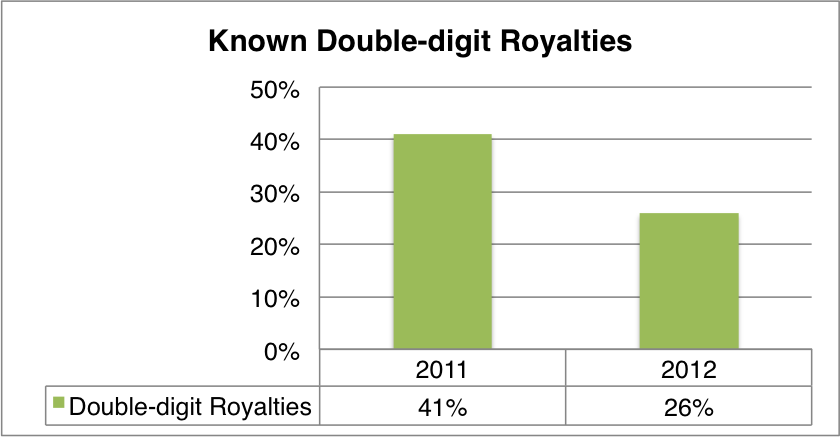
This means that the licensee has exclusive rights to research, develop, manufacture & commercialize, regardless of territory. Of these deals, at least 41% in 2011, and at least 26% in 2012, were reported to pay double-digit royalties to the licensor (10% or more.) It is important to note that this number tends to fluctuate positively, because royalty figures are not necessarily publicly disclosed in licensing deals.

DDRoyalties

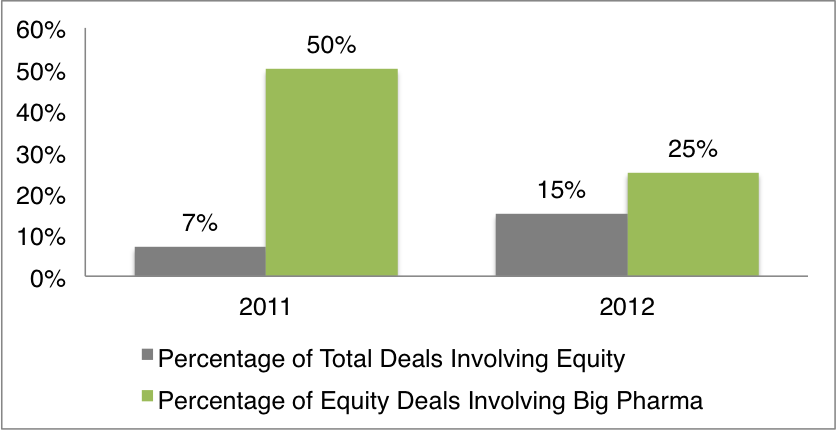
In at least 7% of the deals of 2011, and at least 15% of the deals in 2012, equity payments became publicly available in the database. In 50% of the deals with equity in 2011, the investor was a large pharmaceutical company. In 2012, this figure fell to 25%. This statistic highlights another trend – companies are licensing more to smaller private companies than to big pharma.

EquityDeals2

In terms of deals involving antibody-based therapeutics, there was a 2% rise (from 28% to 30%) between 2011 and 2012. It is important to note here that a majority of these are early stage deals – for example, deals with research alliances and companies in the preclinical stages.

AntibodyDeals

In summary, there is an increase in licensing activity surrounding oncology, antibody-based therapeutics, and among earlier stage products. This shift represents a positive trend for those emerging biotechs targeting this major indication area, who are considering early stage licensing as an alternative route to capital or exit.

Elucidating the Timeline to Capital

17 Apr

By Dennis Ford, CEO, LSN

LSN has written extensively on several facets of the capital-raising process, from the various new types of investors active in the space, to the technologies most actively being targeted by investors. However, we have not yet delved into the actual timeline required to raise money. This is the big question, as most emerging life sciences companies exist in a life-or-death situation. A misconceived notion of the required timeline to capital is the kiss of death for many; this article seeks to correctly define this critical period in the life of a company.

First things first: all of your collateral must be in order – this includes getting the business plan written along with the necessary investor presentation documents (powerpoint, executive summary, and website – yes, your website is an investor presentation tool!). This is a multifaceted process, which goes far beyond just explaining the science. Adroit entrepreneurs will know that as they write their plan, they are also creating a brand and a message that they are delivering to a marketplace of investors, and hopefully beyond. When writing the plan, keep in mind that the document you are creating is for distribution, and that it will be compared and contrasted with other companies that are going after the same capital as you are. If you take the time to present the data and create compelling facts & forecasts around your plan, then you have a leg up. Technology, market sizing and financial forecasting are all important elements, but don’t forget the most important one: your plan is your identity as a company! It can take anywhere from 6-8 weeks to develop and write a business plan, and then a considerable amount of ongoing time to hone and edit it as you move through the fundraising process.

The next step is compiling a global target list of investors that are likely candidates. You need to do your research and outline all of the likely candidate investors. This includes researching past investments in products like yours, groups targeting your specific disease area, and other relevant criteria that are major components of your company. This is why it is so important to have a cohesive understanding of who you are before seeking out investors. You will also want to research & target investors that have declared that they have a current or future mandate for investment in products that are like yours. This can be easy if you decide to buy an up-to-date database of investors, such as LSN’s. Alternatively, it can be incredibly time consuming if you decide to do this by vetting a list of likely investor fits through Internet research. Essentially, this is a process that can take a few clicks of your mouse with a good database, or over a month (or more) if researched manually. Here you must remember that accurate, current information on investors and investor contacts is paramount. Nothing creates thrashing like out-of-date data.

Then it is off to the outbound marketing campaign, and actually contacting investors – creating dialogue that turns into a relationship and, eventually, nets you an allocation. Contacting investors is a tedious, time consuming, and difficult process. It takes incredible tenacity to work your investor list and stay on the mission. Most of the time you spend will be doing referred outreach, cold calls, follow up, and more follow up. Most meetings involve multiple incantations and various follow-ups. This is because, realistically, it takes 2-6 weeks to regroup between follow-ups. What’s more, repeated meetings with various stakeholders can take months. All in all, the process of creating dialogue and developing a relationship takes a serious commitment of time and effort.

This is why it is important to know and understand the cycles of a fundraising campaign. Fundraising used to be more product-centric, but now a big part of the investment is vetting and building a relationship with the executive teams. Fundraising is a numbers game, and if you do get an investor on your radar screen, and the interest is really there, it is a still at most a one-in-four chance of getting through the due diligence, and an even smaller chance of being selected and funded after that. The fact is you really have to find, develop, and maintain an investor target list that includes hundreds of investors that are a fit to go after. If you understand this process, you will understand why it takes a dedicated commitment to raise capital, and therefore, why it takes so much time.

The last step, which is similarly time consuming and expensive, is to get you and your lawyer negotiating and closing the capital allocation down, and getting the cash into your account. Although there are no hard rules on this process, here are some of the things I’ve observed:

  • If you are fortunate enough to be in the right place at the right time with a compelling product or technology, you can raise your required capital in 3-6 months, but this represents a very small fraction of the players. Adding to this, angels, venture philanthropy, and patient investor groups can act swiftly, but they are a minority of investors. This is largely an issue of “passion versus risk” – meaning the venture philanthropy and patient groups move faster because of a sense of urgency in finding a cure.
  • From my firsthand accounts with fundraising clients, somewhere between 6 and 12 months is a reasonable timeline to raise capital, assuming investor climate is suitable and proper campaign execution is present.
  • The rest of the major categories of investors have firm “institutional” best practice investment processes. This means a stringent, time-consuming methodology and adhering to established protocols for the particular investment mandate. In other words, it takes time.
  • 2008 and 2011 drastically elongated fundraising timelines (for obvious reasons) to 9-18 months. This is beginning to soften now, but things can still be tough.
  • Investors are not going it alone anymore, so “herding” spells more time, as more players opt in.
  • Entrepreneurs can plan on spending around 1,000 hours (or about 9 months), which is at the top of the bell curve in my estimate. The 6-9 month point is when you will have a good idea of your funding potential in terms of investor’s feedback and interest. If it’s not working out, something needs to change.
  • A campaign is a living vehicle that needs to be honed and morphed as the investor reaction is calculated, which either enhances or delays your timeline.
  • Finding the right investor fit is critical. If you don’t achieve this, you’re looking at churn, churn and more churn – which can be expected today.

The State of Investment Banks in Early Stage Life Science Investing

17 Apr

By Max Klietmann, VP of Research, LSN

As LSN has been tracking the shift in the investor landscape over the past year or so, an interesting trend has emerged among some boutique investment banks in the space. Traditionally, investment banks in the life science arena were more focused on institutional transactions, and buy-side & sell-side activity. However, as family offices have begun to play a more significant role in the space, some tactically-minded I-banks have reoriented their businesses to focus on serving these constituents.

This is not a trend among the bulge bracket banks for several reasons: first, there is too much separation between the investment banking and private wealth business areas. This lack of communication makes it hard to consistently source direct investment opportunities for family office clients with specific interests. Secondly, family offices want industry specialists to serve as navigators in the space – they are not merely looking for an investment advisor. Finally, the family offices tend to prefer the personal touch gained by working with a smaller, more flexible boutique partner – it is simply the nature of this investor group to look for long-term relationship potential.

The boutique banks that are doing this effectively are maintaining a custom-tailored approach – they are taking a family office’s interest in a specific disease area, and enhancing their search with institutional quality deal sourcing, a high level of industry & sector expertise, and high quality due diligence processes. This yields superior results for family offices that typically have a genuine desire to make allocations, but lack the technical insight to navigate the space on their own.

So what does this mean for the space? Beyond investment banks having a new prospective client base in the life sciences space, there are some other very interesting considerations to make: Entrepreneurs targeting capital should consider boutique, industry-specific investment banks as a source of potential investors. Family offices looking to enter the space should evaluate whether one of these entities might be the right partner with which to approach direct investment in life sciences. The sands are shifting, and those that adapt to these trends first will have the upper hand.