Tag Archives: letter

Hot Life Science Investor Mandate 1: Global PE Looking to Invest up to $80m in CROs, CMOs, Biotech R&D – May 9, 2013

8 May

A private equity group with offices worldwide has approximately $20 billion in total assets, and has raised more than 15 funds to date. Currently, around 15% of the firm’s portfolio is dedicated to the healthcare/life sciences space, and they are currently looking for new opportunities for their most recent fund, which closed at more than $10 billion. The firm is unsure of how many investments it will make within the next 6-9 months, however, they would allocate to a company within the next few quarters if a compelling opportunity were identified. The firm typically allocates between $20-80 million per company.

The PE is looking for companies in the biotech R&D services, therapeutics and diagnostics, as well as medtech space, and are most interested in contract research organizations (CROs), contract manufacturing organizations (CMOs), diagnostics, and medical devices. Because the firm has a global footprint, they invest in companies all over the world.

This particular PE only engages in growth and buyout transactions. They typically look for companies that have between $50-250 in EBITDA, and an enterprise value of at least $250 million. With that being said, the PE will only consider companies that are cash flow positive with a product currently on the market.

Hot Life Science Investor Mandate 2: Non-Profit Seeks Biotechs Developing Brain Disorder Therapeutics – May 9, 2013

8 May

A non-profit based in the Western US with nearly $50 million in assets is interested in biotech firms developing therapeutics that target brain disorders. The firm typically allocates from the hundreds of thousands into the millions per firm, and is looking to allocate to one more firm in the life science’s space for their second fund. They are especially interested in technologies that are able to deliver therapeutics across the blood brain barrier, as well as the personalized medicine space. The firm prefers funds that are in between phase I and phase II of the clinical development process, but will consider products in preclinical, phase I, and phase II development.

Hot Life Science Investor Mandate 3: PE Firm Looking for Biotech Diagnostics – May 9, 2013

8 May

A private equity group based in Canada that provides growth equity to firms in North America is looking for new opportunities in the life sciences space, and will make 5-6 new investments next year. They have allocated to five companies within the last twelve months. The firm typically allocates in the tens of millions per firm. They are most interested in the medical device and biotech diagnostics spaces.Two of the fund’s current investments in the life sciences space include a firm in the medical device market, as well as a firm that focuses on diagnostics for women. They are looking for firms that are pre-revenue, and thus, in the biotech diagnostics space, they will consider firms with products in the preclinical, phase I, phase II, and phase III stage of the development process, and in the medtech space they will consider firms that have a prototype of their device.

Gene Therapy: The Next Hot Subsector For Private Investors

8 May

By Max Klietmann, VP of Research, LSN

Investor interest in companies developing gene therapy products has risen quite dramatically in recent months. In fact, according to the LSN Company database, 20 companies in this space raised new capital in the last twelve months (approximately 50%), indicating strong investor interest. But why are investors suddenly interested in this space again? It all comes down to a wealth of new data surrounding this space, suggesting that gene therapy may be more clinically viable than previously thought.

Gene therapy boils down to using DNA as a therapeutic agent for a specific indication. The basic concept is to take a patient with a genetic disease, and replace the mutated or defective gene of a patient with a healthy, functional gene. Theoretically, this should solve the issue. However, historically, the data was dubious at best, and many investors lost faith in the technology. But this has changed substantially in recent time. Due to a growing body of positive data surrounding a number of gene therapy products, and market approval of a handful in recent months (especially for orphan indications), many investors that previously steered clear from this risky space are now chomping at the bit to make placements. Most interestingly, it is largely private investors willing to take a risk in this emerging field rather than big pharmas. In fact, there are many gene therapy programs actively being pursued by the big pharma players. However, if this space is as promising as the data suggests, it could be the next hot acquisition target for pharmaceutical companies seeking to expand their pipelines.

Keeping a watchful eye on this subsector and capitalization/development trends will be a strong indicator of things to come for the industry. We could be looking at a total industry game-changer.

Science and Investing in an Overhyped World: Profiling Macrocycles

8 May

By Jack Fuller, Research Manager, LSN

For the last year or so, I have been following two interesting classes of molecules that have garnered a great deal of press in the therapeutics space. These are macrocycles and constrained peptides, and they have enormous potential to treat diseases in a number of unique ways. Due to their size (they fall somewhere between small molecules and biologics), and their ability to access previously “undruggable” targets, this class of compounds has caused a recent explosion of big pharma, emerging companies and investors pouring resources into validating these molecules. At least 12 companies are currently developing these therapeutics, and several dozen research collaborations have been formed with big pharma since 2009. This upsurge in activity would appear to indicate that we are entering the early stages of an R&D cycle that will lead to a host of clinical trials and at least a few blockbuster drugs. Getting in now could mean big rewards down the road, but as any savvy life science investor knows, the promise of the next big thing often leads to broken promises and a meager return.

History is a compelling teacher, so let’s look back and remember some hope and hype associated with the next big thing. In the 1990s and into the early 2000s, regenerative medicine and tissue engineering were supposed to allow us to repair or replace damaged tissue and organs. After failed clinical trials and disappointing financial returns, the sector matured, and has since progressed at a measured pace toward developing products and therapies. Similarly, every few years new targets appear in the literature and a rush of companies are formed or refocus their efforts to push the first products through clinical trials and onto the market. One of the reasons is because there are so few druggable candidates remaining for which companies can develop game changing therapies. I understand that executives and investors see the potential for the big ROI and are willing to take the risk. Unfortunately, having so much hype results in overvaluing companies where the fundamental science just isn’t that well understood.  Sometimes, a sector may be 3-7 years away from turning out therapeutics that can pass the clinical review process.

Don’t get me wrong, macrocycles and constrained peptides have a HUGE upside. The science has been relatively static, stuck since the discovery of the first macrocycle therapeutic, cyclosporine, forty years ago. In recent years, advances in synthesizing and screening macrocycles have allowed research to progress at a rapid pace. These compounds have the potential to be formulated as oral pills for untapped intracellular targets. I repeat, oral pills for untapped intracellular targets! If this proves to be the case, the potential markets are enormous.

From a pragmatic side, the reality is that every company developing macrocycle-based therapeutics is aiming for the low-hanging fruit of extracellular targets. This gives the companies less risk, but also lowers the disruptive potential of the products. Another significant problem is that it is relatively easy to develop in vitro assays to screen for potential hits. However, it is yet to be determined how to correlate the in vitro properties of the compound with its pharmacological properties. Basically, these compounds may look like great initial hits, but fail miserably in clinical trials due to poor drug distribution, clearance rates, and cell permeability.

What we have learned in the past may well be applied to current and future trends in drug development. Macrocycles have a real chance to treat diseases and make a lot of money, but we’ve heard that promise before. The message? As always, have top-notch due diligence, and never let the hype outstrip the science.

LSN Database Feature: Discovery Stage Deals Becoming More Plentiful with Better Terms; CNS a Hot Indication Area.

8 May

By Dr. Karin Bakker, Managing Director, PharmaPlus Consultancy, B.V.

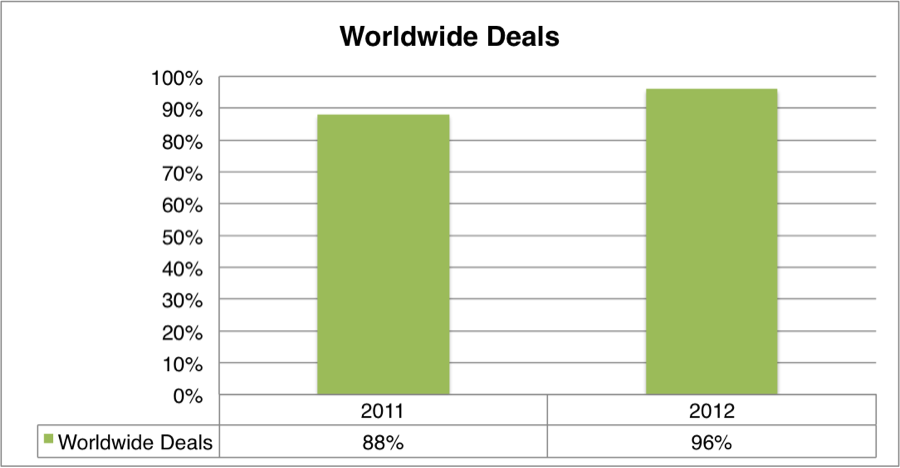
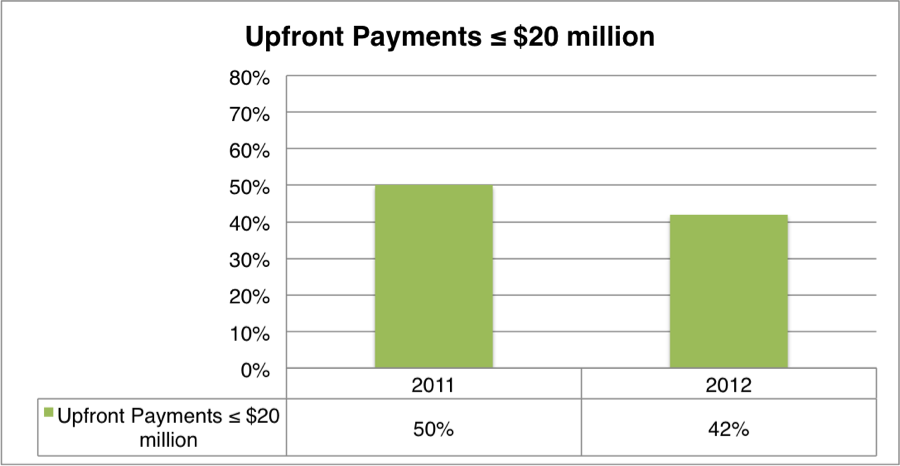
LSN’s deals database is a powerful tool for investors and corporate strategic groups looking to follow key trends in the area of licensing and product/technology specific transactions. This week, LSN takes a deeper look at three major trends indicated by life sciences deal activity around discovery stage assets in the last two years: First, the number of discovery stage deals worldwide is on an upward trend, deals including major upfront payments (greater than $20 million) for assets increased significantly, and the percentage of deals focused on CNS products has effectively doubled. The following charts explain the trends:

Worldwide deals trending upward: For discovery stage deals done between 2011 and 2012, there was an 8% rise in deals that had worldwide licensing rights. This means that the licensee has exclusive rights to research, develop, manufacture & commercialize, regardless of territory.

WWdealsUpfront payment sizes increasing: The number of deals surrounding discovery stage assets with an upfront payment of $20 million or less as part of the terms decreased from 50% to 42%. This translates to a significant increase in deals with large upfront payments, reflecting the trend that LSN identified a few months ago of Big Pharma looking closer to the source when it comes to in-licensing assets.

UpfrontCNS is one of the hottest indication areas: Among a number of shifts in primary indication areas associated with deal activity was a huge increase in CNS deals. The percentage of CNS deals effectively doubled year-on-year, suggesting that this is trending towards becoming one of the hottest activity sectors (soon to overtake oncology, which has seen a downward trend in deal activity).

typesIn summary, there is an increase in licensing activity surrounding discovery stage assets as a whole, an improvement in deal terms at this development phase as a whole, and a significant increase in activity surrounding CNS drugs. These trends will have a resounding impact on industry dynamics, and are critical for savvy players in the space to take into account.

Genomics: The Next Generation of Oncology Diagnostics

1 May

Max Klietmann, VP of Research, LSN

Genomics is becoming a major buzzword in the diagnostics space. In short, the concept boils down to mapping an individual’s genome and predicting health risks, therapeutic efficacy, and/or other variables based on genetic predisposition. Despite some disappointments with genomics in certain other applications, it is rapidly making its headway in preventative and personalized treatment, especially in the oncology space.

Oncology research has helped to identify a host of genetic biomarkers, which creates a particularly compelling opportunity for a robust application of genome sequencing. Moreover, cancer and oncology represent a major indication area and a highly favorable market profile from an investor perspective. Moreover, when used as a diagnostics tool, there is minimal regulatory risk, enhancing attractiveness to investors even more due to the fast track to cash flows. Finally, thanks to the rapidly declining cost of this technology and the accuracy of projections it can deliver on a patient-by-patient level, it is well positioned to become a standardized component of a typical person’s regular health screening. In short – this is a dream opportunity for investors looking to gain from the rapid growth in the life sciences space without risking regulatory exposure.

According to LSN Company Database data, there are 54 emerging companies specialized in this space globally, and less than 50% have secured financing since January of 2012. This presents a particularly interesting opportunity to investors who are seeking the opportunity to find undiscovered value in a non-competitive space. Keep your eyes on this area as a hot sector in 2013.