Tag Archives: life science nation

Strategic Investors Aggregating Early Stage Assets

29 Jan

By Max Klietmann, VP of Research, LSN

Recently, two major trends have surfaced in early stage life sciences investment; the concept of the virtual pharma and private equity aggregation of early stage portfolios. According to several conversations I’ve had with these two categories of investors over recent months, these entities are beginning to employ a new strategy to take advantage of the plethora of promising early stage assets available. The basic idea is to grow a synergistic portfolio around a specific silo (indication, technology, etc.) over time. These portfolios of complimentary assets can then be brought directly to market (via third party distribution) or sold into large pharmaceutical companies, whose pipelines are increasingly suffering from a myopia leaving significant market opportunities unaddressed.

The concept is quite simple and intuitive: In the case of a virtual pharma, a group of highly seasoned life sciences and pharma experts raise capital to buy a portfolio of promising early stage academic assets, vet them, and shepherd them through clinical trials via a very lean model relying heavily on CROs and outsourced development. By focusing on only fast-moving, highly promising assets (and strategically divesting those that aren’t), a very lean pipeline is maintained. This keeps capital allocated exclusively on getting product to market as quickly as possible. Then, either through licensing or third party distribution via a rent-a-salesforce, the products are sold into the marketplace.

Similarly, highly strategic mid-market PE investors (who typically invest in large scale opportunities closer to phase II or III) are making very small $1-5 million investments spread across a very broad range of very early stage assets, including academic laboratory research. The assumption is that by maintaining a hands-on approach and scrupulous focus on performance, a fund is capable of maintaining a portfolio of companies that not only have a promise of success on an individual basis, but as a collective whereby the whole is more valuable than the sum of its parts.

This approach allows investors to follow big pharma and provide solutions to upcoming pipeline gaps. It is also a more attractive opportunity for buyers down the line, because it is a fully integrated and curated portfolio with a strategic orientation towards marketability. The end result is a more efficient flow of capital through the industry, stronger drug development pacing, and an improved return profile for equity holders in life sciences companies that constitute the portfolio constituents.
Creating a Target List of Qualified Investors

29 Jan

By Brian Gajewski, VP of Sales, LSN

Many firms that are looking to raise capital in the life sciences arena have the difficult problem of finding a place to start – that is, figuring out how to gather a list of potential investor candidates to reach out to. As with most firms, the first pass at raising capital is with friends, family, and industry colleagues. This is a great category for the first couple million, but moving past this stage becomes a difficult task for many firms because of their lack of experience in raising capital.

Once a firm has exhausted the investments from that first stage of capital raising, the next step is to create a complete list of qualified investor leads that they can then begin reaching out to. LSN refers to this as a Global Target List (GTL). The fact that the life science arena is a global marketplace justifies getting past the regional mentality for fund raising efforts.

One of the first ways to start collecting investors is to target those that have invested in companies similar to yours over the past 5-10 years of financing rounds (another reason for the global approach). For that reason, it is very important to take the appropriate amount of time in performing research.  One best practice is to start by finding firms that are look-alikes, which are firms that have similar profiles to yours. This allows you to identify major investors in the space that have invested in similar firms based on therapeutic or device indication. For example, within the LSN platform, our clients are able to search through the past 12 years of financing in the life science industry by filtering the series & type of financing, as well as the date, sector, and phase of the product.

The next step in creating your Global Target List of investors is to create a list of foundations that might have an interest in your area of development. Foundations are a key investor in the life science industry because it fills two of their investment mandates – one being capital preservation, and the other, their philanthropic portfolio of investments. What is more interesting is that the donor lists to these foundations are in the public domain. The astute marketer can peruse this list and hopefully parse the high dollar donors and find a few nuggets that would be worth researching for an introductory call or meeting. The premise of this exercise is to remember that donors to foundations have a desire to move the science along for treatments and cures. Foundations are great vehicles to help move science along, despite being held back by process and bureaucracy. However, for some donors investing directly, companies that are moving the science along may be just as compelling.

It is important to remember that when your firm is raising capital, you are not just selling to people, but you are also selling to them a way to potentially affect the world. The most powerful reason for investors to allocate capital is that you are developing a cure for a disease that has affected them, their family or their people in their orbit.

Not only do you want to target foundations that might have an interest in your target indication, but also the major contributors to those same foundations. We are finding that more and more families are becoming interested in investing directly with a life science company.

Finally, you have to think globally, and create a Global Target List, but you must act locally – meaning, draw that two-hour road trip circuit, and figure out how many investors on your GTL are a short trip away. This is an excellent way to start to learn who your good targets are, and to give you the practice you need to make your presentations more compelling.

Now that you have a list of investors that have a specific interest in your type of company, it’s time to make sure you have the bandwidth to begin reaching out to them and tracking your success.

Hot Life Science Investor Mandate 1: CROs, CMOs Prime Targets for Opportunistic PE – January 29, 2013

29 Jan

A healthcare investment firm based in the Eastern US, which runs both a private equity fund and a hedge fund, is currently looking for new investment opportunities for their second private equity fund, which recently closed at $200 million. The firm has more than $500 million in assets, and has raised two private equity funds and one hedge fund in the past year. They have plans to invest in 3-5 new firms by the end of 2013, typically making equity investments ranging from $10-25 million.

The firm is currently most interested in firms in the biotech R&D services and medtech space. Within biotech R&D services, the firm is looking for contract research organizations (CRO’s) and contract manufacturing organizations (CMO’s). They have also recently started looking for firms within the medtech space, specifically those that are producing medical devices. The firm mainly invests in US-based companies, but has allocated to international firms in the past; they would consider European firms on a case-by-case basis.

The firm provides growth equity, expansion capital, and engages in buyout and recapitalization transactions. The firm only invests in established, cash-flow-positive companies. With that being said, the firm will not consider any companies in the medtech space that do not currently have a device on the market.

Hot Life Science Investor Mandate 2: VC Promises Fast Allocations – January 29, 2013

29 Jan

A venture capital fund in the Eastern US with around $20 million in total assets is currently looking for new opportunities in the life sciences space. The fund was created by its state legislature to promote economic growth. The organization has an evergreen structure, which means that they provide companies with incremental payments throughout the development phase of the product or company, rather than providing all of the capital to a firm upfront in one lump sum, which is the model that venture capital funds typically follow.

The fund, which is quasi-public, would allocate to a firm within the next six months if a compelling opportunity were identified. The firm’s typical investment size ranges from $300,000-500,000 per firm. Specifically, they are looking for medtech firms developing medical devices. The organization will allocate to firms that are pre-revenue, but the firm does need to have a prototype of the device. Additionally, they are interested in the healthcare/IT space.

Hot Life Science Investor Mandate 3: Corporate Venture Fund Seeks Therapeutics with Companion Diagnostics – January 29, 2013

29 Jan

A corporate venture fund with offices worldwide – one of the oldest in the world – is interested in the biotech therapeutics and diagnostics space. The fund has invested more than $500 million in the life science space since its founding, has an evergreen structure, and deploys capital on an opportunistic basis, pulling money directly from their main fund as investment opportunities are uncovered. They typically invest in up to 10 firms per year, usually allocating $1-10 million per company.

The firm is most interested in novel therapeutics, and would be especially interested in therapeutics firms that are developing a therapeutic with a companion diagnostic. They are also very interested in small molecule-based therapeutics, as well as companies producing medical devices. The firm has a global investment mandate.

In terms of their interest in therapeutics, the firm is looking for companies whose products are in the preclinical, Phase I, or Phase IIb (proof-of-concept) stage of development, and for medical device companies, the firm will look at firms that have a product in development or companies that have a prototype of their product.

Image

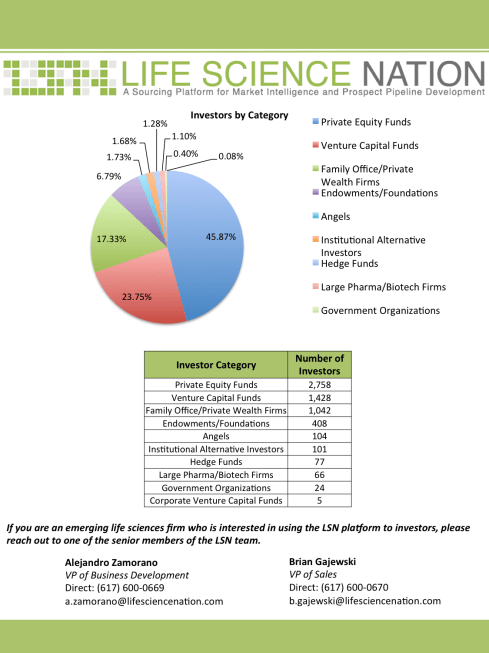
Intro to Life Science Nation – Investor Database

5 Dec

Idata2Idata

Image

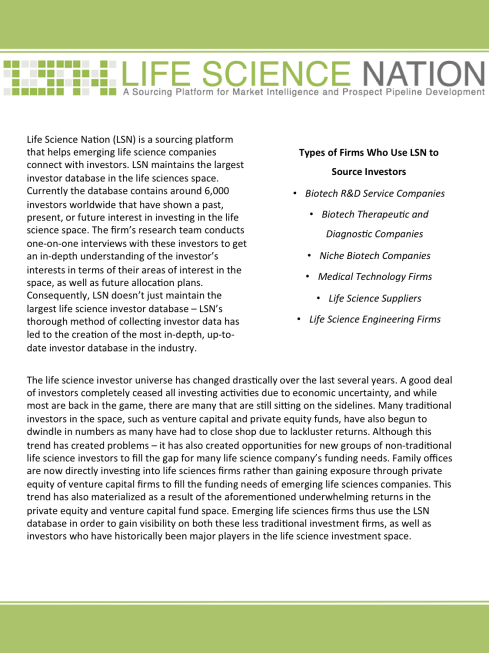
Introduction to Life Science Nation – Database Metrics

4 Dec

InvestorsInvestors2