Archive | March, 2015

Calling All Innovators! RESI Innovation Challenge: Applications Now Open for RESI@TMCx on June 8, 2015

19 Mar

By Jack Fuller, Director of Business Development, LSN

Shaoyu Chang, MD, MPH,  Senior Research Analyst, LSN

JackShaoyu 10*10LSN and the Texas Medical Center Accelerator have partnered to bring the Redefining Early Stage Investments Conference (RESI) to the emerging life science hub of the American Southwest—Houston, TX—on June 8, 2015. We are proud to announce an open call for applications to the RESI Innovation Challenge. Presenting life science companies will have the chance to showcase their innovations to RESI’s audience at the Texas Medical Center’s new life science accelerator TMCx.

If you are a scientist-entrepreneur or fundraising CEO starting to accumulate compelling proof-of-concept animal data or early stage clinical data, the RESI Innovation Challenge is for you. The 30 most innovative applicants will be hand selected by Life Science Nation’s internal scientific review board to be part of the RESI Innovation Challenge, presenting their technologies in an exhibition-style format throughout the full-day conference. Presenters will gain additional exposure to investors and potential partners by showcasing their companies and products in a poster format. Unlike traditional 5- to 15-minute pitch presentations that do not allow any real interaction and provide no actionable feedback from investors, the RESI Innovation Challenge enables executives to pitch directly to attendees, generating more in-depth conversations with more investors, more frequently throughout the event.

RESI Innovation Challenge winners are determined by vote of all attendees of the conference. Each attendee receives “RESI Cash” tokens to “invest” in the presenting companies with the most exciting technologies. The company that receives the most investor dollars by the end of the conference is crowned the winner. Previous RESI Innovation Challenge first-prize winners include Empiriko (Newton, MA), ORIG3N (Boston, MA), and Kineta (Seattle, WA).

Houston has emerged as a robust life science hub and gateway to Latin America, and Texas Medical Center is spearheading life science innovation in the region. If you are raising capital in biotech, medical devices, diagnostics, or health IT, you can gain investor exposure by putting your groundbreaking technology under the spotlight at RESI@TMCx.


Call-for-Innovation

RESI @ TMCx Medtech Angels Panel Announcement

19 Mar

By Michael Quigley, Director of Research, LSN

mike-2

Angels represent an extremely important pool of capital for a fundraising entrepreneur, especially since they have been increasingly syndicating and participating in larger financing rounds. To help entrepreneurs with a medical device or technology better understand how to receive an allocation from an angel, LSN has assembled a panel of angel investors with specific interested in medical technology.

Moderated by Richard Koffler, Member, Tech Coast Angels, the audience will hear from:

This session will help scientist entrepreneurs understand the perspective of an angel. Angels will explain their investment preferences, and those of their respective syndicates. What types of deals are most attractive to angels? How does an angel group filter, evaluate and parse the plethora of deals that surface? What do angels look for in the initial correspondence?

Other topics of discussion will include their criteria for management team, stage of technology, and whether there is a preference for regional or global firms. What is the difference in presenting to an angel group versus a traditional one-on-one investor meeting — and how does the vetting process work? If you’re looking for angel capital to move your technology forward, don’t miss this session of expert insight at RESI.

QQ图片20150318172405

The Shape of A Biotech Pipeline

19 Mar

By Lucy Parkinson, Senior Research Manager, LSN

lucy 10*10In our recent explorations of the life science innovation landscape in various areas of the U.S., we’ve looked at how different regions shape up in terms of pipeline assets, key indication areas, and the kind of investors active in each region. One metric in which we saw substantial distinctions is where assets fall in the pipeline. Not every area with an abundance of preclinical assets also has a large amount of Phase III assets that may become marketed products in the near future.

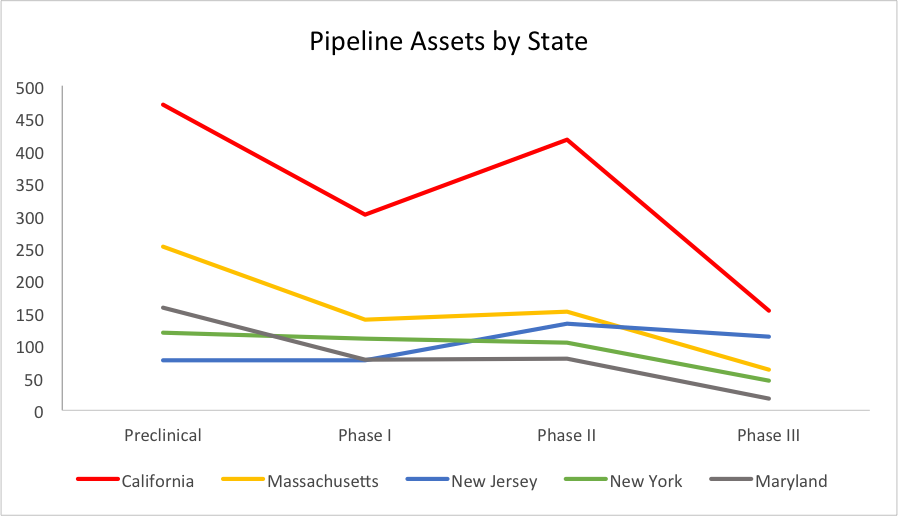
The LSN Company Platform tracks over 30,000 life science companies globally.  From this data, we took a sample of the asset distribution in five states with substantial biotech pipelines: California, Massachusetts, New York, New Jersey, and Maryland (see Figure 1). This data reveals patterns that challenge key assumptions about what a regional biotech pipeline looks like.

f1

Figure 1 | Source: LSN Company Platform, Data as of March 18, 2015

It’s natural to assume that a state that generates many preclinical assets, perhaps from a base of universities and research hospitals, will see these assets gradually winnowed through the trial process, with a certain proportion failing to progress at each stage of development. What we find is somewhat different, with diverse pathways occurring across the range of biotech hubs. In California, Massachusetts, and Maryland, we see a major drop-off after the preclinical stage of development, perhaps due to assets failing in animal trials. We don’t see this in New York and New Jersey; these states have fewer preclinical assets than the other states sampled, but healthy late stage pipelines. It’s been noted that the New York area may be a difficult place to found a biotech start-up due to factors such as high expenses and a lack of lab space in the region. However, a more established biotech company that has developed or in-licensed clinical-stage assets might have gathered the resources to thrive in this area.

The states sampled all show either a similar number of Phase I and Phase II assets, or a markedly greater number of Phase II assets. Of course, many assets undergo combined Phase I/II trials (particularly in the cancer field, which is the largest area of life science innovation in the U.S.), testing both toxicity and efficacy in their first-in-human trials. We mark these assets as being in Phase II. California, Massachusetts, and New Jersey all show an uptick in Phase II. Many small companies look for a larger partner at the Phase II stage, and these three states are all host to large pharma companies.

Another way to consider the pipeline is to ask how many preclinical, Phase I, and Phase II assets there are in each state for every asset that reaches Phase III. While in New Jersey (as previously observed) we track more Phase III assets than early stage assets, the state is a true outlier in this regard. Massachusetts, with its deep bench of early stage biotech companies, has over four preclinical assets for every asset that reaches Phase III. Maryland has a very steep pipeline funnel, with almost nine preclinical assets for every Phase III asset.

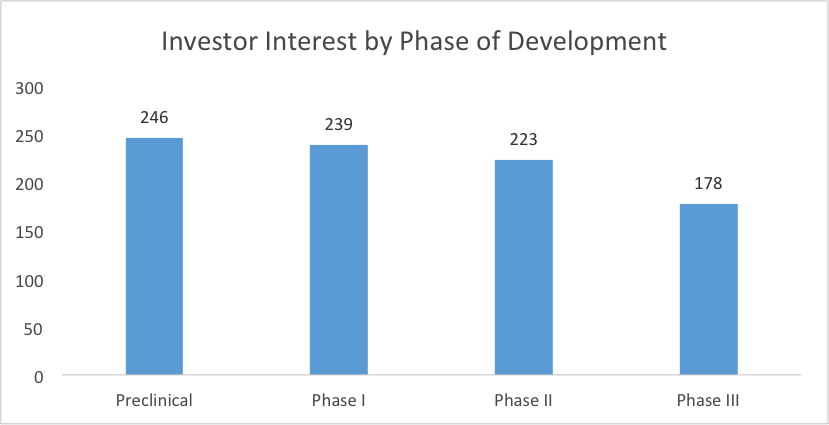
From a look into the LSN Investor Platform, we find that investors are interested in companies at every stage of the pipeline. The following figure (Figure 2) shows investors interviewed by LSN who have stated an interest in therapeutics under development in the U.S.:

f2

Figure 2 | Source: LSN Investor Platform, Data as of March 18, 2015

America’s many life science hubs have strikingly different profiles, and emerging regions without a large pharma presence might nevertheless sustain a thriving early stage biotech landscape. Early stage companies must work hard to find the investments that will keep their assets moving toward the marketplace. It’s notable that only two-thirds of investors interested in U.S. biotech companies are based within the country; the search for capital might extend globally, far from the local biotech hub where an asset began.

Hot Life Science Investor Mandate 1: Family Office Seeking Devices and Diagnostics

19 Mar

A family office with offices in the Northeast and Midwestern United Sates invests its principal capital into high growth companies, both privately held and publicly listed. The firm’s investment size is highly variable and dependent on the financial needs of the company. The firm often leads investment rounds and also has the ability to leverage its additional network of high-net-worth families and like-minded co investors to syndicate for larger deals as well as follow on investments.  The firm looks to invest in companies throughout the United States and has no set number of investments in plans to make, however they are actively reviewing new opportunities.

Within healthcare, the firm is most interested in companies developing Devices and Diagnostics. The firm is looking for companies devices that solve a significant medical problem with strong IP supporting it. The firm is willing to invest in companies from the prototype stage to those that already have their products on the market and is generally agnostic in terms of indication. Historically the firm has invested in companies working with cardiac devices and also has held special interest in the pediatrics space. The firm is generally not as interested in consumer facing devices. The firm is also willing to consider investments in the Therapeutics space though this area is less of a focus.

The firm is looking for companies that have experienced management teams and a strong board behind them. The firm is willing to invest in both privately and publicly held companies with a special interest in making PIPE investments. The firm looks to take a board seat into companies on a case-by-case basis.

If you are interested in more information about this investor and other investors tracked by LSN, please email mandates@lifesciencenation.com

Hot Life Science Investor Mandate 2: CVC Arm of Hi-Tech Company Seeking Connected Device Opportunities

19 Mar

The corporate venture arm of a hi-tech company currently manages a total of $850 million in assets, and is looking to make equity investments ranging from $2-$5 million with the ability to allocate up to $10 million generally in series A-C rounds. The majority of the fund’s investment has been throughout the United States though the fund has invested and is willing to invest internationally as well. The fund is actively reviewing new opportunities and can make 3-4 investments over the next year.

The fund is currently interested in sectors of Medical Devices, Diagnostics and Healthcare IT that increase connectivity in the healthcare ecosystem. The fund is particularly interest in verticals of Health and Wellness, Chronic Disease Care, Aging in Place, Telemedicine, Genomics, Patient Monitoring, Clinical Trails Management, Mobile Software Healthcare IT Applications, and Electronic Medical Records Management. The fund is willing to invest in devices with 510k pathways; however the fund is not currently considering highly invasive medical devices.

The fund is looking for privately held companies with experienced management teams. The fund generally looks to take a board or observer seat following investment and is willing to both lead and co-invest.

If you are interested in more information about this investor and other investors tracked by LSN, please email mandates@lifesciencenation.com

Hot Life Science Investor Mandate 3: Spanish VC Firm Seeking Therapeutics, Diagnostics and Medical Devices Throughout EU and US

19 Mar

A Spanish independent venture capital firm is currently providing private equity financing to early- and mid-stage human healthcare and life science companies. The firm has € 118 million in assets under management distributed over two funds. The second fund has a target size of € 100 million and will remain open to new investors until September 2015. The firm can allocate up to €7M (in equity) per company, generally co-investing with other specialized investors. The firm looks for companies that are based in Europe and the US.

The firm targets the entire healthcare and biotechnology industry, with a special focus on pharmaceuticals, diagnostics and medical devices. The firm is opportunistic in terms of indications and seeks products that have an attractive market potential. In case of niche/orphan indications, the potential market share should be significant and realistic. For therapeutics, the firm invests in small molecules, biologics and advanced therapies. At minimum, the product should have a solid animal data. For medical devices, the firm is also opportunistic and looks for devices that have a working prototype.

The firm looks for a cohesive management team with a proven track record, including relevant business experience and top-notch scientific know-how. The firm requires a board seat in each portfolio company.

If you are interested in more information about this investor and other investors tracked by LSN, please email mandates@lifesciencenation.com

Hot Life Science Investor Mandate 4: US Based Hedge Fund Seeking Range of Therapeutics Opportunities Globally

19 Mar

A biotechnology-focused equity hedge fund based in Western US is looking to invest in therapeutics space. The investment size can vary greatly and the fund is very flexible depending on each company’s needs. The fund is geographically agnostic and looks to invest globally.

The firm is highly interested in biotech therapeutics. The fund is extremely opportunistic in terms of subsectors and indications and will consider companies at all stages of development. The fund recently invested in a European-based company developing small molecule therapeutics for CNS diseases and a US-based company developing therapeutics for oncology.

The firm seeks a company with a strong and experienced management team or technical experts in the relevant technology. The fund will require either a board seat or observer status.

If you are interested in more information about this investor and other investors tracked by LSN, please email mandates@lifesciencenation.com