Archive | Redefining Every Stage Investments (RESI) RSS feed for this section

RESI@TMCx: Agenda Announced

11 Feb

By Nono Hu, Director of Marketing, LSN

RESI is returning to TMCx on April 11th, and LSN has scheduled two all-day tracks of panel sessions that illuminate every corner of the life science investment landscape. Panels will feature senior, experienced investors from a diversity of investor types – including family offices, VCs, angel syndicates, major global pharma and medical device firms, and more. These investors will explore new investment trends in their sectors, and will share their knowledge and insights with RESI’s audience of entrepreneurs. If you’d like to join us at RESI@TMCx to hear the latest on life science financing and book one-on-one meetings with investors, you can register here.

Strategic LPs: A New Approach In Corporate Health Innovation

11 Feb

By Lucy Parkinson, Director of Research, LSN

Many major corporations seek to be involved in new health innovations—not just pharma and healthcare players, but also large firms in other industries such as tech and telecoms. Traditionally, the role of large corporations in the healthcare innovation economy has been primarily to act as M&A players as well as development and distribution partners. Many corporations also have corporate VC arms that can engage with companies at an early stage, before M&A would typically occur.

Corporations also make financial investments, and LSN Research has increasingly heard that corporations are seeking to put those financial investments to a strategic purpose. Corporations that are limited partners (LP) in a private equity or venture capital fund are seeing a strategic opportunity in these investments.

It’s nothing new for a corporation to invest a portion of their capital in a PE or VC fund. However, in the past this was generally seen as a matter of achieving ROI. Recently LSN has spoken with several venture capital firms that are now specifically focused on working strategically with corporate LPs. These include both new firms formed to act on this strategy and also established firms that have recently raised a new fund solely from corporate investors. The VC then focuses on opportunities that are strategically relevant to the corporate LP; in some cases, the LP may be involved in the due diligence process, or may offer a potential post-investment relationship with companies that could benefit from the corporation’s particular niche expertise in development and manufacturing. The VC stake can act as a bridge between the corporation and the early stage portfolio companies, giving the corporation exposure to new technologies in its field of interest.
So what’s the benefit of this strategy to the large corporations?

  • Efficiency and flexibility. Building a strategic corporate VC arm is a difficult task. Acting as a strategic LP in a fund may be much easier for some firms.
  • Diversification. A corporation might invest in several different funds in order to reach geographically diverse research hubs or to access different industry sectors. For example, a corporation based in Asia might seek a stake in a fund that will look for investable biotech startups in the USA, or vice versa.
  • Finally, it’s possible that as a fund LP, the corporation can keep its healthcare strategy and investment activities somewhat shielded from public view.

Due to these factors, major corporations are increasingly using their LP stakes as a supplement to their innovation sourcing activities. It’s now one of many ways for a corporation to build connections with healthcare innovators at an early stage and to look for potential future partnership or M&A targets. On the other side of the coin, many VC firms are eager to build close strategic ties with a corporate LP in order to achieve exits from their portfolio.

Big Pharma Investing In Early Stage Assets

11 Feb

By Shaoyu Chang, MD, MPH,  Senior Research Manager, LSN

Shaoyu 10*10

Biopharma deal-making value hit a record high in 2015. Where do things go from here? What emerging technologies are big pharma companies now excited about? At the opening of 2016, big pharma executives gathered at RESI San Francisco to shed some light on these questions.

Moderated by Kevin Lynch, Vice President of Scientific Assessment at Abbvie, panelists include:

  • Jason Coloma, Vice President and Global Head Roche Partnering Oncology, Roche Partnering
  • Lesley Stolz, Senior Director of Transaction, Johnson & Johnson Innovation
  • Marc Schwabish, US Head, Pharma Business Development & Licensing, Bayer
  • Tomas Landh, Vice President, Senior Principal Scientist Innovation Sourcing, Novo Nordisk

Big Pharma Continues to Seek External Innovations

With emerging fronts such as gene editing, immunotherapy, and digital health, the evolution of healthcare technology is faster than one can keep up with. Big pharma companies are closely observing the trend and seeking innovations to fill the gaps in their pipeline. For example, a team at Roche Partnering has mapped out and gone through every single one of the 450 cancer immunotherapy biotech companies in the Bay area to find potential partners. The panelists expect this trend to continue through 2016.

Early Collaborative Models Become Mainstream

As big pharma companies are heading earlier into phase 1 and preclinical, they are getting onboard with the idea of utilizing their resources to help early stage teams answer key questions without many strings attached. Creative models of collaboration are employed. Johnson & Johnson has set up Innovation Centers around the world as a centralized channel to source innovations. Bayer’s Co-Laborator research incubator is another good example to share resources and foster collaborative relationship with early stage teams.

Understanding the Process

When engaging with big pharma partners, one of the the most significant pieces of advice from the panelists is to understand their internal process. “The least productive way is to contact our chairman,” said Tomas from Novo Nordisk. In many big pharma companies, the business development or partnering team acts as the first point of contact and will refer you to the right person.
While many big pharma companies are trying to encourage transparency, a clear understanding of the review process, key checkpoints and key decision makers will help you go a long way. For example, a good confidential disclosure agreement (CDA) will facilitate due diligence process while preventing intellectual property pollution, and a material transfer agreement (MTA) can allow big pharma to replicate key data. On the other hand, several startups request a non-binding term sheet, which frequently add un-necessary challenge as it requires sign-off from senior management.

Best Practice in Reaching Out to Big Pharma

  • Do your homework. Do not pitch big pharma partners with the same pitch for VCs. Focus on how you differentiate and fit in to big pharma’s pipeline. Contact big pharma’s partnering team to get advice before you pitch. Ask them, what are you looking for? How should I pitch? How can I make a good impression on you? They are there to help you.
  • Many big pharma companies are now sharing notes and communications internally using databases. Sometimes, a company opens discussions with different groups within the same organization about different projects; it does not bring additional value to “shop” around different persons.

Understand big pharma’s approval process. Who are the key decision makers? What do they like to see in terms of validation and milestones? Take the necessary steps to protect your IP while nurturing a long-term, collaborative relationship. This panel video will give you useful tips; here are a few additional things to consider in building big pharma partnerships.

Fundraising Best Practices at the Freemind Group’s Non-Dilutive Funding Summit

4 Feb

By Dennis Ford, Founder & CEO, LSN

dennis-websit

I recently presented on Fundraising Best Practices at the FreeMind Group’s 11th annual Non-Dilutive Funding Summit in San Francisco, to an audience comprised of scientist-entrepreneurs and fundraising CEOs. The Fundraising Best Practices session helped create context and understanding for these entrepreneurs around issues related to branding and messaging of their firms. The presentation also explains why organizing a global target list of investors that are a fit for your sector and stage is vital to an efficient fundraising process. Last but not least, I discussed and debunked some of the myths around fundraising, what works, and what doesn’t work.

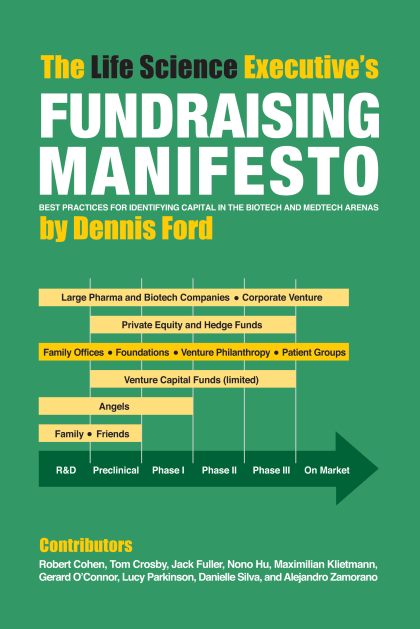
Many of the concepts covered in the presentation are expanded upon in LSN’s book, The Life Science Executive’s Fundraising Manifesto.


Venture Philanthropy Investors Share Their Insights

4 Feb

By Christine A. Wu, Research Analyst, LSN

chrsitine

At RESI San Francisco, a panel of Venture Philanthropy investors engaged in a stimulating conversation addressing patient access for underserved populations, assessment of “positively impactful” technologies, and their relationships with traditional venture capital investors, among many other topics.

Moderated by Christopher de Souza of Broadview Ventures, panelists include:

Patient Access for Underserved Populations

The panel addressed patient access, particularly regarding support for underserved populations who may not have health insurance coverage or access to intervention. Dan Smith said that Autism Speaks takes a deep dive into the reimbursement pathway to make sure interventions are available to those who otherwise wouldn’t be able to afford the technology. Autism Speaks also requires that, once a product is on the market, a certain percentage of the previous years’ sales would be dedicated towards matching giveaways or cost reductions for a specific population.

Both Foundation Fighting Blindness and The Michael J. Fox Foundation (MJFF) provide education for payers. MJFF holds seminars to educate communities on unmet needs in symptomatic Parkinson’s Disease (PD), and where the disease-modifying research is today. Rachel Rimsky added that MJFF also performs big data analyses with communities in the regulatory and payer sides for them to fully understand the unmet need and how to best approach provision and reimbursement.

Weighing “Positively Impactful” Technology

While life science-focused foundations tend to be indication-focused, Breakout Labs and Broadview both have broader venture philanthropy mandates as LP-backed investment firms. Lindy Fishburne and Chris De Souza defined “positively impactful” opportunities to deliver a breakthrough technology to market. “We’re not going to engage in opportunities where you’ve taken an existing technology and turned the widgets around differently,” Fishburne explained. “We’re looking for brand new, breakthrough technology with a new way of looking at a problem, like two sequences coming together for the first time.”

Typical questions Fishburne asks include: “is this a scientific breakthrough? If it were to work, would it matter and is it not just incremental? Is this a team with a structure set up to enter the market and have a shot in becoming successful?”

De Souza agreed, “It’s a matter of looking at the revolutionary, not the evolutionary.”

Relationships with Traditional Ventures

Panelists discussed their relationships with traditional VCs, varying from due diligence collaboration to referring companies to investors for follow-on funding. Zilliox added that while VC due-diligence partnerships are helpful for creating a new company, the exit strategy is more difficult to agree on because the mission and motivation are not always in agreement.

As Breakout Labs invests early, the firm considers the traditional venture world during seed funding as an important part of their model. Fishburne explained that much time is spent on understanding and building the venture investor network in order to introduce their companies to them at the appropriate times to forward relationships. 

Biggest Challenges for Venture Philanthropy Investors

On the scientific research side, Rimsky said that the biomarker field is currently the Fox Foundation’s biggest challenge. Smith acknowledged that addressing the diversity of the autism population and their needs is their greatest difficulty, since autism-related conditions vary among individuals.

On the business side, Zilliox said her biggest challenge is working with companies with no knowledge of the path towards commercialization – “that is my biggest nightmare.” Fishburne further pointed out that there is a delicate balance in finding the right people to lead companies: “Unfortunately there are some scientists that should just be scientists.”

Helping portfolio companies to raise follow-on money from the bigger players is another challenge. Fishburne explained that there’s a lot of incentive to step back and say “I’d like to see more” and the endpoint they’re racing towards keeps moving backwards.

The final challenge is maintaining the attraction of their focus area of research. Managing expectations and keeping the community engaged even when discussing long-term projects has been difficult given the longer research timeline for such breakthrough discoveries.

Final Remarks

  1. “Foundations have a lot of deep expertise on the table that’s overlooked at times,” Smith said, “The mission focus can especially bring you more forward than you realize.”
  2. Venture Philanthropy investors are more open to high-risk, interesting projects
  3. Foundations have a huge access to expertise and are always open to conversations to think through different approaches.
  4. Particularly for these panelists, venture philanthropy investors are always on the look-out for new opportunities, especially for follow-on funders to advance early stage companies.
  5. For platform technologies, in order to approach indication-focused firms, you must have data where you’ve made a real claim for that specific indication. “It’s not for you to come in to us with a platform technology, but as an application of the platform that meets our mission,” De Souza pointed out.

Greater China Investors Optimistic about Healthcare Investment

4 Feb

By Shaoyu Chang, MD, MPH,  Senior Research Manager, LSN

Shaoyu 10*10This year’s JPM saw more than 1000 attendees from China. As the world’s second largest healthcare market continues to grow at a steady pace, Greater China-based investors have shown an expanding appetite for biomedical deals. Despite regional differences, we have observed a few common, interesting trends based on our interaction with investors from China, Hong Kong, and Taiwan.

New Players Enter the Arena

Against the backdrop of the recent market turmoil, Chinese regulators are laying the groundwork to attract capital for small innovative businesses, such as the Strategic Emerging Board to be launched in the second half of 2016. Investors are optimistic. Traditional healthcare VCs based in China have successfully raised new funds. The space is now crowded with new investors from other industries, ranging from information technology and manufacturing to textile and real estate. They all want to seize the opportunity of long-term growth in healthcare.

Increased Cross-border Activities

While biomedical innovation in Greater China has shown great momentum in recent years, partially fueled by the quantity and quality of foreign-trained returnees, many investors see Greater China as catching up in this game. ‘No research, development only’ has become a popular business model for many startups from this region. In addition, the generous supply of capital creates a fear of overvaluation of Chinese businesses. In search of good quality, fairly priced deals, an increasing number of Greater China investors are setting their eyes on technologies emerging from US and Europe.

China Angle Is a Big Deal

Regional collaborations between Japan, Korea, China, Taiwan, Singapore, and Australia are common. However, US-China or Europe-China deals remain challenging in multiple aspects from deal sourcing to due diligence to post-investment management. Some of the most active investors do not care where the investee is based because they are constantly on the fly. The majority of them, however, would like to see a ‘China angle’ so that they can leverage their local resources. A typical example may be a Chinese-led business in Europe or North America looking to expand to Beijing or Shanghai. In other cases, a US or EU-based company may build a relationship through a manufacturing site, joint R&D agreement, or distribution partnership.

Investors Test New Sourcing Methods

Traditional Greater China investors rely on their personal network for deal-sourcing. When it comes to cross-border deals, they tend to co-invest in rounds with presence of a strong local lead, typically one or several renowned VC funds. In recently years, creative investors are testing bolder approaches from sending scouts to setting up offshore funds to creating incubators in major biotech hubs. The idea is that the closer you can get to the source of innovation, the better chance you will spot a technology that no other investor has spotted before.

Mismatch between Health Innovation and Traditional VC Model

With a few exceptions, the majority of Greater China healthcare funds we spoke to operate on a traditional VC model within a 7-10 year horizon. Angel investments are few and scattered. This might be due to the fact that many investors enter the space without full appreciation of the biomedical R&D and life cycle management. The typical exit for early stage investments is primarily in the public market, while M&A is seldom the option, if ever. The VC-collaborative startup formation model that has gained traction in the US is essentially nonexistent in Greater China. The inflexibility in investment models can potentially clash with the long and risky development timeline of healthcare technologies.
Conclusion

Greater China investors are cautiously optimistic about healthcare venture investment domestically and globally. Many of them believe the recent market downturn is only a temporary correction or even a sign of market maturation. If you were a life science startup in Greater China and not blessed by one of the few wealthy angels, you might face years of painful bootstrapping. A roadmap to access early stage capital globally will be critical. For US- and EU-based startup entrepreneurs, it is essential to proactively develop a strategy for engaging Greater China investors at an early stage of your business. As an increasing number of investors are testing innovative approaches to collaborating and investing, we expect to see more creative deals in the future.

Fundraising Season 2016: Making the Most of January – June

28 Jan

By Dennis Ford, Founder & CEO, LSN

dennis-websit

Let the Fundraising Begin! It’s January 2016 . . . Oops . . . We are almost into February! Where did January go? JPM preparation, JPM attendance, JPM recuperation (from the flu or cough or whatever that was), and then JPM follow-up. The swathe of time ahead from February to June is very important to a scientist-entrepreneur or a life science fundraising CEO, and you should be contemplating making hay while the sun is shining.

I know from firsthand observation that the game is afoot. RESI@JPM had over 900 investor meetings in just one day. 350 investors met with over 400 early stage life science entrepreneurs. Based on my back-of-the-napkin estimate, these entrepreneurs were seeking a total of several billions of dollars in development capital—and the investors in attendance have, in total, billions of dollars ready to allocate. The question therefore is: how do you get into the fray?

The first point you have to understand is that fundraising isn’t something you kinda sorta do on the side. It’s a full-time commitment that needs focus and attention and an organized, budgeted campaign.

LSN is now entering our 4th year in the life science arena, and we have supported hundreds of entrepreneurs in using the LSN Investor Platform to prepare to get on the road and raise money. We’ve also met another thousand or so who’ve attended LSN’s RESI Conference events over the last three years. Our consistent advice to entrepreneurs has been to decide honestly if you are committed to raising capital. If so, the next step is to assess your team. Do you have the science maven, the experienced business development person, and a resource available to make the initial phone calls and set up the meetings and follow-up meetings? This is where many campaigns fail: not getting the team straight.
The other key preparation point is to get the right campaign resources together. You need to make sure you have a list of global early stage investor targets that are a fit for your indication and stage. To get the attention of these investors successfully, you must have cogent messaging and a compelling web presence that allows interested parties to net out your value proposition and clearly see where you are in the developmental process.

As a life science entrepreneur, you are up against many competitors for capital, and if you are not up to date with new developments in the life science investment world, then you may be out of step and inefficient in your efforts. At LSN we have seen an unprecedented worldwide investor interest in all facets of early stage life science. It’s real and it’s happening now. It’s a global playing field, and you have to get in front of as many investors as possible that are a fit for your company. Staying regional or focusing on just one category of investor is extremely limiting. Take the time to learn the investor categories that are a fit for you; don’t build barriers, build bridges to success.