Archive | Redefining Every Stage Investments (RESI) RSS feed for this section

CRO Trends in 2015

29 Jan

By Alejandro Zamorano, VP of Business Development, LSN

Alejandro 10*10

LSN maintains regular dialogue with a broad spectrum of contract research organizations (CROs) – from top-tier full service organizations, to small niche-specialized research companies; some are customers of the LSN Company Platform, and others are friends.  Every year we talk to hundreds of business executives in the field. Based on our market insight, here are the top trends we see in 2015.

The Monetization of Data

CROs are beginning to realize the power of their clinical data after years of ignoring this information. Some established CROs are even monetizing their data set by anonymizing the data, providing incredible insight to researchers.  This should also help companies on deciding when a trial should be killed, and whether a drug is a worth pursuing when a sub-population seems to respond the treatment. In an ideal world all clinical data should be standardized for analysis, but this is a great first step.

The Death of the Undifferentiated CRO

The CRO industry has exploded over the past 5 years, and competition is fierce. By searching the LSN Company Platform, one can find profiles of 859 clinical trial providers globally. Standing out amongst the vast herd is becoming harder, and most are competing on location, speed and increasingly price. In order to stay competitive sales teams have started to target biotech companies as early as the discovery stage, in order to form a relationship before others come knocking on the door.

To differentiate themselves CROs are developing and in-licensing unique technology platforms such as unique analytics, manufacturing capabilities, animal models, and biologic expression technologies. In 2015, don’t be surprised if CROs start competing with big pharma for access to these unique technology platforms.

The Search for Patients

Finding patients is often the hardest part in putting together a clinical trial, especially if the trial is in a rare disease field. Today CROs are looking to partner with diagnostic companies to identify specific patient populations for future studies. This close collaboration between diagnostic companies and CROs will change the manner in which the industry conducts its business, and will reap huge benefit to patients looking for access new therapeutics.

Exclusive Agreements with Big Pharma

The majority of R&D expenditure is consumed by big pharma and some CROs are tired of competing with others for a slice of the pie. Thus, larger CROs that have the necessary capacity have started to offer their biggest customers massive benefits to form exclusive partnerships. These include reduced pricing, full time core employees, standardized reporting and analytics, increased transparency, and reserved excess capacity in order to provide services on short notice.  The industry is getting more competitive and exclusive structures is just one of the many ways CRO’s are adapting to this environment.

2015 will be an interesting year for CROs, as the increasing competitive nature of the industry will allow only the strongest, most adaptable companies to enjoy market growth. LSN will continue to track the key market dynamics affecting service providers going forward.

[Video] 5 Major Investors Discuss Clinical Phase I & Phase II Investing

29 Jan

By Nono Hu, Senior Manager, Branding & Messaging, LSN

Nono 2At the fourth Redefining Early Stage Investments (RESI) Conference, LSN put together 16 biotech and medtech investor panels, in which we are featuring five major investors actively investing in and working with therapeutic companies in phase I and phase II of clinical trials. If you have entered into clinical trials (or are preparing to), the panel can help you to understand the keys to positioning your opportunity at this stage and how best to approach investors in the initial outreach. The panelists answered a variety of questions, including: What types of things do you look for in an investment opportunity? Do you prefer companies with a platform approach or those focused on single assets? What do you think of build-to-buy partnerships with big pharma? What company profile is appropriate for venture funding? How do you manage an investment for success? What is the best way to approach you?

Moderator:

Neil Littman, Business Development Officer of the California Institute for Regenerative Medicine

Panelists:

Daniel O’Mahony, Partner, Seroba Kernel Life Sciences

Lisa Rhoads, Managing Director, Easton Capital

Mike Dybbs, Principal, New Leaf Venture Partners

Sam Hall, Principal, Apple Tree Partners

RESI 4 San Francisco: Compelling Connections Created, Dialogues Begun, the Game’s Afoot

22 Jan

By Dennis Ford, Founder & CEO, LSN

Dennis bookLast week, LSN moved its Redefining Early Stage Investment (RESI) Conference series from Boston to San Francisco to partake in the annual migratory life science industry gathering. I am happy to report that RESI 4 was a success.  Attendees included over 200 early stage investors, 200 early stage biotech and medtech entrepreneurs and 100 service providers participating in early stage funding panels, partnering and workshops.  Forbes made mention of RESI in their coverage of the JPM Healthcare event. 

Partnering-Forum

Partnering Forum at RESI 4

The big news is not the size of RESI, but the two compelling constituencies that attended and helped to create such a unique and dynamic event.  The first constituency consists of the 10 categories of global investors attending including angel groups, corporate venture capital, foundations, family office and private wealth funds, government organizations, hedge funds, institutional alternative investors, large pharma and medtech companies, private equity firms and venture capital funds.  The second constituency, the scientist-entrepreneurs from the biotech and medtech arena, are all actively fundraising and therefore want to be as efficient as possible with their efforts. These fundraising CEOs not only need to meet with investors that are a fit for their stage and sector, but also understand the current investor landscape and how best to navigate within it.  Take a look at the program guide and you will understand why RESI is a success and why we are garnering the attention of the industry.

RESI is the only conference that is totally dedicated to mapping out and interacting with the early stage life science investment domain. LSN started RESI because we had determined that there was a need specifically for early stage investment focus.  The life science universe is vast and most conferences do a good job at broad industry coverage but RESI wanted to be micro focused.  The glut of government funded companies with great data and the wealth of academic and pharma scientists spinning up their own firms called for a place for all to gather on a regular basis.

We hope to add a few more venues to augment the Fall Boston RESI conference and the January JPM event, so stay tuned.


RESI 4 Is Approaching – Check Out the Program Guide

8 Jan

By Nono Hu, Senior Manager, Branding & Messaging, LSN

Nono 2The Team at LSN is pleased to announce that for our first RESI Conference on the West Coast we will be bringing together over 500 investors, scientist-entrepreneurs, and strategic partners from around the world for a full day of partnering, panels and workshops.

RESI 4 provides a venue for all early stage scientist-entrepreneurs to connect with early stage investors. RESI’s goal is to facilitate dialogues that open compelling relationships between entrepreneurs and investors.  These relationships lead to capital allocations which will move science along. In partnership with AdvaMed, the sponsor of RESI’s medtech investor panel track, RESI strengthens its reach into the world of medtech startups and investors. In addition to the new Medtech panel track, RESI 4 will also have a Biotech panel track, hands-on workshops, the RESI Innovation Challenge, and the RESI Partnering Forum.

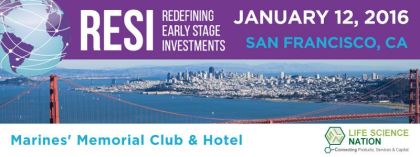
We’re excited to add so much new content to RESI 4. Check out the RESI Program Guide to learn more! We hope to see you at the Marines’ Memorial Club & Hotel in San Francisco on January 13, 2015.

wpresi-4-program-guide-digital-final

5 RESI Panels Featuring 26 Investors from Major Players in the Industry

8 Jan

By Tom Crosby, RESI Conference Manager, LSN

Tom 2

With the first West Coast RESI right around the corner, we’re pleased to announce the remaining five investor panels: Corporate Venture Capital, Emerging Market Investors, Medical Device Strategics, Orphan & Rare Disease Investors, and Clinical Phase I & Phase II. LSN is thrilled both with the world-class speakers and the content that they will be delivering to a record RESI audience of 500+ on January 13th. If you have yet to take a look at the first West Coast RESI’s panels, they’re now all available online. We hope that you’ll be taking in some of this fantastic content along with us next week — if not, look for the recap videos shortly following the conference, and we’ll see you at the next RESI!

Corporate Venture Capital

Corporate Venture Capital (CVC) and Independent Venture Capital are two separate beasts – with different tactics and motivations – and as a fundraising entrepreneur, they should be looked at as such. Learn from the experts in Corporate Venture Capital as to why the life science industry is currently seeing a push for external innovation. As CVC funds continue to grow in size and numbers, it is increasingly important for entrepreneurs to understand these entities as a critical source of potential investment.

The RESI Conference session will feature representatives from some major players in the industry. This is a must attend, one-of-a-kind panel that will provide tremendous insight for the scientist entrepreneur.

Moderated by Graeme Martin, President & CEO of Takeda Ventures the audience will hear from:

Priyanka Rohatgi, Director, Baxter Ventures

Tetsuro Iwata, Senior Manager, MP Healthcare Venture Management

Barbara Dalton, Vice President, Pfizer Venture Investments

Jason Hafler, Director of Investments, Sanofi-Genzyme BioVentures

Sofie Qiao, Managing Director, WuXi Venture Fund

Panelists will answer questions regarding the strategic and financial motivations that drive their investment thesis and how they differ from independent venture capital. The session will also focus on the individual investment preferences of each representative on the panel. What does their portfolio look like today? What is the best way for early stage entrepreneurs to get on their radar screens? All this and more will be answered on Jan. 13th.

Emerging Market Investors

With the growth of emerging markets creating wealth for their inhabitants, many of these countries, including China, Russia and India are looking to put that capital to work into globally-based investments in the life science field. These regions also represent massive and growing markets for many technologies that are approved or in development in other places in the world. This panel aims to shed light not only on how to go about reaching out and forming relationships with investors from these regions, but will also offer insight into how to bring an emerging market angle into your commercialization, distribution, and manufacturing strategy.

Moderated by Pushpa Vijayaraghavan, Vice President of Sathguru the audience will hear from:

Anton Gopka, CEO, General Partner, ATEM Capital

Jean Yao, Managing Partner, Med Qiao Group

Judith Li, Principal, Lilly Asia Ventures

Haolin Sung, Director of Direct Investment, Diamond BioFund

Panelists will discuss what the investment landscape looks like within in their geographic regions and networks. How do you start a dialogue with an emerging market investor? How do cultural barriers affect the process? What types and stages of opportunities are these firms most interested in? What is the best way to position an opportunity to them? These questions and more will be covered on January 13th.

Medical Device Strategics

Large medical device manufacturers and distributors – like their large pharma cousins – have increasingly been looking externally for sources of innovation.  To help RESI attendees better understand what these giants are looking for, and how to go about getting a technology in front of them, LSN has assembled a panel of 5 top-tier strategic players in the medical device space.

Moderated by Paul Grand, the Managing Director of RCT Ventures the audience will hear from:

Albert Lauritano, Director, Strategic Technology Partnerships, Becton Dickinson

Conrad Wang, Senior Director, Corporate Development, Medtronic

Evan Norton, Divisional Vice President, Venture Investments, Abbott Ventures

Greg Fleming, Investment Director, ALIAD

As an entrepreneur in the medtech space, it is crucial to be able to grasp the motives and inner workings of these organizations to understand how a mutually beneficial strategic relationship is formed. This session will discuss the various technology areas, stages and geographies that these groups are currently interested in. How are they going about sourcing external innovation? What do they see for the future of the industry of the next 5 years? Come ask and hear from these top executives directly.

Orphan and Rare Disease Investors

In the United States, the orphan disease space has gained significant interest from the investment community – this is due to the expedited regulatory approval process, combined with the lack of current treatment options that address many of these uncommon conditions. RESI brings together veterans in the orphan disease space to compare and contrast the strategies and motivations of different investors in the field.

Moderated by Mark Day, Senior Director Corporate Development, at Alexion the audience will hear from:

Art Pappas, Partner, Chiesi Ventures

Chris Adams, Founder & CEO, Cydan

Debra Miller, Founder, CureDuchenne

Vinzenz Ploerer, President & CEO, Brace Pharmaceuticals

Panelists will introduce and cover the areas of the orphan disease field they are most involved with and interested in. What stage and level of data are they looking for prior to making an allocation? What is the best way to present an orphan opportunity to a potential investor? The session will outline how orphan disease opportunities are evaluated – and valued – differently than non-orphan technologies. What is their outlook for investment and scientific advancement for these niche diseases going forward?

Clinical Phase I & Phase II

For many investors, in-human data is strongly preferred – if not required – prior to investment. For this panel, LSN brought together a mix of 5 investors interested in making investments into technologies in the first phases of clinical trials, aiming to give the audience a window into how their firms operate and what they are looking for.

Moderated by Neil Littman, Business Development Officer of the California Institute for Regenerative Medicine, The audience will here from:

Daniel O’Mahony, Partner, Seroba Kernel Life Sciences

Lisa Rhoads, Managing Director, Easton Capital

Mike Dybbs, Principal, New Leaf Venture Partners

Sam Hall, Principal, Apple Tree Partners

If you have entered into clinical trials (or are preparing to), this session will help you to understand the keys to positioning your opportunity at this stage and how best to approach investors in the initial outreach. From safety to early efficacy data, learn what these investors value most in a potential investment — and what the red flags that turn them away may be.

Year-End Roundup: Investor Mandates

18 Dec

By Michael Quigley, Director of Research, LSN

mike-2

This year was by far LSN’s best for new and updated investor mandates. LSN curates information profiles on approximately 5000 global early stage investors. Thus far in 2014 we have been able to add an additional 650 new unique profiles gained through one on one interviews with life science investors.  These investors spanned 33 countries and all 10 investor categories. (See Figure 1.)


Mike Figure 1

Figure 1


As a result of LSN Research’s focus on early stage life science investors, the majority of the firms we spoke with in 2014 were making maximum allocations in a range of $5 million to $14.9 million. (See Figure 2.) However, it is also worth noting that many investors were seeking to make larger and smaller allocations. When seeking funding, understanding the potential investment size investors are looking to make in a given round is a huge factor regarding fit. You don’t want to waste your time chasing investors whose allocation size is way outside the range for your round.


Mike Figure 2

Figure 2


Also crucial to the determination of investor fit are the sectors that investors are looking for and that companies are working in. Consistent with our monthly mandate roundups, medical devices attracted the most interest during this year. (See Figure 3.) However, it is also worth noting that, and as we have discussed previously, 59% of the investors we have spoken with were open to investing in both medical devices as well as therapeutics and diagnostics. This overlap is a result of the many opportunistic investors who wish to cast a large net to ensure they get to see all the best possible opportunities in the life science ecosystem. Although oftentimes investors may not have domain mastery over your type of technology, they more than likely are well connected with people who do. These advisors work with investors to help them vet deal flow for scientific and commercial viability.


Mike Figure 3

Figure 3


Where your company is located is also a factor when determining investor fit. The U.S. garnered the majority of investment interest, followed by investors who were willing to invest globally. (See Figure 4.) Many investors now have multiple locations to help in securing deal flow from around the world, while others use their networks as well as LSN to gain access to deals beyond their backyard. We have noticed the globalization of the investment community for some time now; investors are increasingly realizing that location is not necessarily a proxy for commercially viable scientific innovation.


Mike Figure 4

Figure 4


Investors tend to be less opportunistic regarding the development stage of the product. Investors in both the therapeutic and diagnostic space as well as the medical-device sphere have had the highest level of combined interests in products with some clinical data. (See Figures 5 and 6.) This is likely a result of the massive inflection point that many products experience once they have viable in-human safety data and begin to develop human efficacy data. This can cause the large jumps in a company’s valuation that investors are so attracted to.


Mike Figure 5

Figure 5


Mike Figure 6

Figure 6


Notably, investors’ interest in indications showed approximately only a 6% difference between the most popular and least popular indications. (See Figure 7.) This is a likely result of the large number of venture capital and private equity investors we track in the space who tend to not be as focused on indications as investors in family offices, corporate venture capital firms, and foundations. Despite this fact, it is still intriguing to note variations, however slight, from indication to indication. Neoplasms, cancer, and oncology reign supreme in terms of investors’ interest, with their massively unmet medical needs representing a huge potential market, while pain and inflammation represent the lowest level of interest from investors given a more crowded market and often subjective clinical endpoints.


mike 7

Figure 7


The product phase of development, location, and technology type appear to be the largest determining factors of investor fit although all variables have merit. Of all the life science investors that we have spoken with over the course of 2014, these areas held the most variation.

We look forward to uncovering and keeping you abreast of the new mandates we uncover in 2015, and we wish you all a happy holiday season and a joyous new year!

Year-End Roundup: Pharma Licensing Deals

18 Dec

By Lucy Parkinson, Senior Research Manager, LSN

lucy 10*10In recent years, big pharmaceutical companies have filled their pipelines by turning to smaller partners to find innovative products, and 2014 has been no exception. This year has produced so much dealmaking news that you may have lost track of all the new partnerships. But we’ve dug into the LSN Licensing Deals Platform to examine the key data points from the year’s pharmaceutical licensing activity.

Preclinical and Phase II Deals Dominated

Although about a quarter of the licensing deals LSN tracked involved a drug discovery platform, the rest were focused on one or more clinical assets. Of these deals, most were inked either during preclinical development or in Phase II. (See Figure 1.) It’s common wisdom that most assets find a partner in Phase II, but this data demonstrates that it’s important to think about a strategic partner even before entering the clinic.


Lucy Figure 1

Figure 1


Cancer Was the Top Indication

More than a third of the deals that we tracked involved assets in the cancer space. (See Figure 2.) This is perhaps unsurprising as such a huge amount of innovation is occurring in this field. Although many deals have taken place in other indication areas—such as CNS disorders, infectious diseases, and blood and immune diseases—the number of deals hasn’t even come close to the level in the oncology space.


Lucy Figure 2

Figure 2


Gene therapy and immunotherapy enter pipelines, while antibodies and drug delivery remain strong

The LSN Licensing Deals Platform also includes information on the compound type and technological approach of the assets that the deal concerns. Although a huge variety of innovations—including those in the areas of opioids, antisense technologies, and many different types of inhibitors— have been the basis for partnerships in 2014, a few areas stand out.

Antibodies were the largest single field for pharma dealmaking in 2014, comprising 18% of all deals tracked by LSN. Drug delivery technologies, of perennial interest to pharma companies, were the subject of 11% of deals, most of which concerned oral formulations. The emerging field of immunotherapy also made an impact on the deals landscape, with 8% of partnerships involving immunotherapy or immunomodulation. It’s also exciting to see that gene therapy and mRNA therapeutics are making their way into pipelines; these two technology types were the subject of 7% of deals.

Who Came to the Table?

The names of the most active pharma dealmakers in 2014 are unlikely to surprise you. Among the licensing deals LSN tracked, Merck’s name appears on the greatest number of agreements, closely followed by other familiar names, including Johnson & Johnson, Roche, Sanofi, and AstraZeneca. (Note that LSN’s Licensing Deals platform doesn’t include corporate acquisitions, which account for additional flow into the pipelines of big pharma companies.)

However, behind these well-known strategic partners lies the long tail of dealmaking. LSN recorded deals made by 48 licensees all over the world, of which the majority announced only one licensing deal. Even this figure represents a minority of active licensees; in the LSN Investor Platform, we found 108 groups that are actively seeking licensing opportunities.

If you’re looking for a partner for your therapeutic asset, you would do well to keep your horizons wide and execute a partnering outreach strategy that looks beyond the most active, big-name pharma companies.