
Archive | Redefining Every Stage Investments (RESI) RSS feed for this section

LSN Investor Database Feature: Non-VC Interest in Early Stage Medtech

4 Dec

By Max Klietmann, VP of Marketing, LSN

Recently, I wrote a feature detailing the increasing number of non-VC entities investing in early stage biotech companies. Due to the interest that article generated, we’ve decided to follow on with another LSN Investor Database Feature; this edition will focus on the early-stage investor interest in the medtech arena.

As mentioned in the previous feature, LSN’s investor research group maintains quarterly contact with over 5,000 active investors in the life science space, with a particular focus on those categories filling the void left by Venture Capital. This gives LSN unprecedented insight into what private investor trends look like today and going forward.

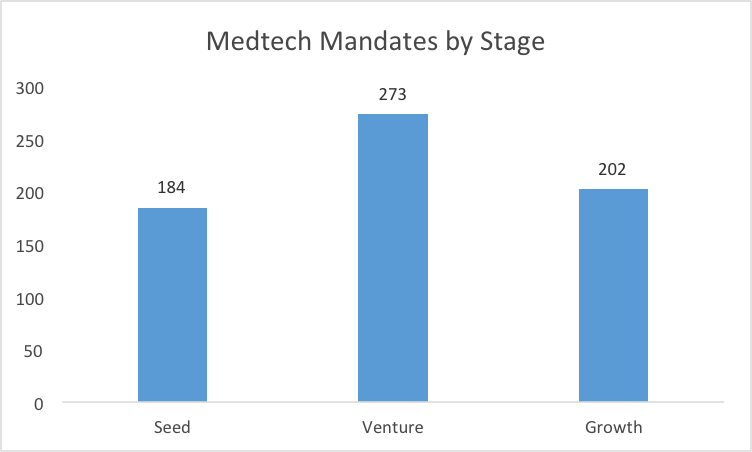
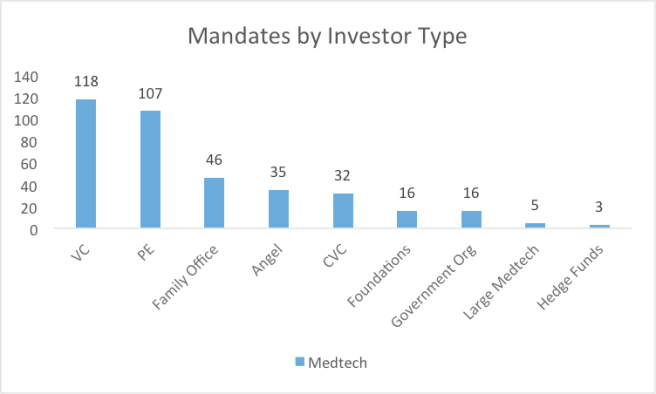
The chart below shows the results of an LSN Investor Database search mapping out all non-venture capital investors tracked by LSN with a declared interest – or mandate – in seed/venture stage medical technology companies with a prototype or early-stage clinical asset. The result is 561 investors globally. This should be very encouraging news to the executives of a space that has seen a great deal of turbulence in recent years in terms of fundraising trends.

Chart Issue 46Click to Enlarge

So what’s the next step? If you’re an early-stage medtech looking to raise money, these investor categories should certainly be on your radar. Second, do your homework on how exactly these categories behave in terms of investment activity. LSN’s research team can help elucidate this information on an investor-by investor basis. Finally, the space is in flux, so stay tuned as LSN continues to offer insights on the changing medical technology investor landscape.

Understanding your Therapeutic Asset’s Landscape

20 Nov

By Alejandro Zamorano, VP of Business Development, LSN

Most early stage biotech assets have the potential to target several disease areas. However, it is critical for entrepreneurs to maintain focus in a specific area – this helps to efficiently bring a product to market, and to show investors a firm commitment to a specific goal. But how do you choose which indication to pursue? Of course, there are advantages surrounding orphan drug regulation, hot disease areas, and other major factors. However, one area that many entrepreneurs do not investigate thoroughly is the early stage competitive landscape in their target indication area. This should, however, be a consideration in any entrepreneur’s mind.

This article seeks to offer a 30,000-foot view of the therapeutic landscape, based on a sample of over 14,000 therapeutic assets. As demonstrated by the graphic below, there is a dense concentration of therapeutic assets in a select few disease areas. In fact, the top 3 main indications represent over 50% of all therapeutic assets currently being developed. This high concentration means that differentiating your asset will potentially be more challenging.

Number of Therapeutic Assets by Disease Area

Screen shot 2013-11-20 at 12.51.39 PM (2)Click to enlarge

Competition will surface not only in the form of showing clinical significance, but also in the fundraising process. However, on a positive note, the clinical path for development should be much clearer, as companies have most likely traversed the same regulatory path your therapeutic is now embarking on. Learning from your competitors always pays dividends.

At the end of the day, you know your asset best, and how you fit into the competitive landscape. What is true for one company may not be true for another, but it is undeniable that every company looking to commercialize an asset needs to understand the therapeutic landscape and how to maneuver it most effectively.

LSN Announces RESI II

20 Nov

By Max Klietmann, Conference Co-Chair and VP of Marketing, LSN

The LSN team is very pleased to announce the second Redefining Early Stage Investments conference, to be held Monday, March 24, 2014 in Boston. This event is the next in LSN’s ongoing conference series focused on creating a dialogue between emerging life science companies and active early stage investors from ten categories around the world. LSN is committed to maintaining its mission of moving science forward by creating a forum for early stage innovation and capital to meet, and we are building on last September’s success. We’ve made some exciting changes for the March event – Here are some highlights:

Full Day Partnering – RESI will have partnering meetings available for the full duration of the day.

More Investor Panels – We’ve increased the number and variety of investor panels available to conference participants, based on cutting-edge content derived from our constant research of the industry.

Free Workshops – RESI will host a series of in-depth workshops in the areas of outbound fundraising, valuation, and the legal landscape.

Disruptive Technology Horizon – RESI will host a half-day session on the emerging disruptive technologies that have the potential to redefine the industry in the future.

New Company Presentation Format – RESI is offering innovative life science companies the opportunity to showcase their technologies to investors via poster displays throughout the (expanded) exhibit hall, giving them full-day exposure to investors and other conference participants.

If you haven’t attended RESI yet, here is a quick overview of attendance distribution from last year:

  • Over 300 attendees last year (targeted 200), estimating 500 this year
  • Over 115 early stage investors from around the world
  • 43% International / 57% Domestic
  • Attendee profile split per the chart below:

RESI Attendance BreakdownSpecial reduced earlybird registration rates for attending and exhibiting are available for a limited time only, so be sure to register now!

Special sponsorship opportunities are also available now.

We look forward to seeing you in March. Stay tuned for more RESI II conference updates.

A Word on Emerging Clusters

20 Nov

By Jack Fuller, Business Development, LSN

As a Boston-based company, Life Science Nation is by all accounts located in one of the greatest life science hubs in the world. An emerging company that can claim residence in Kendall Square somehow finds a certain level of implied acumen simply by virtue of being there. Investors also tend to gravitate toward the east and west coast “superclusters” when setting up offices. So how do companies outside of these geographic areas find and engage potential investors, given this apparent disadvantage?

Emerging Bioclusters such as St. Louis, Chicago, Colorado, and Florida – to name a few – have been growing through a combination of university, government, and private initiatives. Each cluster brings a unique dynamic of infrastructure and resources that have allowed the formation of innovative companies. I have spoken with several individuals at regional investment organizations who suggest that these are vibrant, growing communities of first class entrepreneurs and scientists.

As important as a regional network may be, an executive in an emerging cluster must maintain a global perspective. Any person looking to raise capital in today’s life science industry needs to think and act globally. Local investors and clusters are excellent at taking the first step, and have great experience in new company formation. Typically, good science and a solid management team are able to seed a company. However, in an emerging cluster, the funding gap between seed and a substantial series A tends to be larger than on the coasts.

Companies in emerging clusters have a few interesting value propositions they can distinctly take advantage of. First, many clusters are established around high-quality research institutions that provide a steady supply of qualified talent and innovation. Similarly, other clusters are home to major players in non-traditional “biotech” spaces such as AgBio and healthcare IT that can be taken advantage of when establishing local infrastructure and expertise.

One of the most important factors to an investor is the return per dollar invested.  There is a significant reduction in the cost of running a biotech company outside of Boston or the Bay area. When done correctly, a company can stretch $3-4M in the Midwest, to the equivalent of $6-7M on the coast. This decrease in operating costs means bigger returns for the investor. Investment in emerging clusters has been underfocused, and a savvy entrepreneur needs to leverage the regional momentum and resources available to become even more attractive than a similar company based in a major cluster.

When targeting global investors, the capital efficiency and strength of the management team become key factors in attracting significant interest. The question many investors will ask is: is this team going to be able to execute? The history of success stories, while present in emerging clusters, is still an area of concern to an investor.

All life science companies face the same challenges when raising capital. However, companies in an emerging cluster now have an opportunity to take the leap to the global stage. Take the question of execution out of the picture, and highlight the significant upside of investing in a company based in your region.

LSN’s Partners, Venture Valuation & KPMG, Release EU Cluster Report

13 Nov

By Tom Crosby, Marketing Manager, LSN

LSN’s partners at Venture Valuation recently released a “cluster report” in conjunction with KPMG. This report is targeted chiefly at North American and Asian life sciences companies looking to establish a presence in Europe. The analysis takes a deep look at the state of the European marketplace by examining the strength of bio-clusters in each of the six major EU countries for life sciences. This document is designed to serve as a guide for site selection, and details the particular strengths of each regional cluster – Here are a few highlights:

France:

  • Focused on nutraceuticals and cosmetics.
  • 60% of French life science companies undertake in-house R&D (highest % in EU).

Germany:

  • Highest number of life science companies of any European country (focus on Medical Devices).
  • Largest life science workforce in absolute numbers.

Ireland:

  • Second largest LS workforce relative to the active population.

Netherlands:

  • Attractive to regional HQs of non-domestic LS companies for their R&D activities.

Switzerland:

  • Strong LS clusters with large number of global HQs of domestic companies.
  • Largest number of regional HQs of non-domestic LS companies within the six countries covered.

United Kingdom:

  • Europe’s largest cluster in Biotechnology Therapeutics and Pharmaceuticals.
  • Strong in R&D and a large life science workforce.

To read the full 46 page report that details the evaluation of these regions, please click here

Investor Fit: It’s Not Just About Money

13 Nov

By Lucy Parkinson, Research Analyst, LSN

LSN’s articles on fundraising are largely based on the idea of finding investors that are a strong fit for a life science company’s offering. However, once a conversation with an investor is started, it becomes a complex process. There are a plethora of criteria that many fundraising executives may not be aware of that do have a significant impact on investment decisions. Moreover, an investment represents a long-term relationship that needs to be maintained. In short – Fit isn’t just about pairing cash with an asset.

I interview investors on a daily basis. Yes, we do talk about the assets – such as whether an investor is more interested in biotech or medtech, what stage of asset development an investor is interested in buying into, or which indication areas show the most promise. We also talk about typical allocation sizes and the frequency of allocations. However, one of the most important elements we discuss is the investor’s approach to portfolio building, and what qualities they want to see in a management team before they sign a deal.

In LSN’s experience, it typically boils down to control of the company, which can manifest itself in a number of ways. Let’s face it – nobody likes unnecessary exposure to risk, and investors want to do what they can to reasonably reduce their risk relative to their return. This often manifests itself in a positive way. For example, a corporate VC that offers a portfolio company free expert advisory, access to corporate resources, and easy access to a potential exit into the mother company. However, a dispute over control can lead to serious problems as well, and an entrepreneur should be mindful of how to parse the marketplace depending on different investors’ missions.

Here’s an example – You have a small molecule for oncology and a venture philanthropy in the cancer space chooses to invest. What happens when you find out that even though your asset is promising for cancer, you have a much faster path to market with a totally different disease area. You may now be restricted in your ability to pivot due to your investor’s indication-specific orientation. Similarly difficult situations can arise when it comes to management decisions, and a proactive VC may desire to replace elements of a portfolio company’s core team or to make a significant change in strategy. Vinod Khosla recently questioned the wisdom of these VC-led leadership decisions.

The point is, as an entrepreneur, you need to think both tactically and strategically, and that will help guide your decisions in choosing an investor group to target. So when you initiate your outbound campaign and term sheets begin to surface, think about getting your company to the next level, but be mindful of the levels after that as well.

LSN Investor Database Feature: Non-VC Interest in Early Stage Biotech

12 Nov

By Max Klietmann, VP of Marketing, LSN

LSN’s investor research group maintains quarterly contact with over 5,000 active investors in the life science space. In recent history, LSN has focused on tracking the plethora of new investor categories entering the life science arena filling the void left by Venture Capital. In this edition of the LSN Newsletter, we will be taking a look at some interesting statistics surrounding the new investor categories LSN tracks, and their preferences within the early stage biotech space.

The chart below shows the results of an LSN Investor Database search mapping out all non-venture capital investors tracked by LSN with a declared interest – or mandate – in seed/venture stage therapeutic companies with an asset in Discovery, Lead Optimization, Preclinical or Phase I clinical trials. The result is 875 investors globally. The LSN Research Team uncovers 40-50 new investor mandates per week.

image001Click to Enlarge

One of the most interesting pieces of data gleaned from LSN’s analysis is the overwhelming number of investors with an opportunistic orientation towards early stage technologies (roughly 34% of investors). This shows that for many non-VC early stage investors, especially private equity, other factors are of primary interest (e.g. management team or therapeutic subsector).

When it comes to disease mandate-driven investors (i.e. investors driven by a specific indication) top indications of interest are generally aligned with major disease areas with significant market opportunity. These include cancer – (over 29%!), diseases of the nervous system (e.g. ALS, MS, Alzheimers), infectious diseases, cardiovascular disease and endocrine (diabetes).

So what’s the big deal? First of all – The data shows that non-VC investors are certainly showing interest in early stage biotech, which validates many of LSN’s anecdotal market insights. Second, it shows that even though about 34% of these investors are opportunistic, many have clear mandates in a space that is highly strapped for capital. If you’re looking to raise money, especially in one of the top therapeutic areas shown, these investors should certainly be on your radar. Stay tuned as LSN continues to offer insights on the changing investor landscape.