Tag Archives: cooking

Inomagen Therapeutics: RESI Boston June IPC Winner

15 Jul

Inomagen Therapeutics, led by Chief Business Officer Eric Sandberg, is working to redefine how atrial fibrillation is treated—starting at the molecular level. A recent winner in the Innovator’s Pitch Challenge at RESI Boston June. In this interview, Sandberg shares insights into the company’s novel approach, development progress, and how RESI helped build investor momentum.

Eric Sandberg
CaitiCaitlin Dolegowski

Caitlin Dolegowski (CD): Tell us about Inomagen Therapeutics, what is your core focus, and what inspired your approach to treating atrial fibrillation?

Eric Sandberg (ES): Inomagen Therapeutics is a preclinical-stage biotechnology company developing a non-viral gene therapy to improve the treatment of atrial fibrillation (AF), the most common sustained heart rhythm disorder affecting 10M people in the US alone.  Patients with AF do not feel well and have a 4-5x increased risk of stroke, 2x risk of having a heart attack, and AF is a major cause of heart failure.  Unfortunately, current therapies, including cardiac ablation, have proven ineffective for many patients because they do not address the underlying mechanisms of the disease.

Inomagen’s approach is based on research conducted by our Founder, CEO and practicing electrophysiologist, Dr. Rishi Arora.  In his research laboratory, Dr. Arora identified major molecular mechanisms that contribute to AF in a majority of patients with AF; identified major trans-genes to selectively target these mechanisms in the atrium; utilized low energy electroporation to achieve therapeutic gene transfer and expression; and decreased AF in clinically relevant, large animal models of AF.

CD: What differentiates your platform from other therapies available to treat atrial fibrillation?

ES: Ablation is the mainstay of AF treatment. However, ablation success rates are suboptimal in patients with persistent AF. This is thought to be in large part because ablation is an anatomic procedure that is not targeted to the molecular mechanisms underlying AF. Inomagen has developed a non-viral gene therapy that targets one or more major molecular mechanisms underlying AF.  Specifically, we have demonstrated preclinical success delivering NOX2 shRNA plasmids to atrial tissue to achieve gene knockdown, to silence upstream mechanisms of AF, in order to achieve a therapeutic effect.  To be clear, our gene therapy is not replacing genes or editing genes, we are knocking down the expression of genes that are causing AF.  Based on our preclinical results, we believe that our gene therapy can potentially surpass cardiac ablation as the therapy of choice for atrial fibrillation.

To achieve safe and effective targeted gene delivery, we have developed a novel transvenous gene delivery system that uses low energy reversible electroporation to achieve high levels of gene transfection into atrial tissue.   We believe that our physical gene delivery approach overcomes the known challenges of using viral vectors which include insufficient gene transfection and well publicized off-target effects.  As such, we believe our gene delivery approach can potentially serve as a platform technology for other companies developing cardiac gene therapies, including gene therapy in the ventricles for congestive heart failure.

CD: Where are you in terms of preclinical or clinical development, and what are your near-term goals?

ES: With our recent development of a proprietary NOX2 shRNA gene plasmid and a gene delivery catheter, we have now achieved program readiness to initiate IND-enabling studies to gain FDA approval for a Phase I/IIa clinical study.  In the near term, we will be conducting IND-enabling studies in the 2nd half of the year in preparation for a pre-IND meeting with the FDA early next year prior to conducting pivotal tox and filing an IND in late 2026.  We aim to initiate our Phase I/IIa clinical study in 2027.

CD: What are you seeking in your current fundraising round, and what kind of investors or strategic partners are you hoping to connect with?

ES: We are currently raising a $5M Series Seed round and will be initiating a larger Series A round later this year to support the program through a Phase I/IIa study.  In the near term, ideal investors for Inomagen include angel groups and individuals, while we anticipate our Series A to be led by venture capital investors. Additionally, given the potential of Inomagen’s gene therapy to markedly improve the treatment of atrial fibrillation, we have several potential strategic partners who are tracking our progress.

Inomagen has multiple gene targets in our pipeline and a robust IP portfolio that includes 18 issued patents protecting genes/biologics and gene delivery.  We have an experienced team committed to bringing our gene therapy to the clinic.

CD: How did your participation in the Innovator’s Pitch Challenge at RESI Boston contribute to your visibility or investor outreach efforts?

ES: Our participation provided the opportunity to continue to share the progress that we are making with the attendees at RESI.  And being recognized as a top company in the Pitch Challenge has certainly provided increased visibility for Inomagen through Life Science Nation’s extensive readership.  We have experienced a further increase of interest in Inomagen, including a significant increase in traffic to our  website.

CD: Can you share any valuable feedback or connections that came out of the pitch sessions or RESI partnering meetings?

ES: Following our presentation in the Pitch Challenge, we added several more partnering meetings with interested investors. Given our experience at the June RESI meeting, we registered to attend the September RESI meeting as well.

CD: What advice would you give to fellow early-stage biotech founders about preparing for and participating in a RESI pitch competition?

ES: The RESI pitch competition provided a good opportunity to make sure that we are communicating the Inomagen opportunity clearly to potential investors. We appreciated the opportunity to join the many impressive companies presenting at RESI who have a passion to improve health care for patients and providers.

Applications are now open for the Innovator’s Pitch Challenge at RESI Boston this September.
New! The IPC Pitch Package now includes an optional second full RESI pass at no additional cost—bring a teammate to support investor meetings, pitch preparation, and maximize your conference presence.

Apply to Pitch at RESI Boston Sept. 2025

Pullan’s Pieces #2 – Top Drug Sellers by Geo

15 Jul

By Eric Hayes

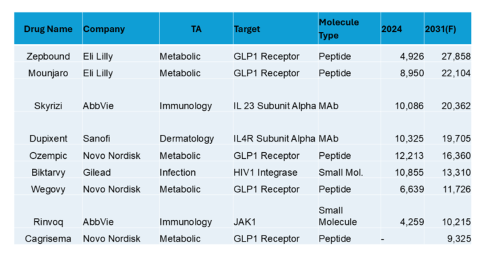
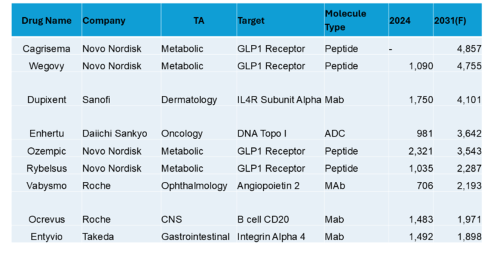
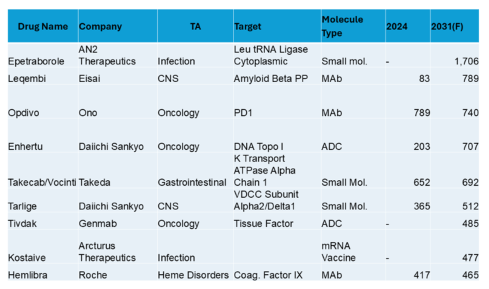
What do analysts think will be the top 10 drugs in the year 2031 (as searched in GlobalData)?

Top 10 in the US in 2031 (USD Millions)

In the US analyst forecasts for 2031, obesity dominates (with immunology, derm and infection for other TAs). Along with the obesity peptides are 2 small molecules and 2 MAbs. The sales are in the tens of billions.

Top 10 in Europe (USD Millions)

In Europe, along with the obesity drugs and dupixent in derm, we see the oncology ADC Enhertu, the ang2 ophthalmology drug Vabysmo, a CNS CD20, and a GI integrin in the top 10. Sales are in the single digit billions.

Top 10 in Japan (USD Millions)

In Japan, obesity is not visible in the top 10. An anti-infective tops the list, followed by CNS, oncology, GI and including heme disorders. There are companies not in the top 20 for global sales. Most of the top 10 have sales below $1B.

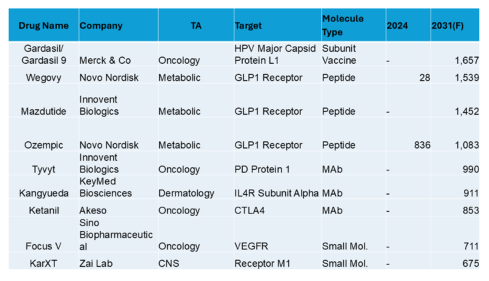
Top 10 in China (USD Millions)

For China, obesity is back in the top 10, but Gardasil, an oncology HPV vaccine tops the list. Local company “fast followers” are apparent and most of the top forecasted drugs are not yet launched (presumably a reflection of the rapidly evolving pharmaceutical environment). To get into the top 10, sales are above $500M.

Conclusion: The marketplace for drugs shows considerable variation in different regions around the world.

Pullan’s Pieces #1 – Organ on a Chip

1 Jul

Acceleration of laboratory-based technical and computational cross-fertilization, and ethical and cost pressures on regulatory bodies and therapeutic innovators is driving advancements in preclinical human-based technologies.

Organ (Lab)-on-chip (OoC/LoC) is one of the most striking examples of new translational research technology expansion with ~35% CAGR expected over the next decade (below).  

Collaborations between academia and CRO’s are driving improvements in organoid technology for the field of oncology broadly and are expected to improve OoC adoption.  Academic innovation using commercial OoC technology is also advancing applications in specific indications in oncology.  CRO’s continue to build off established uses in ADME and toxicology to explore R&D applications in oncology space and have even combined organ systems to support elaboration of multiple drug parameters in a single assay.

DEALS

The Tara Biosystems – Valo Health deal is a nice example of how an organ-on-a-chip technology approach has driven collaborations, acquisitions and deals:

  • Tara Biosystems and GSK collaborate on CV drug profiling (2019)
  • Valo Health acquires Tara Biosystems for CV OoC platform (2022, ~$75M upfront)
  • Valo and Novo Nordisk sign CV drug discovery deal (2023, $60M upfront, $2.7B total)

EmulateTissUse and Mimetas have also been backed by strong big pharma collaborations (AstraZeneca, Bayer, Roche) and funding rounds.