Tag Archives: Fundraising

At RESI@TMCx, Make Your Fundraising Budget Count

3 Mar

By Nono Hu, Director of Marketing, LSN

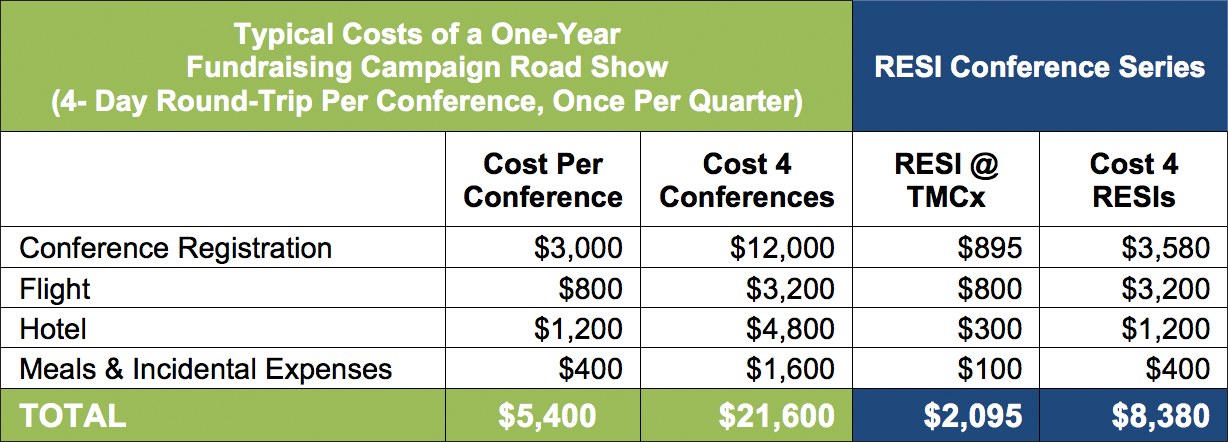
What does it cost to raise capital? In LSN’s experience, one signal that consistently distinguishes a company that is committed to raising capital is that the company has a realistic plan and budget for their fundraising campaign. And when a company has a budget, it’s vital to ensure that they’re getting the most return on investment (ROI) possible from their campaign expenses.

That’s where the Redefining Early Stage Investments (RESI) Conference fits in. As a one-day event with a 1:1 ratio of investors to startup companies, RESI inundates attendees with opportunities to connect. Companies can book up to 16 face-to-face investor meetings in advance of the event; by providing so many opportunities to meet investors in one day, RESI is a high-value event for fundraising CEOs.

RESI Provides a Higher ROI for Cost Conscious CEOs

table
RESI-Houston-2016

RESI@JPM: Biotech Angels Discuss Where and How They Fit into a Fundraise

25 Feb

By Cole Bunn, Research Analyst, LSN

cole-wp

Life science angel investors have long been a fundamental piece of a fundraising campaign, typically providing strategic guidance and capital to entrepreneurs who are right out of the gate. Relaxed crowdfunding provisions and big pharma’s increased involvement in early-stage companies, among other developments, has created new opportunities for angels to find, fund and exit biotech companies. This crucial investor class speaks to the types of deals they like to do, what it’s like to work with an angel investor and how they see the biotech and investment landscapes evolving.

To hear directly from the investors, watch the RESI video recap here:

LSN Summer Reading Series, Chapter 14: “Thirty-One Tips for Effective Fundraising”

27 Aug

By Michael Quigley, Director of Research, LSN

mike-2

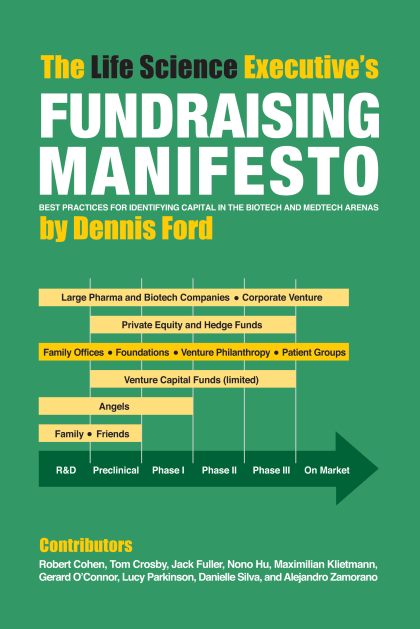
To bring LSN’s Life Science Executive’s Fundraising Manifesto toward a close, we provide some motivational advice and tactical reminders to help a fundraising CEO bring their outbound campaign to a successful resolution.

With illustrations and helpful mottos, this ‘cheat sheet’ chapter will help the reader find their way through the fundraising maze in good spirits. From how to stay optimistic during the tough times, to when to stop marketing to investors, this chapter has it covered.

Click here to download/print the chapter PDF

Join us next week for the book’s addendum: “The View Beyond Venture Capital.”

Enjoyed the preview? Buy now from Amazon.com or Barnes & Noble

Bookcover-Front


East Meets West: The Lessons Learned

3 Jul

By Laura Chess, Research Analyst, LSN

laura-10-10

If you have just read the “East Meets West: By the Numbers”, I would like to provide some additional commentary from a canvassing perspective.

As a research analyst at LSN, one of the reasons I am able to get through to investors is that the purpose of my call is to find out what an investor’s interests are so that I can provide them with qualified dealflow. I am not trying to sell them something. During Asian night, June 18, I was pleasantly surprised with how open and receptive the investor candidates we canvassed were. My goal was to conduct a one-on-one survey that reveals the needs of investors that I had targeted from the Far East. Upon explaining that LSN can help them source and filter global life science companies that are a fit for their current investment mandates, the call becomes a pretty free-flowing conversation.

Below are the two observations I made that may be of help to the reader when canvassing the Asia Oceania region:

1) Many investors in Asia are open to considering western companies and actively seeking deal flow.

Many investors in the Asia-Pacific region don’t have offices in the U.S., which is sometimes misconstrued as a lack of interest in western-based start-ups. In our conversations, however, many Asian investors said they were open to cold calls, interested in establishing relationships with western biotech and medtech companies, and seeking deal flow. These investors were especially interested in companies looking to expand to Asia.

 2) To make the most of late-night outreach, choose large cities, be organized, and add a sense of urgency.

If you have the ability to reach out internationally, choose large cities, such as Hong Kong or Beijing, where investors are well versed in English. Sort the list of investors by time zone, with start times for each. And in the weeks leading up to your outreach, consider contacting investors by email to let them know the date and time when you will call. Taking such steps will help you achieve your primary goal: making as many calls as possible.

The Quest for the Perfect Investor Fit: How Much Does Life Science Expertise Matter?

2 Oct

By Danielle Silva, Business Development, LSN

Here at LSN, I speak with many life science entrepreneurs about investor fit. Typically, life science executives believe that fit is a one-way street, meaning that they need to do all they can to prove they are a fit for a prospective investor. While it is certainly true that an integral part of the fundraising process is proving that your company is a fit for the firm’s investment thesis, this is not a one-sided negotiation. It is just as important for life science companies to make sure a potential investor is a fit for what the firm is looking to attain, and therefore, finding a potential investor needs to be both a strategic and tactical play.

What many life science CEOs struggle with is whether they should favor investors that have expertise in a particular area versus investors that are experienced in a certain phase of development. The answer, by and large, depends on what the life science company is looking to achieve in the long run, but there is of course no easy answer to this dilemma. Many entrepreneurs consider the problem a simple one – why would you want an investor that doesn’t understand your technology, or one who does not have expertise in your particular indication area?

While it is certainly important for investors to have a basic understanding of your disease area, this is only truly important if you are seeking scientific advisors for your firm. If this is the case, then finding a partner that has expertise in your disease area may be favorable to finding an investor that has knowledge of your stage of development. But what if, conversely, the executive is seeking a quick exit or a recapitalization? In this case, it may be more attractive to find an investor with a laser focus on your particular area. These investors already have a great knowledge of the space and thus probably already have a solid network that will be willing to acquire the company once the firm hits certain milestones.

Most life science executives I speak with, however, are not seeking scientific advisors, and instead are seeking investors with the business acumen to help take their product from discovery to distribution. These companies would benefit from a relationship with an investor that has knowledge of their particular phase of development, and who can thereby help to scale their business. It is also very beneficial for companies to be partnered with investors who have a deep knowledge of their phase of the clinical development cycle. These investors will have the expertise to help life science firms partner with appropriate firms in the R&D services space (such as CROs and other service providers).

Again, there is no clear solution to this problem. If your company is seeking an investor with a deep network in the space, then choosing an investor with sector expertise may be the answer. These investors, however, may not be able to help you scale your business to the point where your firm is an attractive investment or acquisition target for a larger investor within their network. Simply put, the answer is convoluted, no investor is the same, and everyone brings something different to the table. Life science executives should clearly define their goals in terms of growth and exit before deciding on an investor based on sector fit versus development phase fit.

Creating a Dialogue with Life Science Investors

2 Oct

By Dennis Ford, CEO, LSN

I write about this subject often – I guess the main reason is that if I can get the message right, I can help educate life science fund-raisers that a current and accurate map does exist for raising capital. If you are in fundraising mode, please have an updated map. There, I said it!

The most interesting component of the fundraising dynamic is the concept of “introduction”. Scientist meets investor, buyer meets seller. One of the initial goals of any fundraising campaign is to get in front of potential investors, and this can be done in two general ways: the first being referral, and the second, fit. I will agree that a referral is often a good way to get a meeting, but many believe that it is the only way to get to a decent investor target.

Being a street-savy salesperson, I always get a bit riled when someone announces that referrals are the only way in. I mean, what if you get referred to an investor and he just simply doesn’t have a current mandate to invest, and if he did, it would be a medical device and you happen to be a therapeutic? My point here is that even though a referral may get you some preferential treatment in the form of a first meeting, there always needs to be a good fit. After all, it’s the final meeting that really counts. I am a big fan of the referral, but I am an even bigger fan of fit.

In my “sales guy mind,” the highest form of a qualified investor lead is a declared fit. A declared fit boils down to this: an investor actively declares a targeted and specific intent on investing in a certain part of the market. I think that is the highest form of investor target – self-declared mandate from the mouth of an potential investor. I mean, what else would a fundraiser want? OK, maybe I shouldn’t have asked that question… because I know the answer: a referred introduction, right?  No, wrong!

Of course, if you know someone who can provide an intro, that’s great. Sans that magical referral/intro, if you are a fit for the declared mandate, all you have to do is tell him via email or phone that you know what they are seeking and you are a fit. Honestly, that’s how it works. Spamming gets you a 1-2% hit rate, but reaching out based on fit gets you a 20-30% hit rate. Why? Because you match what the investor is looking for. Being armed with the knowledge of an investor’s current interest gives you the power to refer yourself.

Phase I of the JOBS Act: Are you ready for the general solicitation revolution?

2 Oct

By Lucy Parkinson, Research Analyst, LSN

Back in April 2012, the JOBS act was passed with the aim of (the clue is in the name) Jumping Our Business Startups. The SEC has moved slowly on implementing the JOBS Act and is saving the most innovative provisions for a second phase of changes, but as of Monday, September 23rd, the long-standing ban on making general solicitations to accredited investors has been rescinded. This will have a huge effect on the institutional landscape of investing, as companies can now use mass public advertising to look for investors, rather than being restricted to using funds from family, friends, and private networks of accredited investors.

So does your start-up’s fundraising campaign have to change? Not necessarily, but you may reap great benefits by using the new regulations to your advantage and seeking for investors with a wider net than was previously possible. However, obeying the restrictions surrounding general solicitation is not as straightforward as you might think. As such, any company looking to raise capital would be advised to spend some time with their lawyer before sending out a mass solicitation; similar to the domain of intellectual property, we could see an influx of law firms seeking to partner with emerging biotech companies to guide them through the regulatory quagmire and maximize their visibility with investors.

While many life science companies could benefit from following the new path laid out for general solicitations, some may wish to eschew the added regulatory burdens and stick with the old model that, in addition to accredited investors, allows them to ask up to 35 unaccredited friends and family to contribute to each funding round. This doesn’t mean foregoing all the benefits of the law; the investment groups themselves will have more room to advertise for contributions under the new law, and that may lead to investors having more dry powder to invest – particularly to under-the-radar angel firms, who have previously found it hard to advertise to prospective investors. Building partnerships with these lesser-known investors will remain as important than ever.

Will general solicitation be worth the added costs? It could be, and this is especially true for life science companies. One thing LSN has observed frequently about emerging types of investors in the life science space is that more so than investors in other industries, they often have personal motives. Essentially, what we’re seeing is funding provided by angels, family offices and venture philanthropy funds looking for more than just ROI – the founders of these investment vehicles often want to make an impact on the world by targeting a particular disease that has affected their life or runs in their family. So, when we start to see general solicitations blaring from every billboard, TV set or web search, life science pitches will have a unique draw that other startup prospects lack because in this industry, general and personal come together.

This distinction will only become more valuable when phase two of the JOBS Act rolls out equity crowdfunding. For that, we’ll have to wait until next year.