By Patrik Frei & Benoît Leleux
Valuing a company has always been more art than science. In this article, we provide a basic outline of how to conduct a proper valuation exercise and present two common methods used to value an early stage biotech company.
Gauging value
A company’s value lies in its potential to generate a stream of profits in the future. All valuation exercises are thus based on envisioning a company’s future, relying almost entirely on educated guesses. Value is based on assumptions as to what a company’s future may look like, what important milestones will have to be met and strategic decisions taken. These assumptions are grounded in three fundamental factors: first, the state of the market targeted by the company; second, the principle elements of a company’s science and technology; and third, the ability of management to deliver on the business plan. We would recommend that every valuation start with a systematic and rigorous testing of a company’s economic, technological and managerial hypotheses in combination with the following two key approaches:
• Primary valuation, which is based on such fundamental information as projected future free cash flow (FCF) and costs of capital;
• Secondary valuation, which is based on comparable information, where valuation is done by analogy to other similar companies.
With a good understanding of the above two approaches, an entrepreneur is already well equipped to tackle the negotiations that will ultimately determine the deal valuation.
Fundamental valuation
The most common approaches to primary valuation in the corporate finance literature are generically referred to as the discounted cash flow (DCF) methods, whereby a company is valued at the present value of the future cash flows it will be able to generate. These methods are conceptually robust but can prove difficult to implement in high uncertainty environments, such as those of early-stage biotech firms. Typical problems include highly uncertain and distant positive cash flows, a business model based on many assumptions and a difficult risk profile. Corporate finance theory indicates that the value of any asset is equal to the present value of its future cash flows. Therefore, in principle, all that is needed is (i) to estimate the expected future cash flows of the business, and (ii) to discount back to the present all these future cash flows, using a discount rate consistent with the level of risk in the project. In practice though, problems emerge at every step of this process. First, projecting performance for several years into the future is a process seen by many as too speculative to be useful. Second, selecting a forecasting horizon for the future cash flows (5 years, 10 years or 20 years) is purely arbitrary and leaves open the question of the residual value of the business at the end of that horizon. Third, obtaining an appropriate discount rate for an early-stage, privately held company presents difficulties.
Projecting cash flows into the future is never an easy endeavor, especially for smaller, high-growth life science firms. The key data used for valuation is the FCF. According to Copeland, Koller and Murrin (1), “[FCF] is a company’s true operating cash flow.” In other words, the FCF refers to the cash flows free of (or before) all financing charges related to the corporate debts. These cash flows include all necessary fixed asset investments and working capital needs, as both are normally needed for a viable business. The FCF is estimated through the financial projections of the business plan. Depending on the available information and the time frame needed for a steady revenue flow, a forecast period of 5 or 10 years is most commonly used.
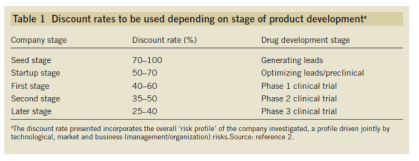 The easiest approach to determining the most appropriate discount rate in a DCF is one that would use the stage of development of the company, which can be determined by the drug development stage of products in the pipeline as proxies for risk (see Table 1). For example, a company that is generating leads without further developed products would be considered a seed stage company and a discount rate of between 70%–100% would be used. Although conceptually a bit loose, the method is surprisingly reliable. Several factors typically influence the risk profile of a biotech company. Once identified, the risk factors can then be used to determine the discount rate within the ranges provided in Table 1. The discount rate to be used in a DCF calculation depends on the degree to which a company fulfills each of the criteria. As the discount rate is critical in determining value, it is appropriate to spend time in meticulously assessing each criterion and to investigate the sensitivity of the results to the various parameters.
Comparable valuation
The comparable method is also known as a “secondary” valuation method because it uses the market value of comparable companies or transactions as reference points. The method relies on available key figures, such as earnings, sales, number of employees, number of PhD’s or R&D expenditures, to estimate value. In a sense, secondary valuation makes the assumption that these comparable companies have been properly valued, and can serve as benchmarks when assessing a company. For example, if a comparable public company is valued at $1,000 with R&D expenditures of $500, for a price/R&D ratio of 2, then the private company to be valued with R&D costs of $200 would, by analogy, be worth an estimated $400.
Closing remarks
Humility and realism are the two key attributes of the prospective company valuator. Humility is needed to recognize that the exercise is primarily about envisioning the future, and that the exercise is fraught with uncertainty. Realism will help to understand that the inherent uncertainties do not constitute an excuse for sloppy estimates of the valuation components. Whether the valuation is done explicitly (as in the DCF methods) or implicitly (as in the comparable methods), either method will give an accurate valuation if carried out by experienced valuators.
Although the valuation methods described here are routinely used by investors, we offer three important cautionary remarks to help the newcomer to watch for typical pitfalls. First, investors often refer to pre- and post-money valuations: pre-money is the value before the investment is included; post-money is the value including the new investment. Thus, pre-money value + investment = post-money value. Investors routinely play with different figures and company data. Numbers are their daily business and they may try to use them to their advantage.
Second, don’t enter into negotiations without having completed your homework. Management needs to master the figures and numbers and have clearly laid out its expectations about pre- and post-money value and the corresponding value of its shares. Only with preparation and a good understanding of valuation drivers can management establish itself as a credible partner in front of investors.
And third, valuation is not everything. The investment contracts that accompany investments can easily take away everything that was given in a rich valuation, by imposing drastic restrictions on the future conduct and wealth of the founders. Similarly, a company must feel comfortable with its investors because they will share the same bed, figuratively, for a long time to come. It would thus be foolish to maximize the short-term share price if it is at the cost of the long-term value creation potential of the company. Never lose track of the fact that a financing round is just a means to an end, not the end itself!
Patrik Frei is the CEO of Venture Valuation
This story was reprinted with some modification from the Building a Business section of the Bioentrepreneur. Web portal: (http://www.nature.com/bioent), 21 June 2004, doi:10.1038/bioent814.
1. Copeland, T. , Koller, T. & Murin, J. Valuation: Measuring and Managing the Value of Companies.(John Wiley & Sons, New York, 2000).
2. Frei, P. & Leleux, B. Valuating the company. In Starting a Business in the Life Sciences—from Idea to Market. (Luessen, H. (ed.).) 42–55 (Edition Cantor Verlag, Aulendorf, Germany, 2003).
Tags: biotechnology, consulting, family offices, Fundraising, investor, letter, Life Science, life science nation, medicine, news, newsletter, pharma, private equity, research & development, startup, venture capital





 Next Phase Newsletter