By Dennis Ford, Founder & CEO, Life Science Nation, November 2012
The primary marketing challenge for the life science CEO is finding the sales and marketing expertise required to realize capital inflows. Compounding this issue is the fact that the SEC and FINRA regulatory landscape is morphing at a time when institutional life science investors are re-evaluating investment strategies and reshuffling portfolios. These dynamics require life science executives to review and recalibrate their sales and marketing strategies.
In order to do this life science executives need to answer three main questions:
- What is the current fundraising environment?
- How are firms raising capital and building their investor base?
- What must firms do to prepare and execute successful fundraising campaigns?
Fundraising is not a singular event. In fact, it must be an integral and ongoing part of every firm’s business strategy to validate a firm’s model, and to ensure profitability and growth. Although fundraising at most firms tends to ebb and flow, it should never be far from your collective consciousness.
Thousands of life science executives are currently seeking allocations and yet many don’t understand what it takes to execute a sales and marketing campaign. These executives need to realize that effective sales and marketing is key to raising capital from life science investors, and that effective implementation requires years of experience.
The Fundraising Environment
Back in the days of yore, investors could discover a high-flying life science firm. If the firm had the right business plan and a compelling story, investors would make an allocation. The whole due diligence process was often completed in a relatively small amount of time, typically six to twelve months. This was more on the passive side of fundraising. An interested VC would herd together other co-investors and though the fund raising staff had to be nimble and responsive, the money was still there.
Active fundraising didn’t require much more effort. Times were good. When life science firms wanted to raise capital, they could call upon their stable of investors and ask them to increase their commitments.
Those days are long gone. The paradigm has shifted. No longer are investors coming in over the transom, and the financial crisis caused many stalwart, dependable investors to leave firms. Today, life science companies looking to raise capital must “go outbound” and find investors that are a good fit for their products.
Unfortunately, this change comes at a time when raising capital is more urgent than ever. Most firms, regardless of their place in the market, face the same problem: their funds have dwindled to record lows. The economic downturn caused many investors to stop investing all together.
Transition Creates Opportunity
Although life science executives are scrambling to replace assets and find new investors, they are not the only group in transition. Alternative institutional investors are also undergoing a huge change. They are rethinking past strategies and reshuffling their portfolios. VC and PE firms are being forced to realize that they have not been successful in turning investments into returns and have lost a lot of money. The VC community – with the exception of some marquee names – has been severely hindered and may or may not re-emerge.
This dynamic has created some problems, but more importantly, it has created opportunities. New categories of investors are open to talking with life science executives that they declined to speak with in the past. Investors are also examining strategies that previously were not on their radar screens. Indeed, family offices are filling in some of the gaps by investing directly and there is a trend in the market to find the new VC.
At the same time, investors are echoing the same message to life science executives. You must scrutinize your projections, show a good track record of adroit development and discovery capability, educate and engage us in dialogue, and let us vet the executive team. Only then will we seriously consider your firm.
Times have changed.
Although much money is still on the sidelines, investor data shows that allocation distribution is trending upward. A recent report published by Silicon Valley Bank found that venture-backed M&A is on the rise, and that big exits (deals greater than $50 million in equity) are at a seven year high at $12.5B[1]. The average upfront deal size for life sciences firms has also increased[2], and both of these factors have led to increased investor interest in life sciences sector.
So how do life science firms go about raising capital and growing their investor stable in this new environment?
Think Differently, You Have No Choice
Going outbound is the new modus operandi. However, outbound marketing and sales are their own distinct universe. If you do not know this, believe it to be true.
Outbound marketing and inbound marketing couldn’t be more different. It is safe to say the two are like night and day. It would require an additional white paper to describe all the subtle differences between the two, but here is a concise snapshot – a fundraising staff comprised of marketers that simply screen incoming VC calls and identify those of value are not the right people to make the hundreds of outbound calls per week that are necessary in this environment.
Inbound marketers are not familiar with the incredible effort it takes to vet a target list of investors. They don’t know how to speak with a cold prospect. They are not used to making 10 to 15 calls and receiving only one back. And they don’t know how to set up conference calls and road trips with prospects.
When the economic world changed, so did the job descriptions of the fund raising and marketing staff. Inbound and outbound are two distinct marketing styles. Each attracts certain personalities and requires special talents. It is imperative to adjust to the new paradigm if your firm is going to successfully raise capital.
First Things First
If you are considering launching a fundraising campaign—or are in the throes of one—how you go about it will determine your success. One of the most important facets to grasp is that sales and marketing take money, time, and commitment.
The first major hurdle many life science firms must overcome is accepting the old adage, “it takes money to make money.” Every life science firm needs to budget the dollars necessary to prepare a fundraising campaign.
The second obstacle is that raising capital today takes a minimum of six to eighteen months[3]. Life science firms must come to grips with the fact that investors want to observe a firm’s development milestones for several quarters and establish not only a compelling dialogue but also a relationship with a firm’s major players.
The third hurdle is that continuous fundraising is a firm-wide commitment. From the top of the organization to the bottom, every employee must buy in. This can happen if you choose an effective fundraising leader—someone who cannot only communicate the importance of this effort up and down the ladder, but also can win everyone’s support.
Many firms have a full-time professional who heads fundraising or marketing and can lead this effort. However, as noted earlier, this is usually not the same person that led your inbound marketing efforts during better times.
If your firm is not big enough to afford a full-time marketer or a fund-raising life sciences firm, then one of the partners must fill this role. How do you determine who is the best candidate to represent the firm to potential investors? Ask this question: which partner can best explain who we are and what we do in a cogent, lucid, earnest, and succinct way?
After you have designated a leader, he or she must assemble a team. A marketing team is like any other team; each player is assigned a position and is expected to know the playbook and execute. It takes teamwork to win. In the new outbound sales and marketing model, the team often includes outsourced firms.
The bottom line is that someone has to take responsibility for raising capital, and the rest of the firm must fall in line and support the effort.
The Value of Keeping Your Investor Data Current
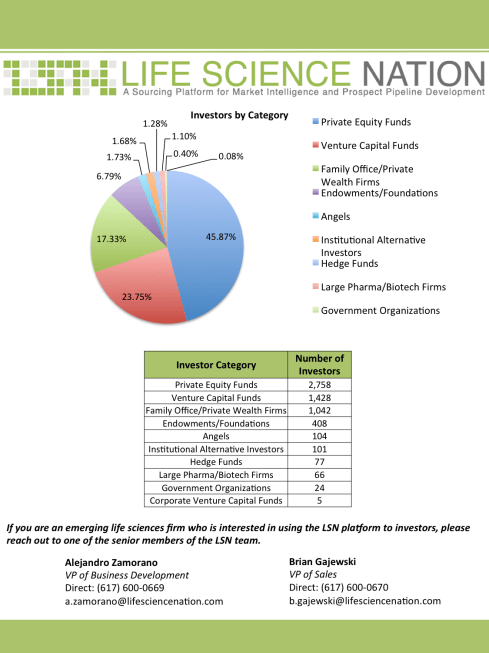
The first task the marketing team must tackle is to decide which investors to target. At the top of the list should be the investor categories with which the firm has been successful in the past. For example, if foundations and endowments have been the firm’s sweet spot, determine if they are still viable prospects.
The team must then ask if there are additional investor categories to consider. Perhaps now is the time to seek a new type of investor such as family offices or hedge funds.
After the team has agreed on one or more categories to target, the next task is assembling a target list.
The first place to look is in-house. In-house investor lists are typically an amalgamation of spreadsheets, Microsoft Word documents, e-mails, and other disparate files and databases. They are a mix of personal and company contacts. They may even include some third-party lists bought haphazardly over the years. Usually, all these lists have been gathered but not maintained by the in-house marketing staff.
Many marketers incorrectly assume that these lists can be the basis for a fundraising campaign. In fact, nothing creates outdated lists faster than market churn, and there has been a lot of it in the past few years. Considering all the changes in the alternative industry caused by the financial crisis, this data must be viewed as circumspect.
Some marketers may attempt database triage on in-house investor lists, but most quickly abandon the effort, electing to start from scratch and purchase a list. They believe that this will save them time, money, and much frustration, but often the opposite is true.
Most investor databases come in two forms: out of date and very out of date. In fact, it is challenging to find a source that even provides accurate phone numbers, never mind accurately providing the types of life science firms and strategies that investors are seeking. Calling incorrect numbers, reaching the wrong people, and chasing companies that have long gone out of business stymies phone campaigns; large numbers of bounced messages derail e-mail marketing efforts.
Successful fundraising campaigns are those that target investors whose interests match the firm’s product offerings. For that you need current and accurate investor and mandate information.
Thus, the adroit marketer takes a two-pronged approach. First, knowing that there’s probably some gold buried in the in-house data, he or she will vet these lists. Though this can be a gargantuan task and may delay the launch date, the smart marketer understands that it is a necessary step. Secondly, he or she will investigate third- party sources and do the research necessary to find the list and database providers that update their information frequently.
After completing the above steps, the marketer assembles a current database that combines the best targets from in-house sources with a solid third-party list. Starting fresh is a good way to begin a campaign and put into place the processes that are necessary to maintain a current database.
Keep It Simple
After the database is in place, you can begin to formulate plans on how to use the investor profiles. Much of what follows may sound obvious. However, sometimes simple marketing concepts get lost in the hubbub of arranging investor meetings and getting new money in the door.
Typically, it is best to divide the master database into two lists of investor targets. The first contains the low-hanging fruit – the obvious fits, the strategic fits, and those that are similar to targets that marketers have successfully sold to in the past.
The second list is comprised of new investor candidates—prospects that your firm has not approached before. These may be new investors or investor categories that you feel are good fits based on their profiles.
When you have the two lists, choose a method for selecting investors to contact. Location is the best method. Which investors are a walk, car ride, or short plane trip away? This is where you should concentrate your efforts. This may seem an obvious approach from a logistics perspective, but there is another reason. In this new era, it is important for as many executives as possible to hear what investors are saying. If investors are close by, it will be easier to sign up executives for the meeting. Their understanding of investors will be crucial in developing the ongoing marketing strategy.
Ingredients for a Successful Campaign
Have you hired a professional marketing firm to hone your corporate messaging, branding, market positioning, and value propositions? Have you allocated funds to create your marketing materials? At a minimum, every life science firm should have a logo, tag line (6-12 words that nets out your products/service’s value), elevator pitch (3-4 high level sentences that describe exactly who you are and what you do), executive summary (1-2 pages tops), a power point (10-12 pages tops), and website that is used as a fundraising and scientific information tool. This collateral is absolutely necessary in the game of fundraising in the life science arena.
In addition, you must budget to fund an ongoing marketing campaign that includes travel, purchasing lists, subscriptions to investor database services, investor road trips, and attending seminars and industry events. To raise money you have to spend money.
Firms that try to save money by cutting corners or producing collateral themselves will inevitably learn some hard lessons. The most important of these lessons is that they are not able to effectively compete with their peers that have done it right from the start by making the investment. The second lesson is that they wasted valuable time trying to be a marketer, graphic designer, and content generator. Last but not least, they realize that their campaign has created the wrong impression in the minds of target investors.
The competition for life science investment dollars is stiff. An investor today can receive upwards of 100 unsolicited e-mails and 100 unsolicited phone calls per week. To differentiate yourself from all the “noise,” your messaging has to be spot on.
Understand that marketing collateral is a direct reflection on the ownership of the firm. Your firm’s commitment to fundraising cannot appear frivolous, cavalier or, even worse, novice. Investors want life science firms who are savvy and understand that every aspect of their firm will be intensely scrutinized and that the management team’s professionalism is as important as firm’s concept and business model.
The Global Target List (GTL)
Another key component for a life science firm’s marketing campaign is the Global Target List (GTL). A GTL is a list of all prospective investors that are a good fit for a life science firm’s product. Creating a GTL is one of the most critical steps in the fundraising process; some marketers will make the mistake of attempting to reach out to as many investors as possible in hopes that they will stumble upon investors who are a fit for their firm. This methodology wastes time and resources for both the firm’s marketer as well as the investor who is receiving hundreds of similar solicitations on a weekly basis. Thus, by creating a GTL, a marketer can identify and engage investors that are potential allocators in a much more efficient manner than marketers who are blindly canvassing the investor universe.
Attempting to identify the appropriate investors to contact can be a challenging endeavor. However, a life science firm’s marketing team can roughly gauge the types of investors that would be most interested in their product based on its stage of development. Family and friends, as well as angels typically provide capital for products that are in the R&D phase, or are in the pre-clinical stage of development. Family, friends, and angels are more likely to make allocations at the earliest stages of the product’s development because they may be less risk averse than more institutional investors, and these investors may have a personal connection with the product’s development team, which makes them more willing to invest in the earliest stages of a product’s life cycle. Angels are also often times willing to provide capital to firms that are in phase one of clinical trials. However, because they generally make allocations that are less than $1 million, angels typically do not participate in making investments into products in later rounds of the development cycle due to the large amount of capital that is required. The main play for angels is interest in product or service, being able to participate with management team boards, and minimal investment for outsized returns.
Family offices and foundations as well as venture capital funds (the few that remain active) typically invest in products that are in the pre-clinical stage; or those that are in phase one or two or clinical trials. Large pharmaceutical and biotech companies are increasingly shying away from investments that are in the pre-clinical stage of development due to the amount of risk involved in these types of products. Thus these types of investors typically will only invest in products that are going through clinical trials, whether they are in phase one, two or three of this process. Private equity tends to focus its capital further down the pipeline as well, largely due to the small ticket size and high risk of early stage plays in life sciences. Firms that are attempting to compile a GTL can thus get a rough idea of the kinds of investors they should be reaching out to based on their product’s development stage. However, in order to create a more targeted list, the firm would have to obtain information regarding the investor’s area of interest in the space.
Moreover, due to the availability of capital in the past, life sciences CEOs are used to putting on their “fundraiser hats” when capital is needed, and returning to their primary duties of developing product once it has been raised. This approach no longer makes sense in today’s market, where investors need to be courted over longer periods of time through the establishment of a dialogue and relationship. Therefore, it is important not only to have a target list focused on present capital needs, but also future capital needs. CEO’s should focus outbound fundraising efforts not only on the investor base that is a good fit for current capital raise efforts, but also those that will be a good fit two or three capital raises further down the line. Establishing this dialogue early streamlines the financing of the organization over time, reducing the amount of effort and resources required for fundraising over the organizational lifecycle. This lets the company focus on what is most important: bringing product to market.
 Fundraising Campaigns Are Dynamic
You have your goals, your plan, and your materials. As soon as you launch, something will change. Guaranteed. Do not despair; it is the nature of the fundraising beast. Learn, adjust, and continue on.
If you fall short of your campaign goals, regroup and set new milestones. If you discover a problem with your plan, rework it. If investors raise questions not covered in your power point, revise it.
Too often marketers make the mistake of adhering to the same investor pitch, despite clear signals that it is lacking in some way. Your power point is a work in progress. If investors ask the same questions over and over, change your presentation so it addresses them in future meetings. The fundraising team must be open and ready to change tactics and try new things. The power point should evolve along with your marketing campaign. It is part of understanding and adjusting to your market.
Investors want to see how firms work month-to-month and quarter-to-quarter. They expect life science firms to report not only on reaching product development milestones, but also to forecast monthly and quarterly goals ahead of time. Firms’ victories and defeats will serve as a barometer of the executive team’s experience and proof of their strategies.
Life science firms that are able to build a sustainable relationship with market-wary investors will attract future investors. Life science firms that are able to learn from mistakes and adapt in real time will secure allocations. Investors on the whole are a forgiving group, as long as the facts are on the table and all assumptions and rationales are vetted. They will not tolerate doubletalk when it comes to explaining good or bad non-attained plan performance.
Marketing Is a Numbers Game
Here is a rule of thumb for direct outbound marketing: 1,000 targets (good, clean targets) yields 100 leads, which produces 10 qualified leads, and generates one to two deals. If you purchase a list with 1,000 names, and 20 to 30 percent of the data in a list is inaccurate, your marketers are being set-up to fail. According to these direct marketing statistics, they do not have enough prospects to call to make a sale.
Another important fact is that people fail in marketing their firm because they do not follow-up. A study published by Herbert True, a marketing researcher at Notre Dame University, noted the following:
44 percent of sales professionals quit trying after first call
24 percent quit after the second attempt
14 percent quit after the third call
12 percent quit trying to sell a prospect after the fourth call
This means that 94 percent of sales executives quit before the fifth call. The irony of this is that 60 percent of all sales and sales connections are made after the fourth call. Mapping this report to the practices of your own in-house marketing team may mean life or death for your fundraising efforts. The overwhelming majority of marketing professionals don’t give themselves the chance to sell their own product.
In short, the two main reasons why firms fail to raise capital are that they waste time targeting the wrong investors and do not understand how to reach out, make contact, create a dialogue, and grow a relationship with investors.
Summary
The fundraising game has changed. In today’s environment, raising capital must be an integral and ongoing part of a company’s business strategy. Unfortunately, many senior executives have not evolved their fundraising strategies to meet the needs of the new landscape. They must adapt to the realization that investors no longer come to promising life science firms with checkbooks in hand.
Those days are long gone. If your firm is navigating the future by looking at a historical map, you will not be successful. Worse still, if raising capital is not at the top of your corporate agenda today, you will be playing catch-up tomorrow. And that will be an even bigger drain on your firm’s human and capital resources.
Continuous fundraising is a big commitment. First and foremost, it takes time, money, and resources (if you are focusing your firm’s marketing campaign regionally it may cost $40,000-$60,000, while global campaigns could cost upwards of $80,000-$120,000). Then there is the execution and follow-up. However, while many investors are still on the sidelines, they will not be there for long.
Now is the time for life science firms to jump-start outbound marketing efforts, find investors that are fits, engage them in a compelling dialogue over three to four quarters, and provide them with collateral materials and reports that help them understand your operations and plans for success.
Life science firms that recognize the rules have changed and react proactively, will successfully raise capital and build their investor base.
About Life Science Nation
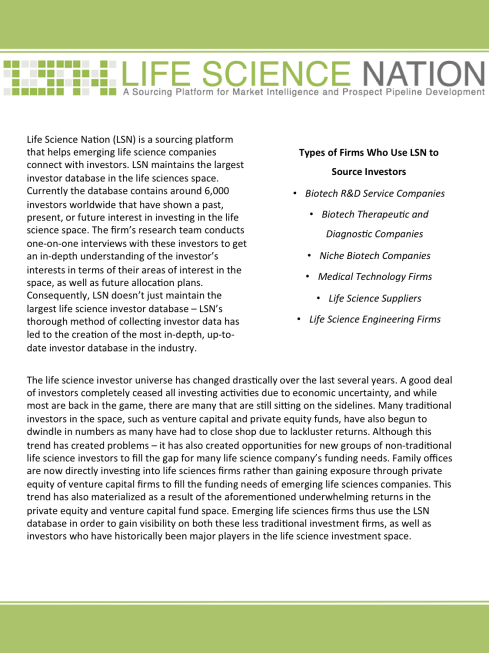
Life Science Nation (LSN) is a sourcing platform for market intelligence and prospect pipeline development in the life science arena. LSN enables life science professionals to generate a list of qualified global targets that are a fit for their company’s products, services, and fundraising efforts.
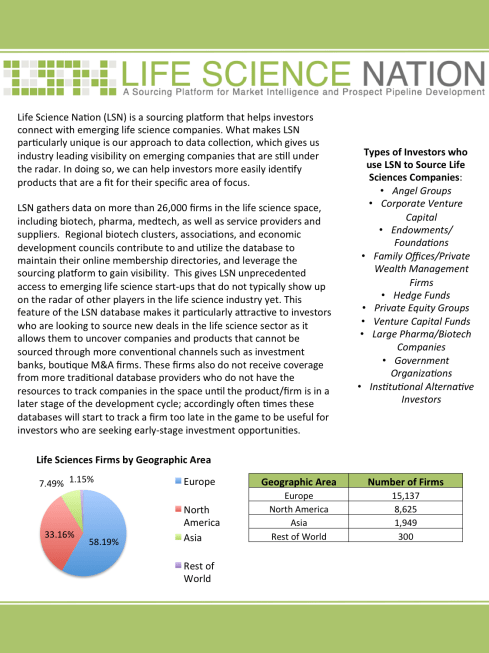
As a leading B2B source for decision-maker contacts in the life science industry, the LSN platform has more than 24,000 life-science organizations worldwide, including biotechnology, pharmaceutical, medical technology, service providers, suppliers, nonprofits, and investors. The LSN platform utilizes the most extensive research and data mining techniques to provide deep insight into target markets, top-tier accounts, and global business opportunities and help clients earn a measurable ROI on their marketing investment.
Contact
To learn more about Life Science Nation please contact,
Life Science Nation
9B Hamilton Place
Boston, MA 02108
Phone: +1 (617) 600-0668
Email: info@lifesciencenation.com
[1] Silicon Valley Bank, “Continued Rebound: Trends in Life Sciences M&A”, July 18, 2012
[2] Silicon Valley Bank, “Continued Rebound: Trends in Life Sciences M&A”, July 18, 2012
[3] Madison Park Group, “Guide to Venture Capital”
Posted on November 27, 2012. | Tagged biotechnology, consulting, family offices, fundraising, investor, life science nation, medicine, pharma, private equity, research & development, startup, venture capital | Leave a comment | Edit
Tags: Investors, letter, Life Science, news, newsletter

 There is not enough capital to fund all of the good ideas from life science companies, which is a major challenge for life science CEOs today. To identify the next not-so-obvious investors, fundraising executives should look to the capital-raising practices of start-ups in other industries. If they do, they will learn that the basic premises include thinking outside the box and being flexible and more creative.


 Next Phase Newsletter