Tag Archives: medicine

Personalized Medicine Trend Spurs Investments in Diagnostics

14 Mar

By Danielle Silva, Director of Research, LSN

There has been a great deal of buzz surrounding the topic of personalized medicine in the life science sector recently. Personalized medicine attempts to forecast a patient’s likelihood of being afflicted with certain diseases through genetic testing, and offers cures that are tailored to their specific needs. Thus, diagnostics and therapeutics are moving towards personalization based on an individual’s phenotypic and genetic makeup.

As a result of the Human Genome Project (HGP), which was completed in 2003, DNA sequencing has become much more accurate, and the cost of sequencing a single genome is dramatically lower than it was in the past due to advances made in the area of sequencing instrumentation (it’s estimated that the price is getting down to around $1,000 per genome)[1]. One of the uses for this lower-cost DNA sequencing technology is the development of individualized biomarkers. The development of these biomarkers, however, is just the beginning of the story; to truly develop a well-rounded therapy involves the use of a diagnostic as well, which is why investors have been drawn to investing in firms developing diagnostics as of late.

Overexpressed proteins (or genetic markers) are unique traits that are often associated with a specific disease. These are known as biomarkers. Creating a therapeutic that targets an individual biomarker can create a favorable result in terms of patient outcome. The biomarker, however, needs to first be located in order for the therapeutic to truly fall under the umbrella of a personalized medicine. The agent that locates the specific biomarker is therefore known as a companion diagnostic. The advantage of using such an agent is that it is easy to identify whether or not a given patient can benefit from the use of a certain therapeutic.

Because of the importance of companion diagnostics in the personalized medicine space, interest from investors in firms developing diagnostics has surged accordingly. From 2011 to 2012, the number of reported financing rounds in the Life Science Nation Financing Rounds database increased from 11 to 31. This represents an increase of nearly 182%. In January of this year, Cambridge, Massachusetts-based Foundation Medicine received $13.5 million in Series B expansion equity, adding to the $42.5 million they had received just four months prior in their initial Series B round. The firm focuses specifically on conducting cancer genomic analysis to match patients with a targeted therapy and clinical trial. In the area of cancer, the development of companion diagnostics is arguably the most advanced. This is a large reason why cancer diagnostics have been a particularly attractive area for life science investors.

In a recent conversation with a large corporate venture capital fund that typically invests in 5-10 firms per year, the firm expressed a particular interest in therapeutics with companion diagnostics. Advances in genome sequencing are predicted to continue, and if the cost of sequencing a single genome falls below $1,000 it is possible that insurance companies may even begin to start to cover some of the costs of this service. Consequently, LSN predicts that investor interest in the area of personalized medicine and diagnostics will continue to gain steam.

[1] http://articles.philly.com/2013-03-06/news/37503360_1_genetic-tests-caplan-expectant-parents

Indication Diversification: Big Pharma’s New R&D Driver

14 Mar

By Max Klietmann, VP of Research, LSN
 
I’ve written previously about how big pharma is changing in terms of targeting emerging biotech companies for acquisition, rather than investing in in-house R&D, but there are also profound changes taking place in terms of what indications are most attractive, and how to strategically approach the replacement of blockbusters that are about to fall off the patent cliff.
 
Big pharmaceutical and biotech companies were historically synonymous with blockbuster drugs: therapeutics targeting an indication afflicting a large patient population, such as cardiovascular disease or diabetes, drawing billions of dollars into the company while enjoying the price premiums afforded by robust patent protection. However, the impending patent cliff, which is the rapidly approaching inflection point at which many blockbusters will lose patent protection, means that these revenue streams will soon vanish and be replaced by cheaper generics. This translates to billions in sales lost to generic competitors. Worse yet, pharmaceutical companies are scrambling to find replacements for these revenue streams, and despite great effort and expenditure, there are few candidates with the potential to fill the gaps. Moreover, competition is highly aggressive for blockbuster indications, making it very easy to lose significant sums in R&D. However, strategically oriented pharmas understand this conundrum, and when it comes to blockbuster indications, the big pharma business model is evolving too.

Rather than sinking astronomical sums into major indications, the focus is beginning to shift towards a diversified portfolio of niche therapeutics targeting less common indications. This doesn’t necessarily mean orphan drugs (which have always had a clear advantage on the regulatory front), but simply those disease areas that were previously less attractive, e.g. pancreatic cancer or kidney cancer. This way, there is diminished completion for market position upon commercialization.

One large pharmaceutical plans to take this strategy one step further by focusing on therapeutics that target biological disease pathways, rather than specific indications, so that a drug can be re-purposed for a variety of indications further down the road. Multi-purpose drugs are by no means new to the space; plenty of scientists have argued that their pre-clinical compound is a panacea (many of these folks never get much further than this stage, as this “scattered” approach is often unattractive to investors who value a targeted and focused drive to market.) But multi-purpose drugs historically were repurposed due to favorable side-effects discovered by accident. What is happening today is very different; for the first time, pharmaceutical companies are strategically targeting drug candidates with the potential to treat several indications simultaneously. Specifically targeting these drugs creates the opportunity to develop a novel type of blockbuster via a multi-indication revenue stream approach whereby a single drug can become a multi-billion dollar product across a variety of smaller disease markets. However, it is important to remember the regulatory issues associated with multiple FDA trials for various indications.
           
These trends will be important for both early stage investors and life science CEOs moving forward on a track to partner with large pharmaceutical companies down the road. The most attractive indications of the future are not necessarily the largest single markets, and keeping a watchful eye on secondary disease areas will help to create a strategic approach to drug commercialization.

Sourcing New Science

14 Mar

By Dennis Ford, CEO, LSN

The two groups that everyone wants information on are academic scientists, and the private emerging biotechs & medtecs – scientists who have gone commercial. These two constituents make up the source where all the new science and technology is stemming from, but for several reasons, they remain difficult to consistently identify and map. However, the innovation currently occurring in the university labs and the fledgling private startups is where the next generation of life-saving drugs, devices, treatments and cures are coming from. More to the point, the rate of this innovation is accelerating as the knowledge that enables new discovery becomes increasingly available.

This is where the interest in innovators in academia and the emerging private sector comes from. The problem, however, is that no entity has effectively and efficiently linked it all together. Furthermore, there is a plethora of academic assets that are waiting to be discovered and brought to the light of day. Many entrepreneurial players in the industry – both large and small – would like to know what information is available, but the data assets of life science academia have not yet been aggregated in one central place. These assets are the scientists who are working on the research, and the technology that has been discovered and is in different forms of development, waiting to be licensed out of academic institutions.

There are two major opportunities that need to be addressed in the life science market. The first is the aggregation of both academic and private research & development under one user-friendly, affordable application. The reason is obvious in that as the life science business world starts to head towards the source, they need an easy way to find who they are looking for. The answer is a platform that solves the “finding” issue in such a way that encompasses both academic and private emerging biotech. The chart below represents the three life science source silos that represent the core data that the life science industry is searching for.

The second opportunity revolves around how academic scientists typically surface at and utilize forums and publications to connect-the-dots. While emerging biotech’s go to general themed conferences and utilize the side bar partnering sessions that are a big part of a life science B2B DNA. A great deal of the market place has been programmed to do partnering through conference attendance and partner showcases which typically is an adjunct side event. When it has been done as a pure partnering play it turns out to be so broad in the B2B concept that it is a virtual industry free for all. The truth is that there really isn’t a dedicated emerging biotech/investor partnering conference that has blown it out of the water yet, and therefore, a great opportunity exists to be that vendor.

Image

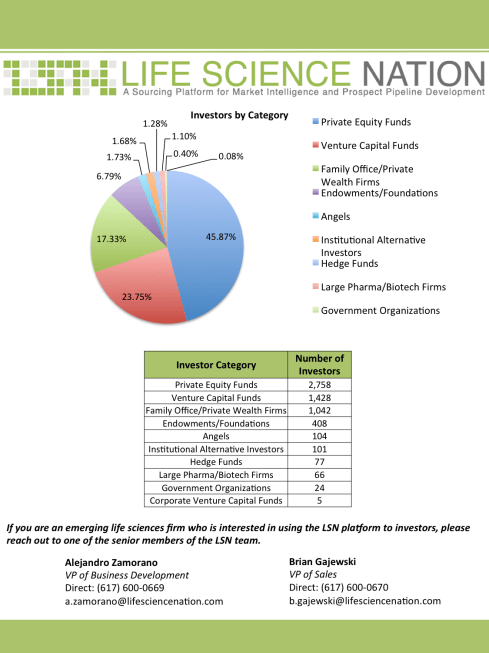
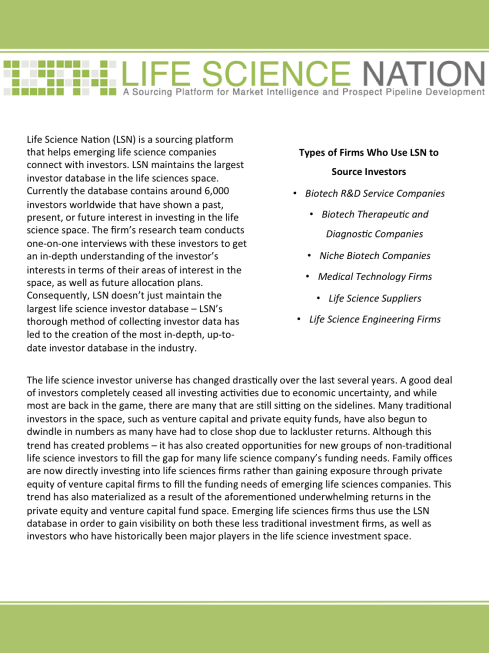
Intro to Life Science Nation – Investor Database

5 Dec

Idata2Idata

Image

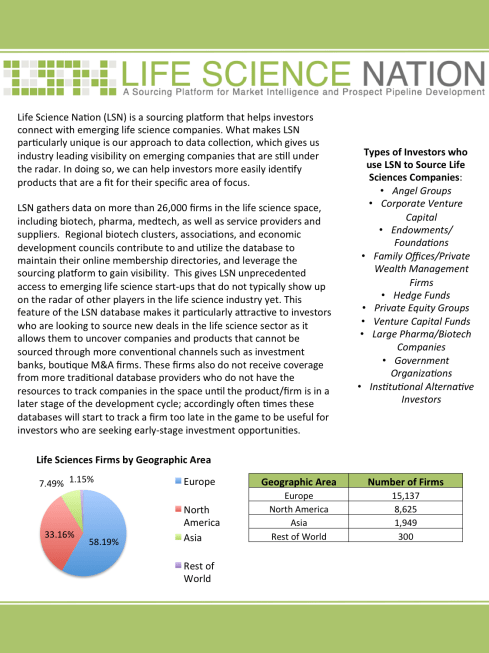
Introduction to Life Science Nation – Database Metrics

4 Dec

InvestorsInvestors2

Prospect Pipeline Development for Product and Service Providers

30 Nov

by Brian Gajewski, VP of Sales, Life Science Nation

The uncharted nature of emerging biotech makes it an extremely difficult space to navigate. New start-ups are not initially on the industry radar screen and big pharma projects are buried in the corporate maze. Product and service marketers typically spend 20% to 30% of their time generating new leads and qualifying prospects. CRO marketers often comment to Life Science Nation staff that an inordinate amount of time is required because the marketers are looking for the proverbial needle in the haystack—active biotechs and small projects within big pharma firms who are interested in their particular niche product or service. Regardless of whom your target is, life science marketers spend an enormous amount of time trying to find good prospects.

Conversely, emerging biotechs and big pharma have a difficult time sourcing reliable, top-quality product and service providers. Traditionally these entities have three ways for their internal staff to ferret out and vet these providers: word of mouth, information portals like Google, and partnering conferences. Still, it’s a time-consuming, brute force effort. The well-known data and information providers in the life science industry do little to help these marketers. None really track the small projects at big pharma well, and most small start-ups do not have enough size to fit the tracking metrics of the large data houses, so they are overlooked. Life Science Nation solves this “sourcing dilemma” by offering a platform integrated with a life science ontology that enables marketers – with just a few clicks – to effectively and efficiently connect with emerging biotechs and “small” big pharma projects.

Life Science Nation gathers data on more than 24,000 life science organizations, including biotech, pharma, medtech, service providers and suppliers, public/nonprofit organizations, and life science investors. Regional biotech clusters, economic development councils and life science conference show providers contribute to and utilize the database to maintain their online membership directories, and leverage the sourcing platform to gain visibility. This grass-roots aggregation allows LSN to identify and add emerging companies to the database very early on in their start-up cycle.

Life Science Nation offers the best of both worlds with its comprehensive coverage of all the large and small companies in the life science industry—whether that is keeping up to date with the large players or finding the latest small, innovative companies that will be the stars of tomorrow.

Valuation – What You Need to Know

27 Nov

By Patrik Frei & Benoît Leleux

Valuing a company has always been more art than science. In this article, we provide a basic outline of how to conduct a proper valuation exercise and present two common methods used to value an early stage biotech company.

Gauging value

A company’s value lies in its potential to generate a stream of profits in the future. All valuation exercises are thus based on envisioning a company’s future, relying almost entirely on educated guesses. Value is based on assumptions as to what a company’s future may look like, what important milestones will have to be met and strategic decisions taken. These assumptions are grounded in three fundamental factors: first, the state of the market targeted by the company; second, the principle elements of a company’s science and technology; and third, the ability of management to deliver on the business plan. We would recommend that every valuation start with a systematic and rigorous testing of a company’s economic, technological and managerial hypotheses in combination with the following two key approaches:

• Primary valuation, which is based on such fundamental information as projected future free cash flow (FCF) and costs of capital;

• Secondary valuation, which is based on comparable information, where valuation is done by analogy to other similar companies.

With a good understanding of the above two approaches, an entrepreneur is already well equipped to tackle the negotiations that will ultimately determine the deal valuation.

Fundamental valuation

The most common approaches to primary valuation in the corporate finance literature are generically referred to as the discounted cash flow (DCF) methods, whereby a company is valued at the present value of the future cash flows it will be able to generate. These methods are conceptually robust but can prove difficult to implement in high uncertainty environments, such as those of early-stage biotech firms. Typical problems include highly uncertain and distant positive cash flows, a business model based on many assumptions and a difficult risk profile. Corporate finance theory indicates that the value of any asset is equal to the present value of its future cash flows. Therefore, in principle, all that is needed is (i) to estimate the expected future cash flows of the business, and (ii) to discount back to the present all these future cash flows, using a discount rate consistent with the level of risk in the project. In practice though, problems emerge at every step of this process. First, projecting performance for several years into the future is a process seen by many as too speculative to be useful. Second, selecting a forecasting horizon for the future cash flows (5 years, 10 years or 20 years) is purely arbitrary and leaves open the question of the residual value of the business at the end of that horizon. Third, obtaining an appropriate discount rate for an early-stage, privately held company presents difficulties.

Projecting cash flows into the future is never an easy endeavor, especially for smaller, high-growth life science firms. The key data used for valuation is the FCF. According to Copeland, Koller and Murrin (1), “[FCF] is a company’s true operating cash flow.” In other words, the FCF refers to the cash flows free of (or before) all financing charges related to the corporate debts. These cash flows include all necessary fixed asset investments and working capital needs, as both are normally needed for a viable business. The FCF is estimated through the financial projections of the business plan. Depending on the available information and the time frame needed for a steady revenue flow, a forecast period of 5 or 10 years is most commonly used.
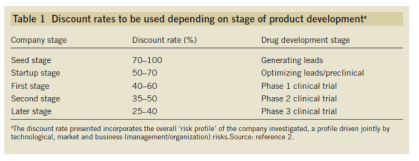
Table 1The easiest approach to determining the most appropriate discount rate in a DCF is one that would use the stage of development of the company, which can be determined by the drug development stage of products in the pipeline as proxies for risk (see Table 1). For example, a company that is generating leads without further developed products would be considered a seed stage company and a discount rate of between 70%–100% would be used. Although conceptually a bit loose, the method is surprisingly reliable. Several factors typically influence the risk profile of a biotech company. Once identified, the risk factors can then be used to determine the discount rate within the ranges provided in Table 1. The discount rate to be used in a DCF calculation depends on the degree to which a company fulfills each of the criteria. As the discount rate is critical in determining value, it is appropriate to spend time in meticulously assessing each criterion and to investigate the sensitivity of the results to the various parameters.

Comparable valuation

The comparable method is also known as a “secondary” valuation method because it uses the market value of comparable companies or transactions as reference points. The method relies on available key figures, such as earnings, sales, number of employees, number of PhD’s or R&D expenditures, to estimate value. In a sense, secondary valuation makes the assumption that these comparable companies have been properly valued, and can serve as benchmarks when assessing a company. For example, if a comparable public company is valued at $1,000 with R&D expenditures of $500, for a price/R&D ratio of 2, then the private company to be valued with R&D costs of $200 would, by analogy, be worth an estimated $400.

Closing remarks

Humility and realism are the two key attributes of the prospective company valuator. Humility is needed to recognize that the exercise is primarily about envisioning the future, and that the exercise is fraught with uncertainty. Realism will help to understand that the inherent uncertainties do not constitute an excuse for sloppy estimates of the valuation components. Whether the valuation is done explicitly (as in the DCF methods) or implicitly (as in the comparable methods), either method will give an accurate valuation if carried out by experienced valuators.

Although the valuation methods described here are routinely used by investors, we offer three important cautionary remarks to help the newcomer to watch for typical pitfalls. First, investors often refer to pre- and post-money valuations: pre-money is the value before the investment is included; post-money is the value including the new investment. Thus, pre-money value + investment = post-money value. Investors routinely play with different figures and company data. Numbers are their daily business and they may try to use them to their advantage.

Second, don’t enter into negotiations without having completed your homework. Management needs to master the figures and numbers and have clearly laid out its expectations about pre- and post-money value and the corresponding value of its shares. Only with preparation and a good understanding of valuation drivers can management establish itself as a credible partner in front of investors.

And third, valuation is not everything. The investment contracts that accompany investments can easily take away everything that was given in a rich valuation, by imposing drastic restrictions on the future conduct and wealth of the founders. Similarly, a company must feel comfortable with its investors because they will share the same bed, figuratively, for a long time to come. It would thus be foolish to maximize the short-term share price if it is at the cost of the long-term value creation potential of the company. Never lose track of the fact that a financing round is just a means to an end, not the end itself!

Patrik Frei is the CEO of Venture Valuation

This story was reprinted with some modification from the Building a Business section of the Bioentrepreneur. Web portal: (http://www.nature.com/bioent), 21 June 2004, doi:10.1038/bioent814.

1. Copeland, T. , Koller, T. & Murin, J. Valuation: Measuring and Managing the Value of Companies.(John Wiley & Sons, New York, 2000).

2. Frei, P. & Leleux, B. Valuating the company. In Starting a Business in the Life Sciences—from Idea to Market. (Luessen, H. (ed.).) 42–55 (Edition Cantor Verlag, Aulendorf, Germany, 2003).