Tag Archives: news

Opportunistic Family Office Invests in Life Science – December 11, 2012

10 Dec

A highly opportunistic, London-based private investor backed by a single family office LP in the life sciences space is interested in making 2-4 allocations over the coming six months. Within life sciences, the firm has no specific criteria for investment and will look at opportunities regardless of sector, indication, development phase or financing round. The firm has comfortably made allocations from seed stage financings to multi-million dollar, late-stage investments. The firm has a very long-term orientation and has the capital available to make several follow-on equity capitalizations for subsequent rounds.

If you are interested in more information about this investor and other investors tracked by LSN, please emailĀ mandates@lifesciencenation.com

Private Equity Investor Seeking Range of Life Science Opportunities – December 11, 2012

10 Dec

A private equity group that invests in the life sciences space based in New York with nearly $2 billion in AUM is currently looking for new firms for potential investments for their third fund, which targeted $650 million, and currently has $350 million in dry powder to deploy to new firms over the next year or so. The firm typically allocates $20-50 million per firm, and is currently looking for firms that are seeking growth capital. The firm is interested in medtech and biotech therapeutic and diagnostic companies. The firm is very opportunistic and will look at the full gamut of subsectors. In the biotech therapeutics and diagnostics space, the fund is most interested in firms focused on infectious diseases, cardiovascular disorders, and pediatrics. They are looking for firms that have products in phase I or II of clinical trials. The firm invests in companies based globally.

If you are interested in more information about this investor and other investors tracked by LSN, please emailĀ mandates@lifesciencenation.com

Family Offices: The New VCs

10 Dec

By Dennis Ford, CEO, Life Science Nation

dennis-websitThere is not enough capital to fund all of the good ideas from life science companies, which is a major challenge for life science CEOs today. To identify the next not-so-obvious investors, fundraising executives should look to the capital-raising practices of start-ups in other industries. If they do, they will learn that the basic premises include thinking outside the box and being flexible and more creative.

The economic turbulence of 2008 and 2011 has forced institutional investors and family offices to reevaluate how they fundamentally invest. The poor performance of some of VC and PE fund managers have concentrated fewer dollars in the hands of fewer managers, and the increased competition for those scarce dollars have slowed the life science market at a time when the number of potential technologies and products are surging. The banks, pensions, endowments, and insurance funds that made up a large portion of new VC and PE funds have become risk averse.

However, a new paradigm is emerging: family offices, the investment and philanthropic arms of ultra high net worth families and individuals, are becoming the new VCs. The void left by the institutional investors is, to a surprising extent, now being filled by family offices. They have brought Wall Street talent in-house and adopted and incorporated all the processes and procedures of alternative institutional investors. There is a lot of press being generated about this new opportunistic investor in the life science arena.

The big win for life science fundraising executives is that unlike traditional alternative institutional investors, family offices are not solely driven by a rate of return. They also want to see their investments benefit and impact the world. This opens yet another door for life science entrepreneurs: starting with the philanthropy arm of family offices.

The fact of the matter is that philanthropy and life science investment go hand in hand. Bill Gates, Warren Buffet, Michael J. Fox, and many other billionaires and celebrities have all contributed to making it politically correct to be globally aware and to put capital behind facilitating science and technology that can change the world.

Life science fundraising executives who are quick to take advantage of the shifting investor landscape have an opportunity to find investors who are interested in their company’s research and at its current stage.

According to a Grant Thornton/ Prince Associates survey of domestic and foreign family offices during the first quarter of 2012, the average investible assets of a family offices are roughly $276 million, and seventy-eight percent of family offices already invest in private equity in some form. This equates to a multi-billion dollar asset pool that is rapidly expanding. A similar survey in 2009 found only about 30% of offices involved in this space. Of those family offices that invest in private equity, 17% put 25% of their investable assets or more to work. More common is between 10% and 25%. Forty-seven percent of offices fall in this category. Increasingly this group is moving away from funds and moving towards direct investments, which is major news to CEOs looking to raise capital and represents an unprecedented shift in the industry.

Comparison of early stage funding in the US and EU – who gets more money?

10 Dec

By Patrik Frei, CEO, Venture Valuations

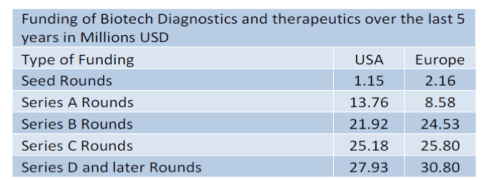
It is a common perception that privately-owned biotech firms seeking funding in the United States receive more money per round than their European counterparts. However, when comparing and analyzing the financing rounds of biotech companies working in the field of diagnostics and therapeutics for both geographies, it is clear that this is not the case. We looked at 156 financing rounds in Europe and 265 in the US over the past five years for biotech therapeutic and diagnostic companies, all of which are listed in the Life Science Nation database. For each data point, we had at least nine financing rounds.

The table below shows the average value by financing round in both the US and Europe over the last five years. In later financing rounds – especially series B, C, D and above – the average value is nearly identical in both the US and EU. We can see, from the table below that the largest variances in financing rounds come right at the beginning of the biotech’s life; in seed financing (61% higher in Europe) and Series A financing (46% lower in Europe).
t1Source: Life Science Nation

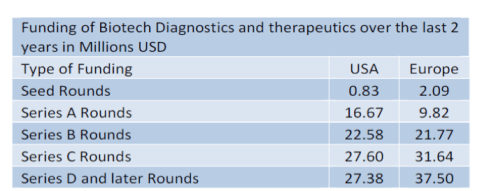
Looking at the table of just the last two years below, we can again see that the US does not receive more money compared to Europe. In fact, the difference between average financing rounds in the US and EU shrank for both series B and C financing. On the other hand, regional disparities for Seed and Series A financing becomes even more apparent. The percentage difference between seed rounds grows to 85% in Europe’s favor while the US widens the gap in series A financing up to 51%.

It should be mentioned that the gap in series D and later rounds also grew substantially in Europe’s favor. It is our opinion that this difference is largely due to outlier effects on a decreased sample size. In April of this year, Circassia, a biotech firm in the UK, closed a GBP 60 M (USD 98 M) series D round, significantly skewing the data set for Europe’s ā€œSeries D and later Rounds.ā€

t2Source: Life Science Nation

We have seen that differences do exist between the US and EU when it comes to early stage funding – specifically, Seed and Series A financing rounds. But what causes these differences? We believe that one causes the other.

One reason for the differences between seed funding could be the increased availability of early-stage funding in Europe as opposed to the US. In A Comparison Between European and U.S. Venture Capital Industries, Vanessa Anderson and Frank Brinkhaus, PhD,cite initiatives such as the European Seventh Framework Programme (FP7) and Innovative Medicine Initiative (IMI) which combine to funnel up to USD 3.8 B into European small and medium sized biotechs, as resources that make funding more easily available. More angel investors and family offices may also allow European biotechs an easier time acquiring early stage funding while the US is left to finance through the three F’s (friends, family and fools). Additionally, there might be significantly different criteria for receiving funding between the US and EU. Since FP7 and IMI, as well as other initiatives, have the goal of fostering an emerging biotech industry in Europe, a comprehensive business plan and top-quality technology must be looked at alongside the potential for job creation and other economic stimulation when determining which firms will receive seed financing. Simply put, the focus is not always on what firm will have the greatest returns, but rather, where the greatest value is created for the economy as a whole. Secondly, the biotech industry is more mature in the US, and therefore, early investors have more experience determining value from business plans and early technology.

If it is the case – that funding for start-up capital is harder to come by in the US than it is in Europe – this may be the reason the US has higher A financing rounds. In the US, only those companies showing considerable promise, a unique technology, solid business plan, and extensive management capabilities and experience will receive the capital necessary to start-up their biotech. If only the most promising firms receive start up funding, there will be a ā€œweeding outā€ effect, meaning only those most promising biotech firms will be seeking venture capital funding for Series A rounds. Financing is done in rounds to allow venture capitalists to see important milestones without having to commit all their money up front. This allows the VC’s to wait for less risk before they inject more money. If a US biotech firm is able to show an exceptional technology has been taken through the proof of concept stage, and the management has done it under considerable monetary constraints as opposed to its EU counterparts, VC’s should view this as a high up-side potential company with a decreased risk profile. Consequently, venture capitalists will be willing to invest more in a Series A rounds to own a larger share of the biotech company.

If you would like to get more information on the individual data points or search any of the over 3,000 financing rounds in the life sciences space, please have a look at the Life Science Nation database. http://www.lifesciencenation.com

Big Pharma Pursues Early Stage Opportunities for Direct Investments

10 Dec

By Max Klietmann, VP of Research, Life Science Nation

Increasingly, over the past few years, large pharmaceutical and biotech companies have been slashing in-house basic R&D budgets at a fast clip. But at a time when the industry is performing remarkably well and basic R&D is more critical than ever, this trend may appear confusing to many observers. However, what many do not recognize is that this is not a cost-cutting trend (though it is saving considerable money for many firms). Rather, it is reflective of a novel means by which the R&D pipeline is being approached from the ground up, reflecting major changes in the industry over the past decade. In the past, pipeline gaps were filled with the intent of maintaining market share, and in order for a biotech to be a fit, the product needed to be relatively far down the pipeline. Now, all of that is changing.

The reason is a massive paradigm shift in the collective ā€œbig pharmaā€ psyche. The nature of the marketplace has changed in that the best researchers with the best ideas are no longer seeking out positions within big pharma, but are starting their own companies, largely due to the fact that CRO’s and other outsourcing partners in the space have made it possible to do groundbreaking research with minimal investment in infrastructure. Some might see this is a problem, as big pharma seems to be starved of innovation and desperately needs to refill dry pipelines. However, this isn’t necessarily bad news – the opportunity for pharma to selectively buy into independently developed projects on a global basis allows for a geared ROI on the R&D budget and introduces an enormous amount of fresh capital to the marketplace at the early stage (an area that many VC’s have all but abandoned).

Traditionally, big pharma wasn’t even on an emerging biotech’s radar screen until a product was entering later stage clinical trials and required a strategic partner to enter the marketplace. Simultaneously, the large pharma and biotech firms’ search & evaluation teams tended to focus their energy on discovering opportunities to plug existing pipeline gaps closer to market, and not on early stage assets that could form the basis of the forward-looking R&D pipeline. This is changing rapidly and the implications are massive; large pharma is increasingly focusing efforts towards building bins of the pipeline from the ground up by investing in small and emerging biotechs. Sanofi made a major announcement earlier this year that the firm would be reducing its R&D budget by 12% vs. 2008 to reflect efforts to move into this direction, and in April, Merck announced a $250 million biotech fund raised together with Flagship Ventures, one of the handful of remaining venture capital firms that invest in early-stage biotech companies at all. The capital is provided Merck Research Ventures Fund with the specific mandate of investing strategically in early-stage companies.

Eli Lilly and GSK also announced major investments in start-up stage life sciences companies in the last year, in particular therapeutic companies, and the trend is accelerating. This is great news for emerging biotechs, who are struggling to find capital, as traditional sources of financing have all but dried up, however the challenge remains for big pharma to effectively target the most interesting strategic opportunities in a ā€œgray areaā€ of the market.


Image

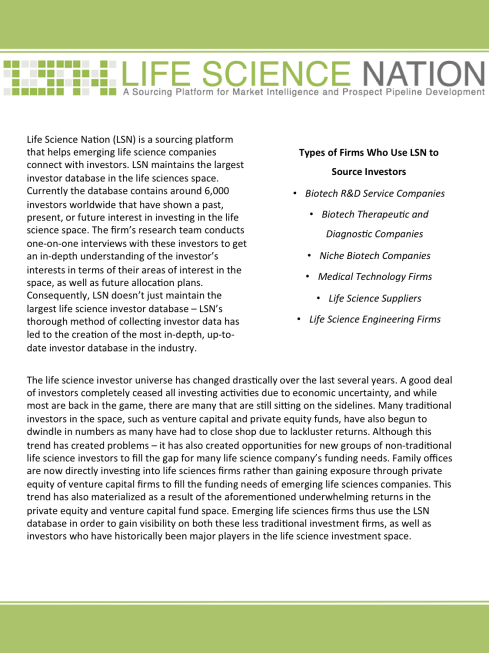
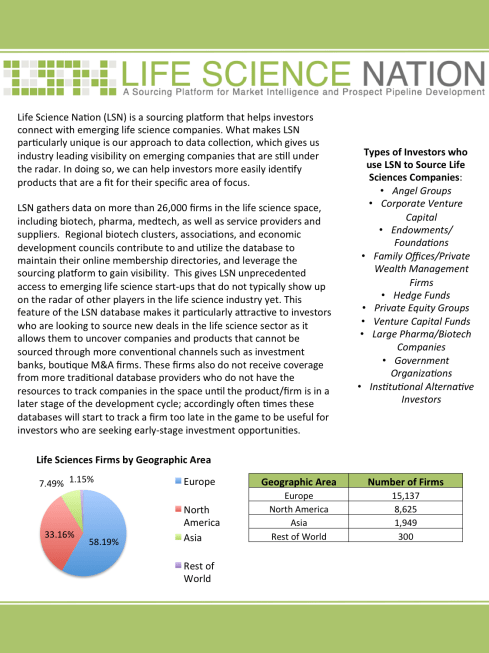
Intro to Life Science Nation – Investor Database

5 Dec

Idata2Idata

Image

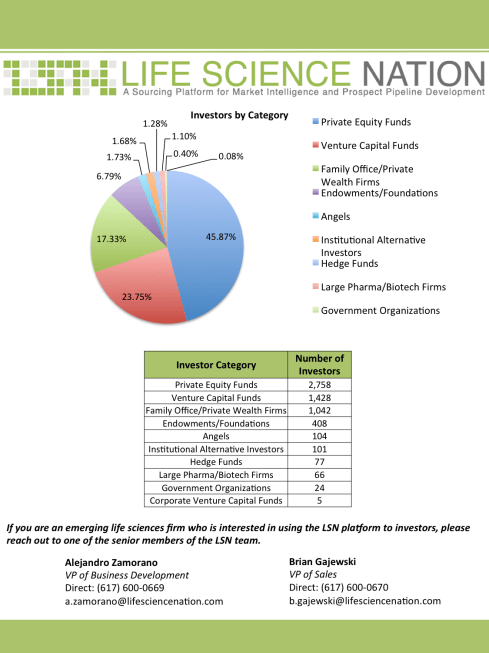
Introduction to Life Science Nation – Database Metrics

4 Dec

InvestorsInvestors2