Category: Redefining Every Stage Investments (RESI)
The Redefining Every Stage Investments (RESI) Conference is an ongoing conference series that provides an international venue for life science companies across Biotech, Medtech, Diagnostics and Healthcare IT and to source investors from around the globe, create relationships, and eventually, secure funding.
By Natasha Eldridge, Marketing Manager, Life Science Nation
Panelists will discuss in-depth the key motivators behind big pharma’s shift towards an early stage strategy as a way to fill the gaps in their pipelines. What indication areas are the most sought after? How does an early stage entrepreneur interface with business development executives from pharmaceutical companies? LSN’s Big Pharma RESI Panelists will shed light on these questions and more.
Moderated by Donnie McGrath, VP, Business Development, Bristol-Myers Squibb this panel will feature:
Sylvaine Cases, Head of External Science & Partnering,US West,Sanofi
Hear from big pharma executives as they explain how they engage with early stage startups, and how they like to be contacted. The speakers will help the audience understand their timeline for contact, and give advice on how to create a dialogue that leads to a relationship and an eventual alliance. If you need to understand the timeframe and limitations of how big pharma corporate works, this expert session is crucial for you to attend.
LSN Research often hears from investors that when choosing a company to invest in, a sound management team is just as important a factor as the quality of that company’s technology. Developing an innovative biotech or medtech product is a lengthy process fraught with risks, and it takes a strong management team to successfully guide a scientific discovery through all the challenging steps. So what are the qualities of the ideal management team, and how will investors judge whether yours has what it takes? Investors have reported the following important attributes:
– A Balance of Expertise
It goes without saying that investors feel most confident working with people who are experts in their fields of technology. However, many investors have told us that they look for management teams with a balance of skills, both in science and in business. While deep expertise in a company’s area of technology is valued, some investors are apprehensive about working with a scientist who has a solely academic background and lacks familiarity with the mechanics of turning IP into a commercial business. For example, an inexperienced manager might not be able to position the company to meet the needs of commercial partners, even if the company’s scientific program is carried out highly effectively.
– Ability to Build Value
Investors often stress that a scientific discovery in itself doesn’t make a company valuable. The management team has to build value by developing and positioning the technology for commercialization. They must have a solid plan for how to achieve this, and show that they have the ability to execute on this plan as well as adapt to any changes that occur on the way. A team must also demonstrate that they have the vision to grow a company and will be able to handle difficulties that may arise, such as issues with competitors and regulatory requirements.
– Capacity to Strategically Work with Partners
Developing and commercializing a biotech or medtech asset requires coordination with development and strategic partners. Management teams not only have to identify the right partners for their company, but also must ensure that their work is carried out according to those partners’ requirements. Big pharma scouts are typically very focused on this quality in smaller collaborators; they want a management team that shows awareness of the particular data the partner needs to see, and how to structure a study in order to obtain that data. Working effectively with others may be particularly challenging if the company has multiple partners who have differing goals that they require the management team to meet.
– Ability to Adapt with the Changing Environment
Considering the long development time frame that is required for healthcare products, it’s very likely that a company will be affected by changes in the landscape that occur as they move forward. Certain factors that are favorable today, such as buoyant public markets for biotech companies and an increasing pace of FDA drug approvals, might change in the future. Investors need to rely on the management team to continue to build the company’s value even if the environment becomes more adverse.
– A Solid Track Record
In order to gauge the strength of a team across all of these factors, investors typically study the group’s track record in great depth. Even if you’re not a serial entrepreneur, it’s important to highlight your relevant past experiences, both successful and not. Have you operated in a challenging environment? Have you demonstrated your ability to adapt to changes in your field? As one experienced investor told us recently, there is never a way to guarantee that a management team will be able to succeed, but indications of experience and depth throughout their track record increase the odds.
A great technology can be doomed to failure without the right team and while many investors are willing to tolerate scientific risk, they generally pass whenever they feel this risk extends to management or execution. Keep these variables in mind when you are building your team and identifying your strengths and weaknesses, and your company will have a much higher chance of making it through an investor’s vetting process.
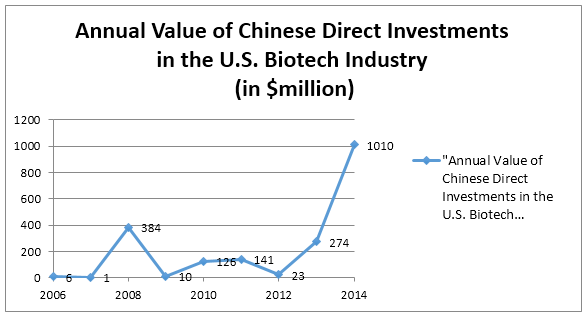
As China’s economy has grown over the past 10 years, Chinese investors have begun to allocate their capital to companies overseas, including those in the U.S. life science industry. Figure 1 shows that the annual value of Chinese direct investments in the U.S. biotech industry has increased most rapidly in the past two years.
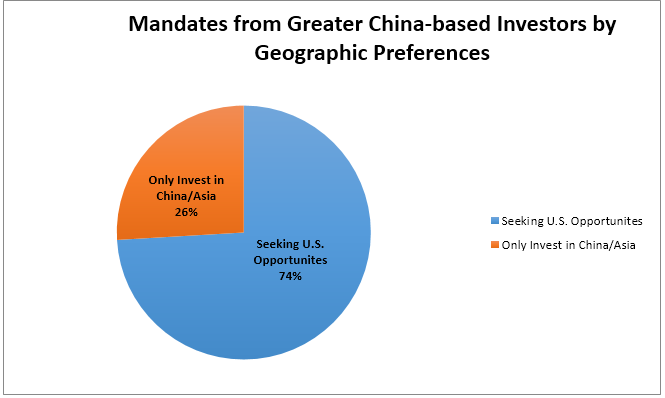
Of the Greater China-based life science investors interviewed by LSN Research, a staggering 75% are interested in opportunities based in the U.S. [See Figure 2.]
Figure 2 Source: LSN Investor Platform data as of May 12, 2015
Let’s take a look at the factors that make the U.S. life science industry an attractive opportunity for life science investors based in China.
Rising Chinese Wealth
China now has the world’s second largest millionaire population—over two million millionaires as of 2013.(1) Additionally, many Chinese companies have increased their resources and are interested in investing capital overseas for both financial and strategic purposes. Many of these companies and individuals are particularly interested in investing in the U.S., where patent and legal systems can provide better protection for their investment assets than in China.(2) These investors are often interested in diversifying their investments across U.S. industries, including the life science and healthcare fields.
Strong Life Science Industry and Innovation Ecosystem
The U.S. is the global leader in the life science industry, with a complete value chain from R&D to market and distribution. Some 46% of global life science R&D is carried out in the U.S., which is one of highest shares in any industry.(3) Solid financing supports the research successes in the U.S., with NIH funding supporting life science companies at a variety of stages of development via STTR and SBIR grants.
The U.S. has many other resources for early stage life science companies that are scarce in Greater China, such as incubators that provide financial assistance and expertise to life science start-ups. Since 2012, at least 12 new biotech incubators have been founded in North America to provide support to life science start-ups spinning out of academia.(4) The increasing numbers of biotech incubators launched by academic institutions, laboratories, medical centers, and top pharma companies are well placed to provide space, equipment, services, expertise, and other resources to early stage companies. These companies are developing innovative technologies and are prepared to move to the next stage of their development, and many are therefore attractive investment targets.
Talented Entrepreneurs and Access to Expertise
In the U.S., large bioclusters have formed in cities that boast top universities and research institutions. A large number of talented entrepreneurs have emerged from those universities, which provide access to expert scientific guidance. This talent pool provides early stage life science companies with leadership that supports companies in their development process. Investors generally put great emphasis on the quality and depth of a management team, and companies based in U.S. life science hubs are often able to satisfy this requirement.
Exits
For life science investors, return on investment is key, and exit opportunities are therefore an essential consideration. With the number of IPOs among U.S.-based companies up 66% in 2014 compared to 2013, the market for life science IPOs is hot.(5) The U.S. also sees significant M&A activity in the life science sector, thus providing multiple avenues to exit.
Challenges
For foreign investors seeking opportunities in the U.S., barriers and challenges are unavoidable. The time difference might make it difficult to set up a meeting, and cultural differences might cause misunderstandings between investors and entrepreneurs. Also, Chinese investors may not have expertise navigating the U.S. regulatory system, whether for financing or clinical development. All parties must be prepared to address these unique difficulties.
Over time, we have come across several China-based investors employing creative methods to overcome these challenges. A few larger institutions have set up outposts in major biotech hubs such as San Francisco and Boston. These overseas offices act either as scouts for new technologies or as bridges to expand the parent company’s business operations. A considerable number of consulting and broker agencies are emerging to provide services to China-based investors who are looking to increase exposure to U.S.-based companies.
However, as this article has outlined, there are compelling reasons that Chinese investors are interested in U.S. start-ups, and LSN Research has contacted many investors in that region who have expressed such interest. We expect that increased connections and communications will pull Chinese investors and U.S. companies more closely together in the future.
By Natasha Eldridge, Marketing Manager, Life Science Nation
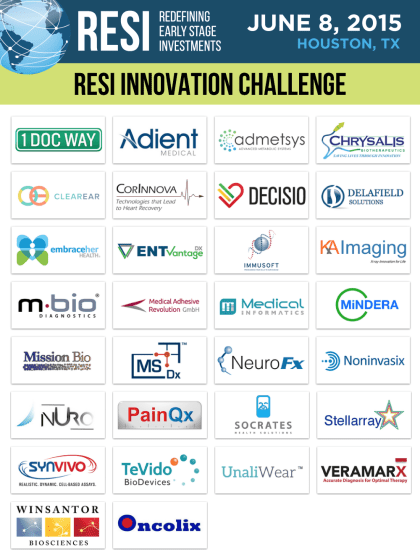
The RESI Innovation Challenge is taking place in a new home in Houston Texas on June 8th at TMCx and will feature 30 handpicked early stage biotech, medtech, diagnostic and healthcare IT innovators from around the country. These entrepreneurs have been selected by LSN’s scientific validation team to receive a presentation space in the exhibit hall for the full day of the conference to showcase their innovations to investors and fellow entrepreneurs. LSN has found repeatedly that companies presenting in this venue interact with more investors—and with more meaningful dialogues—throughout the course of the day than would be possible in a traditional 15-minute pitch contest.
To add some friendly competition to the mix, the RESI Innovation Challenge invites all attendees to participate in a virtual investment contest. At the start of the day, each attendee will receive “RESI Cash” to allocate to the entrepreneurs whose technologies they expect will be most influential. The capital that was invested will be tallied up and the top three winners will be featured in our RESI newsletter recap that will go out to LSN’s 20,000 newsletter readership.
First prize winner of the RESI Innovation Challenge will receive complimentary subscription to the LSN Investor Platform for a year.
Second prize winner will receive two complimentary RESI tickets, to be used within 12 months.
Third prize winner will receive one complimentary RESI ticket, to be used within 12 months.
Whether you are an investor, an entrepreneur, or a service provider, make sure you check out the exhibit hall to meet with some of the top innovators in the field and invest your “RESI Cash.” We will see you there!
Developing and commercializing a product in the life science space is notoriously capital intensive and usually involves a high level of risk. To assist with this difficult development process, many organizations have formed that are designing and utilizing new approaches to help move science forward in the early stages of development and clinical research. These include Studios, Incubators, Accelerators, and Funds that aim to create more financially efficient and de-risked models of engagement for companies and investors. The RESI conference will bring together some of the best and brightest of these groups to discuss how they are creating, coaching, and funding life science companies in a more productive manner.
During this panel, moderated by Dennis Ford, CEO & founder of Life Science Nation, the audience will hear from:
Although the forming of virtual companies has shown great promise in reducing costs and keeping companies nimble, along the product development pathway, many inefficiencies remain. This panel will discuss what some of the most cutting-edge groups in the space are doing to tackle these challenges. Conference attendees are sure to gain insight from these individuals who are working to make the life science product development process more streamlined.
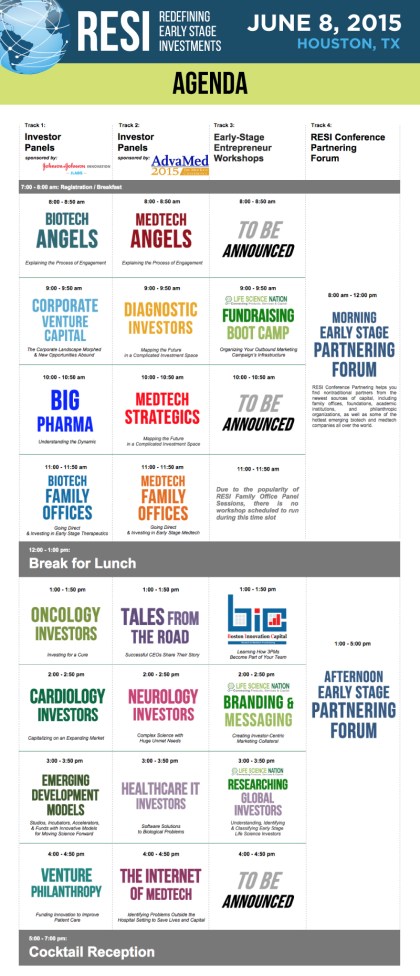
LSN founded the RESI conference with the goal of providing a venue for life science CEOs to build relationships with potential investors and partners. In addition to the opportunity to book up to 16 back-to-back partnering meetings, RESI offers a full day of panel sessions at which CEOs can hear the latest on tactical fundraising straight from leading life science investors. And since each of the 16 sessions is focused on a different life science sector or investor category, RESI’s panelists can speak to a diverse range of companies, offering relevant experience from throughout the biotech, medtech, diagnostic, and healthcare IT fields.
The RESI @ TMCx morning session will offer separate biotech and medtech panels, featuring angels, family offices, and major healthcare corporations that work with startups in these areas. In the afternoon, RESI’s panels will be more topical, with two sessions devoted to new funding alternatives in life science — venture philanthropy and emerging development models — and six sessions focused on fundraising . Finally, in the Tales from the Road session, the audience will hear from start-up CEOs about their recent experiences in raising money to grow their companies.
Throughout these 16 panels, active life science investors will share their insight and provide tactical advice on outreach, positioning, and building the right relationships to move your product forward. Visit the RESI @ TMCx agenda and click on each panel to view the full speaker lineup.
LSN has partnered with Meeting Mojo, an emerging partnering portal developer based in the UK to develop the RESI Partnering Platform. RESI attendees can use the system to find other attendees who are a fit for their product, development stage, and other relevant factors. This highly customized solution uses metatagged profiles populated by LSNs propitiatory investor data that can be searched by the entrepreneurs to pinpoint a specific fit for an investment mandate by one of the investment firms present at RESI. The RESI Partnering Platform provides the foundation for a one-of-a-kind partnering experience based on current investor mandates that can be easily matched to the emerging biotech and medtech startups that fit the investment criteria.
In short RESI partnering provides an opportunity for life science companies and investors to meet the right people, create compelling dialogues, and foster long-term relationships.


 Panelists will discuss in-depth the key motivators behind big pharma’s shift towards an early stage strategy as a way to fill the gaps in their pipelines. What indication areas are the most sought after? How does an early stage entrepreneur interface with business development executives from pharmaceutical companies? LSN’s Big Pharma RESI Panelists will shed light on these questions and more.