Tag Archives: economy

How to Identify Best-Fit Investors at Partnering EventsĀ 

27 May

By Sougato Das, President and COO, LSN

Sougato-DasPartnering conferences are a great place to meet investors, in-licensors and strategic partners. These events tend to be segmented in the following ways:

1) Focus: General, Licensing/BD or Investment

2) Modality: Biotech, Device/Diagnostics, Digital Health

3) Therapeutic area: General or Therapeutic area-specific

4) Stage: General or Early Stage

While it seems obvious, it is critical to align your events (and your limited time and budget) with your company objectives. In my experience at dozens of different partnering conference, I’ve found that each of the above are largely binary. For example, while a Licensing/BD conference will have some investors attending, you’ll have many more meetings with investors at a investment-focused meeting. And vice-versa. Additionally, an interesting pattern that I’ve noticed is when it comes to stage, a partnering event that has a general focus tends to skew late-stage (clinical or later, with lots of players looking for phase 3 or commercial assets). This leaves companies with preclinical or early clinical assets scrambling to identify and meet the relatively few investors who are interested in early-stage companies.

Since partnering conferences allow for a limited number of outgoing meeting requests that can be in the ‘requested’ state, it’s important for you to be able to identify the attending investors that are a good fit for your company. This is complicated by the fact that investors typically don’t do a stellar job populating their profile with information that makes their remit clear. While it may be tempting to use the filters provided by the partnering system to identify best-fit investors, this ONLY works if every investor profile is consistently populated. Why? Because blank values are not returned in filtered searches. What does that mean? That means that if you use the filters in the partnering system to look for those who invest in oncology, and there are some oncology investors who have not filled out their therapeutic area field in their profile, those investors will not be returned in the results. Some partnering conference providers, such as RESI, prevent this issue by having the staff populate the investor profiles on behalf of the investors, ensuring that all profiles are complete and searchable.

All that said, what do you need to look for to find the investors that fit your company best? The most important criteria (that you probably know already if you’ve done any investor outreach) is stage. “Too early” is a response that every pre-clinical and phase 1 company has heard a million times. At RESI it’s easy. You can filter accurately on stage. But at other conferences that depend on the investor to self-populate their profile, you’ll have to read the profile carefully and visit the website. If it doesn’t say explicitly, then look at the portfolio companies.

The next aspect is the assets under management and the check size range. This kind of information not only shows if the investor is appropriate for the amount you’re raising, but also shows if the investor is indeed an investor and not a financial consultancy or investment bank (in some conferences, such entities end up being classified as investors).

Next, and as alluded to above, is the therapeutic area focus. While many investors go across therapeutic areas, some focus on only one or a few.

Next is the modality. Of course if you’re a med tech investor you don’t want to target a biotech-only investor. Within biotech, there are some investors that only do advanced therapies and some who do everything except advanced therapies. Etc.

Next there is the geographic focus. Some investors target specific geographies.

Finally, there is the investor type or model. Not all investors are equity investors. Some are debt, some royalty, some are venture builders, some are CROs that provide services for equity, etc.

If you have access, looking up the investor in Life Science Nation’s investor database will return all the details you need with regard to the above. Other databases have information on investments a given investor made, which provides some insight. By ensuring the investor you send a meeting request to is actually suitable for your company, you’ll maximize your ROI and, with any luck, extend your cash runway.

Register for RESI San Diego

Merck, Servier & Meiji Pharma Leaders Share Pharma BD Insights Ahead of RESI San Diego & Convention Week

19 May

By Sougato Das, President and COO, LSN

Sougato-DasAs partnering activity ramps up ahead of convention week in San Diego, early-stage life science companies are preparing for a critical week of fundraising, licensing, and strategic business development. To help companies better understand how large pharmaceutical companies evaluate new opportunities, Life Science Nation is hosting a webinar featuring leaders from Merck, Servier, and Meiji Pharma USA.

The webinar, Large Pharma BD & Investment: Merck, Servier & Meiji Pharma Prep You for RESI & Convention, will take place on June 2, 2026 at 1:00 PM ET and will be moderated by Sougato Das.

Carla-Bauer
Carla Bauer
Director, Search and Evaluation, BD & Licensing
Merck
Irene Blat
Irene Blat, PhD
Head of External Innovation, NA
Servier
Sho-Takahata
Sho Takahata
Senior Director, Venture Investment
Meiji Pharma USA

The discussion will explore how pharma companies source and evaluate external innovation, what teams look for during initial meetings, how internal screening processes work, and what makes a company stand out for continued engagement. Topics will also include licensing, R&D partnerships, strategic investment, platform collaborations, and practical tips for improving partnering conversations during convention week.

For companies preparing for RESI San Diego and broader convention week activity, the webinar offers an opportunity to hear directly from pharma business development and investment leaders before arriving in San Diego.

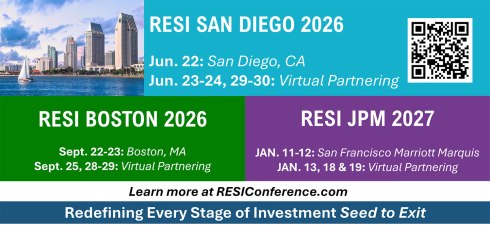
RESI San Diego begins June 22 with an in-person conference day followed by four days of virtual partnering on June 23–24 and June 29–30, connecting early-stage companies with active investors, pharma scouts, strategic partners, and global healthcare stakeholders.

Sign Up for the Webinar

Do RESI San Diego and BIO Overlap?

12 May

By Sougato Das, President and COO, LSN

Sougato-Das

The fourth week of June is one of the largest gatherings of life science business development and investment professionals on the calendar, second only to JPM. If you are an early-stage company raising anywhere from $250K to $75M, that week in San Diego is not optional. The question most founders are asking right now is whether attending RESI means missing BIO.

The short answer is no. Here is why.
RESI partnering starts early morning on June 22. BIO Convention partnering does not start until early afternoon. That means you can run a full morning of investor meetings at RESI before BIO gets going. The two venues are about 15 minutes apart, making it straightforward to move between them in the afternoon. RESI has virtual days both that week and the following week, so any meetings that do not fit in person can be held on Zoom with no schedule conflicts.

If you find yourself double booked across both events on Monday afternoon, the partnering systems give you real options. Move the Convention meeting to another day. Move the RESI meeting to the morning or to a virtual slot. Or simply decide which meeting matters more for your specific raise. Having choices is better than not having them.

Fundraising is a numbers game. Companies with tight budgets need to maximize every hour and dollar spent in San Diego each week. RESI is not a scheduling conflict. It is more meetings with investors and pharma external innovation teams that are specifically focused on early-stage deals. Add it to your agenda.

Bonus: Increase your networking ROI by attending the many side events and receptions during Convention week. Luckily we’ve assembled the most complete list for you! Click here.

Register for RESI San Diego

Convention Week: How to Get the Most Investor/InlicensorĀ Meetings & ExposureĀ 

5 May

By Sougato Das, President and COO, LSN

Sougato-Das

Prep for the June mega-events in San Diego, BIO Convention and the neighboring RESI, starts now. We’re 7 weeks out and it’s getting warm. In another week, the Heat is On by Glen Frey. Three weeks or so after that, scheduling starts and it’s Hot Hot Hot by Buster Poindexter. Finally, when partnering starts on June 22, it’s the Heat of the Moment by Asia. 80s music references aside, here are the top things you need to do NOW to ensure your company succeeds:

  1. Register. Want to meet investors funding seed through series B and pharma external innovation? There will be over 300 at RESI. Click here to take advantage of RESI early bird rates.
  2. Consider registering to pitch, with many opportunities throughout Convention week. Pitching at RESI puts you in front of a panel of well-aligned investors who are obligated to be interactive and give you feedback.
  3. Log into the partnering system and find your ideal partners. Repeat this every week to account for new registrants. At RESI this is straightforward as the LSN staff populates investors profiles very granularly based on the LSN Investor Database. Investors are carefully vetted. Searching for investors interested in a given modality, disease, geography, stage, etc. is fast. Searching for well-aligned partners in the larger Convention ecosystem can require more oversight (e.g. is an in-licensor looking for early stage, late stage or on-market assets?) Join my webinar to learn the best way to do this!
  4. Open as much availability on your calendar/agenda as possible. Convention week is NOT the time to block the early morning time slots because you want to sleepĀ inā€ÆšŸ˜‰
  5. Send customized meeting requests. Meetings are more likely to be accepted if you spend some effort customizing each meeting request to the interests of the receiving company. Join my webinar to learn the best way to do this!
  6. Minimize the number of people from your company who are required to attend the meeting. The fewer people in the meeting the more likely it is to get scheduled (if it’s accepted).
  7. Follow-up on unanswered meeting requests. As someone who’s been behind the scenes running partnering at dozens of partnering events, I can tell you there is a complex series of variables that determines if your meeting request gets accepted. Sometimes it’s as simple as the person who would accept your meeting request did not register until later, even though his/her colleagues registered earlier. That’s why it’s important not let unanswered meeting requests languish indefinitely. Join my webinar to learn the best way to do this!
  8. Cancel ā€˜dead’ unanswered meeting requests. When you determine you won’t get a response for a given meeting request, cancel it to increase your meeting request allotment. Join my webinar to learn the best way to do this!
  9. When scheduling starts,Ā immediatelyĀ reach out to the other party for meetings that cannot be scheduled due to lack of mutual availability. You can also try reaching out to the partnering system administrators to see if they can help.
  10. Practice your meeting presentation to ensure everything gets finished in the allotted time.Ā For Convention, 25 minutes is a good guide, as meetings can be far apart from each other.Ā For RESI, 30 minutes as meetings are physically close together.Ā To get between RESI and Convention, plan at least 20 minutes.
  11. Take advantage of virtual partnering. RESI provides virtual partnering during Convention week and the following week. Extend your ROI by continuing the momentum of Convention week into the next week.
  12. Be prompt about your follow-up the week after Convention.

Whew! I’m So Tired (by the Beatles) just writing this, I can’t imagine how I feel after I go through the Convention Week + RESI gauntlet! For more details on how to succeed at Convention & RESI, join my webinar on May 20 for all the best tips and tricks!

Sign Up the Webinar

Reception & Event ListĀ forĀ Convention Week in San Diego

21 Apr

By Sougato Das, President and COO, LSN

Sougato-DasConvention week in San Diego has become much more than a single conference. One of the major events taking place during the week is RESI San Diego 2026, hosted by Life Science Nation on June 22, followed by four virtual partnering days on June 23–24 and June 29–30. This is the best place to secure meetings with early stage investors.

Around RESI and the Convention, investors, founders, pharmas, service providers, and regional delegations host receptions, networking events, investor forums, pitch sessions, private meetings, and educational programs across the city.

For attendees, the week often becomes a full schedule of opportunities that extends well beyond the official conference agenda. A company may attend RESI or Convention during the day and continue conversations at networking receptions and evening events across San Diego.

That is why having a compiled list of convention week events can be so valuable. Life Science Nation has curated a list of convention week events taking place throughout San Diego to help attendees better navigate the week. Covering Sunday, June 21 through Friday, June 26, the list serves as a useful resource for attendees looking to plan their schedules and make the most of their time in San Diego.

The list includes events for a range of audiences and interests, from investor networking and startup showcases to regional receptions, educational panels, business development gatherings, and informal social events. Some events are designed specifically for early-stage companies looking to connect with investors, while others are focused on strategic partnerships, market trends, or geographic regions.

Convention week can also be an important opportunity for companies to make the most of their time in San Diego. Rather than relying on one conference alone, attendees often use the week to build a broader schedule of meetings and introductions.

Whether attendees are focused on fundraising, partnering, business development, or networking, convention week offers a wide range of ways to connect.

View the Compiled List of Convention Week Events

Best Practices for Cap Table Management: What Founders Need to Know Before Their Next RaiseĀ 

31 Mar

By Sougato Das, President and COO, LSN

Sougato-Das

Early-stage companies often focus heavily on product development, market traction, and investor outreach—but one of the most critical foundations of long-term success lies in how equity is structured from the very beginning. A well-managed cap table is not just an administrative tool; it is a strategic asset that can influence fundraising outcomes, talent acquisition, and overall company growth.

To help founders navigate this essential aspect of building a company, J.P. Morgan and Polsinelli are hosting an upcomingĀ webinar,Ā ā€œBest Practices for Cap Table Management.ā€Ā This practical, founder-focused session is designed to equip early-stage leaders with the knowledge needed to make informed equity decisions and avoid costly mistakes down the road.

Register for the Webinar

The session will cover key fundamentals every startup team should understand, beginning with how to approach founder equity splits. Establishing fair and strategic ownership early on can prevent misalignment and friction as the company scales. From there, the discussion will move into dilution—an inevitable part of fundraising—and how founders can plan for and manage it effectively.

Another critical topic is the use of SAFE notes, which have become increasingly common in early-stage financing. While they offer flexibility, they can also introduce complexity if not fully understood. ThisĀ webinarĀ will break down how SAFE notes work and how theyĀ impactĀ future equity distribution.

Importantly, the session will also explore how cap table structure directly affects fundraising outcomes. Investors often scrutinize ownership distribution, and a poorly structured cap table can create hesitation or even derail a deal. In addition, speakers will highlight the importance of building a thoughtful stock option pool,Ā an essential tool for attracting andĀ retainingĀ top talent in competitive markets.

ThisĀ webinarĀ is particularly relevant for founders, CEOs, and CFOs who are looking to strengthen their financial strategy, prepare for upcoming funding rounds, and build companies that scale responsibly.

The session will take place onĀ April 14,Ā 2026Ā at 11:00 AM ETĀ and will feature insights from industry experts Vanessa Blanco (J.P. Morgan), Alan Gould (J.P. Morgan), Sara Dauber (J.P. Morgan), Jeremy Arak (Polsinelli), and Sougato Das (Life Science Nation).

Attendees should note that thisĀ webinarĀ willĀ not be recordedĀ and will be availableĀ exclusively to live participants, making attendance especially valuable for those looking to gain actionable insights in real time.

Sign Up Webinar

RESI Europe and European VC CoalitionĀ SeekĀ to Boost EU Biotech InvestmentĀ 

24 Feb

By Sougato Das, President and COO, LSN

Sougato-Das

RESI Europe is one of the major pieces in the puzzle of how to stimulate biotech and life science investing in Europe. In addition to the largest investor partnering conference coming to Lisbon on March 23, the European Life Sciences Coalition (ELSC), a new alliance of major venture capital firms advocating for increased funding and policy support for Europe’s biotech sector, has launched. The coalition includes leading investors such as Novo Holdings,Ā SofinnovaĀ Partners,Ā Forbion, and Omega Funds,Ā representingĀ a combined €24 billion in life sciences assets and involvement in more than 1,400 companies. ItĀ launchedĀ in association with Invest Europe, whose 650+ members manage 60% of European private equity and venture capital, totaling €1.25 trillion in assets. Alongside major initiatives like the European Innovation Council, whose funded companies enjoy 50% reimbursement for attending RESI Europe, the ELSC hopes to bring new energy to the entrepreneurial sector of life sciences.Ā 

Despite Europe’s strong pharmaceutical presence—five of the world’s top 10 pharma companies by revenue are European—and the industry supporting 29 million EU jobs, the region struggles to scale andĀ retainĀ biotech and life science innovation. The coalition highlights several challenges:Ā 

  • Fragmented capital marketsĀ 
  • Declining numbers of specialized VC firmsĀ 
  • Regulatory hurdlesĀ 
  • Limited access to growth capitalĀ 

Europe accounts for only 7% of global venture capital, compared to 63% for the U.S. and 14% for China. Fortunately, events like RESI Europe create a forum whereĀ nearlyĀ allĀ ofĀ the firmsĀ representingĀ the 7% are available for partnering, acting as a facilitator toĀ stimulateĀ European life science investment. The dire need for this is underscored by the fact thatĀ nearly allĀ EU-basedĀ biotechsĀ that went public last year chose to list outside the EU, highlighting concerns about capital flight.Ā 

ELSC members joined the coalition to help reverse these trends, emphasizing the need for sustained funding from both public and private sources across all stages of lifeĀ sciencesĀ development. Industry leaders argue that Europe must increase investment in innovative medicines and treatments, and create supportive policy frameworks and forums, like RESI Europe, or risk losing access toĀ cutting-edgeĀ therapies. The ELSC aims to work with policymakers and leverage Invest Europe’s network to strengthen Europe’s ability to fund and scale biotech innovation domestically.

Register for RESI Europe