
Tag Archives: issue

The Good, the Bad & the Ugly of Crowdfunding

1 Aug

By Dennis Ford, CEO, LSN

The Good

I like crowdfunding for the life science arena because this industry already has a proven global audience that “votes with their feet” through a vast web of charitable platforms that raise money for research. Take, for instance, the crowds on any spring/summer weekend walking for this or that cure; the fact that everyone is in some way affected by disease makes these crowds not only readily available – but also relatively knowledgeable – potential investors.

Another unique value that these potential investors possess is that they emphatically want to change the world and help mankind. The fact is that almost everybody already donates in some capacity to research that aids in fighting disease, be it the extra dollar at grocery store checkouts or a planned donation to a charity or foundation. The question is whether or not crowdsourcing portals channel this worldwide source of capital in an adroit and compelling way. Basically, the net/net here is that crowd sourcing is already alive and well – and working. However, the biggest question is if the model can be transferred into the general population of potential investors made accessible by the jobs act, not just the accredited ones.

A side effect of this medium is that when you get onto the grid with your fundraising campaign, and are now in the mix and published, you are visible to everybody, which means an investor (or syndicate of investors) can come over the transom and write a big check and solve the fundraising issue by including you in a portfolio of life science assets.

So, the good is: it will work for launching a firm. However, you cannot raise over $1 million per year, and over $500k requires extensive filing and compliance, which can easily become an administrative headache.

The Bad

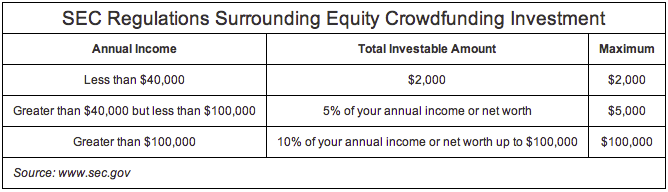
The main issue here is the numbers game that one has to play in order to reach a seven-figure goal, which translates to a large volume of required investors considering the SEC limits on investments in equity crowdfunding (see chart at the bottom of this article) – not to mention how to create dialogue and manage ongoing relationships with a group of investors of this size.

Crowdfunding is a paradigm shift. However, the ante into the game is where the biggest questions of all arise. Some sites are showing a very greedy edge, with equity positions ranging from 2 to 10+%, and/or a piece of the monies raised (between 5 -20%); that’s a pretty steep business model for a virtual company profile and a three minute video. As I look at the first batch of crowd sourcing portals and their associated business models, I am reminded of the Wild West and the stereotypical cast of characters. The mantras from the entrepreneurs who run these portals are pretty much all the same: “the risk to the investor is low because the investment dollar amount is low,” with the lofty slogan “the people will decide what makes its way into the market”.

Translating this into experimentally based life science technologies may be tricky, as the general public isn’t necessarily going to grok the subtleties of therapeutic biomarkers, or mechanisms of action, or physics-based, next-gen medical devices. The obvious candidates for this kind of funding, therefore, are easily understood healthcare IT solutions and/or simply comprehensible medical devices. The trick then for the therapeutic technologies is to take the high road, and use a similar easy-to-understand, high-level approach when pitching their technology.

Keeping it simple and using crowdfunding as a tactic for part of the strategy for early stage capital raising will be fine. However, it won’t be the full-blown solution to the industry’s capital needs.

The Ugly

How ugly can it be if you cannot see it yet, and where does crowd funding really fit? In my opinion, the fog has not been cleared on the regulatory side, and we have to wait for the rules and regulations to come down from on high. As of July 2013, no one knows what crowdfunding for equity investment currently really looks like!

I can speculate that because of the associated regulations, the best bet is as follows: if you need less than $500K to jump start your company, then you do not have to make the considerable investment of filing audited financial statements, which may also include compliance issues like keeping track of all communications through phone, email, and face-to-face meetings, etc., which translates to a very large administrative overhead.

The Bottom Line

The big challenge for the translational scientists is simplifying their message to a wider, less technically versed audience. Science needs to move through the experimental process step by step, and therefore, trying to get funding step by step is a reasonable approach if it is part of an overall fundraising strategy. What I mean by this is avoid the guardrail-to-guardrail, fits and starts approach, and have crowdfunding as a tactic in your overall strategy. Find small dollars to demonstrate efficacy, and then move on to the traditional groups and the new direct family offices and institutional investors for the larger capital needs.

At the end of the day, the scientist-entrepreneur has to understand that if he wants to play, he has to educate his or herself in the world of capital allocation, and the map that they use to do this has to be fresh and accurate and not dependent on the old models of fundraising, but rather reflect all the options, and how those options may map to the company’s needs over the next 5-7 years. The real take away from this discussion is that you need to create a strategy that covers all stages of your company’s financial needs by drawing the map of investor prospects for each stage.
Screen shot 2013-08-01 at 12.04.31 PM (2)

The Family Office Love Affair with Medical Technology

1 Aug

By Danielle Silva, Director of Research, Life Science Nation

Over the past couple of weeks, I’ve been speaking with many entrepreneurs developing medical devices regarding LSN’s upcoming Redefining Early Stage Investments Conference. What has struck a chord with many of these entrepreneurs is when I mention that we’re targeting non-traditional investors to attend our conference, such as family offices. Surprisingly, it’s not just because many of these medtech firms are looking to get in front of family offices – it’s because a good deal of them already have.

What I’ve heard from many of these companies developing medical devices is that family offices have been the first round of capital that they have received after gathering up funds from friends and family. This week, I spoke with a west coast based-company developing a medical device where this was the case, but have had countless conversations with other medtech companies that have echoed this trend.

If we take a deeper dive and further examine these two groups (early stage medical technology companies and family offices), they actually have a great deal in common. Early stage medical technology companies are often times in “stealth mode” – they don’t want other companies to know what they are doing, and certainly do not want their competitors replicating any IP that hasn’t been patented yet. Family offices are also incredibly secretive; as such, many of them don’t have websites, and their physical addresses typically can only be found by rifling through hundreds of SEC filings. The majority of the family offices that do have websites do not boast their portfolio companies on their website (like private equity funds or VCs typically do), or even mention what asset classes they typically allocate to. Thus, because family offices like to fly under the radar, they are a perfect fit for stealth mode medical device companies that want to keep their technology – and their investors – undisclosed.

What is also quite surprising is that these medical technology companies are not just receiving capital from small, single-family offices (SFOs) that are making one-off investments in the space; many are also being funded by multi-family offices (MFOs) that are institutional-quality investors, and have several hundred million in assets under management. These MFOs are actively looking to invest in a number of medical technology firms annually, and are not just making one-off investments in the space. I recently spoke with a family office based on the east coast that is actively looking to allocate to several medical technology companies before the year’s end.

So the question still remains – why are family offices so in love with early stage medical device companies? We’ve spoken at great lengths in previous articles about why family offices are attracted to the life science space as a whole, and we’ve touched upon the fact that these groups have a dual mandate – they are obviously focused on ROI, but also generally make philanthropic donations as well, and investing in life sciences fulfills this dual mandate. However, what makes investing in the medical device space so attractive to family offices is that understanding if a medical technology investment is attractive doesn’t require as much scientific knowledge compared to determining whether or not a therapeutic product is a sound investment. Also, what makes the medtech space more attractive than the therapeutics space for family offices is the fact that medical devices receive FDA approval much more quickly compared to therapeutics.

Another reason family offices have become more and more attracted to life science in general is that often times, a family member will be afflicted with a certain disease and thus the family office will attempt to push along the science in a particular area by investing in a company developing a product targeting this disease. This makes family offices particularly unique investors in the medical technology space – as most traditional investors in the space are not indication-oriented. The traditional investors in the medical technology space (like private equity firms and VCs) invest in a medical technology company based on the kind of device they are developing (for example they will look solely for companies developing active and implantable devices). As aforementioned, family offices are more indication-oriented, and so are less focused on how the technology functions and more concerned with what disease the device targets.

So if you’re an early stage company developing a medical device, it’s time to think outside the box, and start targeting non-traditional investors in the space like family offices. You should especially start to consider raising funds from this group of investors if you are a company in stealth mode that has not raised capital from institutional investors. From what I’ve been seeing and hearing over the past several weeks, it seems as if the family office love affair with investing in medical technology companies will only grow stronger.

Research Hospitals Poised To Disrupt Early Stage Innovation & Commercialization

1 Aug

By Max Klietmann, VP of Research, LSN

In the domain of early stage biotech and med-tech innovation, point-of-care facilities are typically not where one would expect to find nascent translational technologies. However, some highly innovative hospitals and clinics are taking a novel approach to the healthcare arena by not only providing care, but also by actively driving new therapies into the marketplace. These entities are leveraging physicians and specialist staff to vet technologies and ideas in their earliest stages of development, and choosing the best to shepherd through the clinic and onto the market.

Why are they doing this? As hospitals are under increasing cost pressures, it serves as a natural way to create a competitive edge in the marketplace, and can create long-term commercial value, as well as a measurably higher standard of patient care. What makes this trend particularly interesting is that the vetting is done by boots-on-the-ground doctors – those who are addressing real-world medical challenges that they encounter on a regular basis. This is a significantly higher level of insight than any traditional provider of capital could bring to the table when evaluating commercial viability. Essentially, this means that they have an edge when it comes to picking winners, and that we can anticipate some of the leading sources of commercialized products in the future will be coming out of research hospitals.

One large hospital group that began implementing this strategy less than ten years ago serves as a perfect example. The Ohio-based institution has made tech commercialization a priority, and is finally seeing some very impressive results: the group has registered approximately 500 patents, and has created over 50 new companies. Those figures are the result of excellent vetting done by experienced specialists who understand the patient needs from the very beginning. This allows selection of the best science, which can then be backed by the capital of a major institution with a long-term orientation.

So what does it mean for the industry? First, this is a solution to one of the biggest issues in life sciences today: that there are so many emerging companies that it is difficult for anyone to know what is truly leading technology and how to vet it, leaving many early stage companies with great science to perish in the valley of death. Research hospitals can vet technologies better than anyone, and help to cut through much of the “noise” in the early stage space.

What’s more, these “pre-selected winners” can then access the capital required to move them past the early stages and into a position to be spun out or sold to a strategic buyer. This allows for more fair valuation, a partnership approach, access to resources on a massive scale, and will undoubtedly move science along faster and more effectively than by traditional means. This trend is poised to be a major disruptive factor for the life sciences at large, and will shift much of the industry dynamics.

Hot Life Science Investor Mandate 1: Angel Group Looking to Allocate to Companies Producing Pre-Revenue Devices & Orphan Therapeutics

1 Aug

An angel group based in the Eastern US is currently deploying capital from its third fund. With around $15 million in total assets under management, they are looking for new opportunities within the life science space, but have no set timeline to make allocations. The group typically allocates between $250,000 and $2 million per company.

Currently, the angel group is most interested in the biotech therapeutics and medtech space, specifically only those that are targeting orphan indications. The group will not consider therapeutics and diagnostics that are treating any other indications due to the difficulty of the current FDA regulatory framework.

The angel group is currently looking for pre-revenue companies within the life science space. With that being said, they would consider companies in the biotech therapeutics space that have products in the preclinical stage through phase III of development, and in the medtech space the firm is looking for companies that have a product in development, or have a prototype. With that being said, the firm is looking to provide seed capital to privately held, early stage firms.

Hot Life Science Investor Mandate 2: PE Arm of Pension Fund Seeks Add-on Acquisitions

1 Aug

A private equity investment arm of a pension plan located in Canada, which has over $100 billion in total assets under management, is looking for new opportunities in the life science sector, and is currently targeting add-on acquisition targets for one of the firm’s portfolio companies. The pension’s equity investment size will vary depending on the size of the add-on target, however the firm is looking to acquire a strategic partner for their portfolio company as soon as possible.

The PE arm is currently looking for firms in the biotech R&D services sector. More specifically, they are seeking small, clinical-focused contract research organizations (CROs), and are most interested in firms that specialize in the areas of cardiology and endocrinology. The fund already has a good deal of exposure to clinical CRO’s that specialize in the oncology space, and thus would not be interested in investing in a company with exposure to that area.

The fund is currently only seeking firms for acquisition, and thus is only looking for firms that are interested in a buyout or recapitalization transaction. The pension is seeking firms that have around $2-5 million in EBITDA.

Hot Life Science Investor Mandate 3: PE Group Targets Orphan Diseases, Neurological Disorders

1 Aug

A private equity group headquartered in the Western United States is looking for new opportunities in the life sciences space, and although it has no set time frame to make allocations, the firm would invest in a company within the next six months if a compelling opportunity were identified. The firm’s equity investments can range anywhere from $1-25 million.

The firm is most interested in the biotech therapeutics sector, as well as the medical technology space. In terms of companies in the medtech space, they are most interested in firms producing optical devices and active implantable devices. In the biotech therapeutics space, the firm is looking for firms developing drugs targeting neurological disorders of all kinds. They also have a particular interest in companies that are developing therapeutics targeting orphan diseases.

The firm will invest in both pre-revenue companies, as well as companies that have products that are already on the market. The group has a venture capital approach to investing in pre-revenue companies, and for those that have products on the market, it has more of a growth equity approach.

Hot Life Science Investor Mandate 1: State Fund Seeks Biotech R&D, Others for Allocations

26 Jul

A fund based in the Central United States, which has around $400 million under management, was set up by its state government in order to attract start up companies, and is currently seeking new investment opportunities in the life sciences space.

The majority of the funds investments (53%) are in the life sciences space, and since 2005, the fund has dedicated around $900 million to the sector. The fund typically invests in 10-20 companies a year, and their allocation size ranges from $250,000 to $5 million. The firm is most interested in the suppliers and engineering space, biotech therapeutics and diagnostics, and biotech R&D services. The firm is specifically interested in the medical devices space within the suppliers and engineering space, and is seeking firms focused on genomics in the biotech R&D space.

In terms of biotech therapeutics and diagnostics firms, the fund is fairly opportunistic in terms of subsector and indication, however does have a special interest in small molecules. The firm will consider pre-revenue firms, as well as firms that have products on the market. With that being said, the firm is agnostic in terms of the product’s development phase.