By Joey Wong, Director of Investor Research, Hong Kong BD, LSN
Many large corporations establish ventures or innovation arms to invest in and partner with life science and healthcare startups. Unlike traditional institutional VCs, corporate venture capital (CVC) groups bring unique strategies, goals, and ties to their parent organizations. Some CVCs focus closely on opportunities that align with the corporation’s core businesses, while others pursue innovation beyond existing portfolios, creating broader avenues for collaboration.
This 50-minute discussion will bring together leaders from corporate venture arms of global pharma, biotech, medtech, and healthcare corporations. Panelists will share how they evaluate early-stage opportunities, what distinguishes their investment criteria from institutional VCs, and how they balance strategic alignment with financial return. Startups will also gain valuable perspective on how to approach CVCs, what additional benefits they can expect beyond funding, and how relationships and collaboration may evolve post-investment.
For entrepreneurs seeking strategic partners, this session offers a chance to hear directly from active CVC investors about how they drive innovation, accelerate R&D, and bring transformative solutions to the market.
Andrew Merken Shareholder Polsinelli PC
(Moderator)
Komeil Nasrollahi Sr. Director Innovation & Venture Partnerships Siemens Healthineers
Claire Leurent Managing Director AbbVie Ventures
Jeffrey Moore President MP Healthcare Venture Management (MPH)
Alex de Winter VP of New Ventures Danaher Corporation
Join us at RESI Boston this September to take part in this discussion and connect with investors across the life science and healthcare ecosystem.
While most parts of biotech early-stage financing have been in the doldrums in the past two or three years, so-called tech-bio startups have been thriving. Since the posterchild $1.0 billion mega series A round last April of Xaira Therapeutics, which was founded by scientists out of Nobel prize winner David Baker’s group at the University of Washington, several startups seeking to develop machine learning models for designing miniproteins or peptide binders of challenging or ‘undruggable’ targets have emerged, including Enlaza Therapeutics, Vilya, and UbiquiTx. All of these have been developing their own proprietary models based on Alphafold 3, Boltz-1 or Chai-1 for structure prediction and tools based off RFdiffusion, Bindcraft and ProteinMPNN for peptide design. Predicting CDR loops for de novo antibody design is a considerably more challenging task than for simple peptides, but Nabla Bio, founded last year by scientists out of George Church’s lab at Harvard, claims it is doing just that for GPCRs and ion channels. Earlier this month, Chai Discovery also launched with a $100 million series A from Menlo Ventures to optimize multimodal generative models such as Chai-2, which, according to the company, already “achieves a 16% hit rate in de novo antibody design.”
Designing peptides that can selectively bind to a protein target and show therapeutic activity remains a challenge, however, as it often depends on the availability of high-quality structural information about the target molecule, which is seldom available for many disease-relevant proteins that are unstructured or conformationally disordered. Similarly modeling protein-protein interactions like antibody-antigen interactions that are extremely dynamic and floppy also poses problems. All of which raises the question as to whether binders could be predicted simply using amino acid sequence information instead of structural data.
Now, a team led by Pranam Chatterjee from Duke University has addressed this question. In a recent paper in Nature Biotechnology, Chatterjee and his collaborators report the creation of PepMLM, a peptide binder design algorithm based on masked language modeling. A key feature of the algorithm is that it depends exclusively on protein sequence, not structure. Built upon the ESM-2 (Evolutionary Scale Modeling 2) protein language model, PepMLM masks and reconstructs entire peptide regions appended to target protein sequences. This design compels the model to generate context-specific binders. To train PepMLM, the team used high-quality curated datasets from PepNN and Propedia comprising ~10k putative peptide-protein sequence pairs. PepMLM output was consistently found to outperform RFDiffusion on held-out/structured targets, with a higher hit rate (38% to 29%) and low perplexities that closely matched real binders, with generated sequences showing target specificity, even in stringent permutation tests.
The PepMLM model is trained by labeling with ~10k putative target protein-peptide sequence pairs and is built with a target protein sequence and a masked binder region. During the generation phase, the model has a target protein sequence and then mask the binder to facilitate the prediction of peptides of specified lengths. (Source: Nature Biotechnology)
The model generated binders predicted to have higher binding scores than native and structure-based binders designed through other methods. Indeed, in vitro validation experiments confirmed the high affinity and specificity of PepMLM-generated binders.
Structural comparison of PepMLM-designed binders (red) and experimental test binders (blue), with contact residues in target proteins H-2Kb MHC complex (2OI9)and Lck tyrosine kinase (1LCK) (gray) shown in corresponding colors. (Source: Nature Biotechnology).
Chatterjee and his colleagues went on to turn their binders into degraders by fusing them to E3 ubiquitin ligase domains, such as CHIP/STUB1. When tested in vitro, over 60% of these degraders knocked down their target proteins. PepMLM peptides achieved nanomolar binding affinity on the drug targets neural cell adhesion molecule 1 (NCAM1), a key marker of acute myeloid leukemia, and anti-Müllerian hormone type 2 receptor (AMHR2), a critical regulator of polycystic ovarian syndrome (where RFDiffusion-predicted peptides failed to bind). The authors also demonstrated that PepMLM-predicted peptides fused to E3 ubiquitin ligases not only degraded MSH3 but completely eliminated mutant huntingtin protein exon 1 containing 43 CAG repeats in Huntington disease patient-derived fibroblast cells. Similar results were obtained for a PepMLM-predicted peptide binder of MESH1, a protein controlling ferroptosis, in collaboration with Ashley Chi Jen-Tsan’s group at Duke University (RFDiffusion again gave no hits). And with Madelaine Dumas and Hector Aguilar-Carreno’s group, in collaboration with Matt Delisa’s group at Cornell University, PepMLM-derived peptides bound and reduced levels of viral phosphoproteins from Nipah, Hendra, and human metapneumovirus (HMPV); indeed, in live HMPV infection models, the PepMLM peptide mediated high levels of P protein clearance.
The ability of PepMLM to design binders purely on the basis of target-protein sequence is an important advance towards designing therapeutic peptides against hitherto inaccessible targets that lack structural data. Future work should explore how to incorporate chemical modifications such as cyclization or stapling to enhance stability of the binders, as well as the evaluation of the strongest candidates in vivo. Another challenge will be to ameliorate the immunogenicity of these foreign de novo proteins. The use of protein engineering approaches, such as incorporation of mirror amino acids that can cloak foreign peptides from the immune system, may offer solutions. But it is likely that candidates discovered using sequence or structure prediction tools will still require lengthy development programs to be turned into safe and effective drugs, despite the hype.
Showcase your innovation to active life science investors
By Max Braht, Director of Business Development, LSN

Life Science Nation (LSN) is now accepting applications for the Innovator’s Pitch Challenge (IPC) at both RESI London and RESI JPM. The IPC provides early-stage life science and healthcare companies with the opportunity to pitch directly to a panel of active investors, receive interactive feedback, and showcase their technology in the RESI Exhibition Hall.
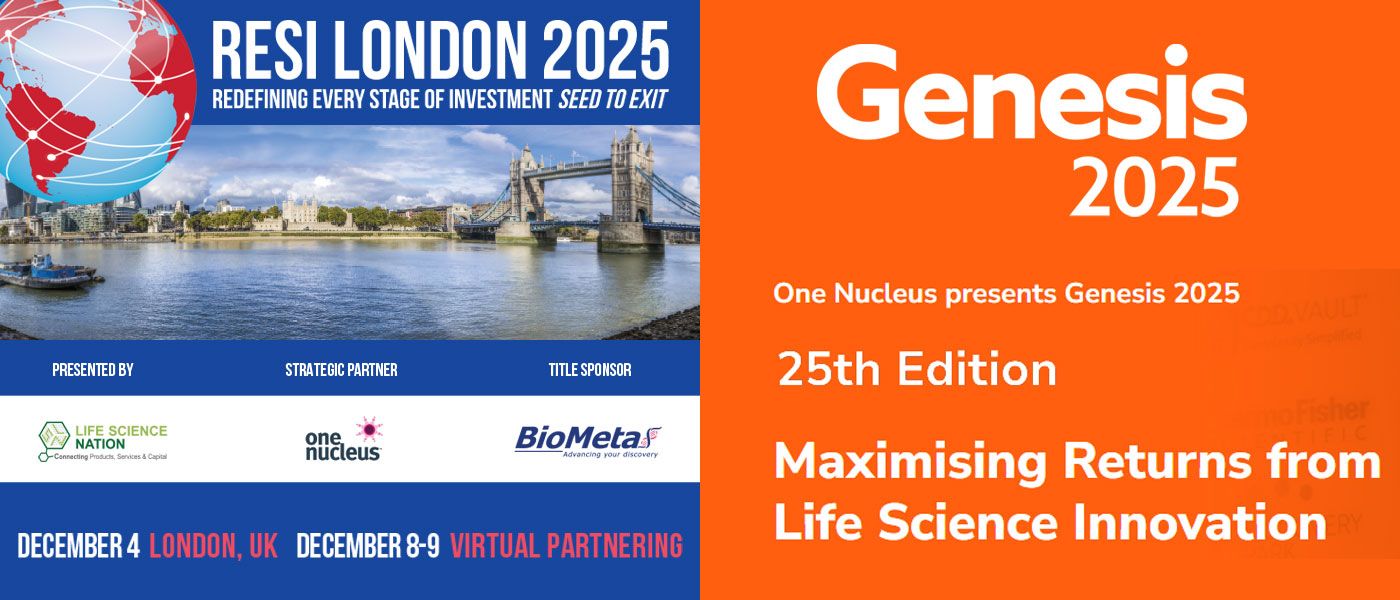
RESI London – December 2025
The first week of December marks the largest life science partnering and venture week in the UK. For companies raising pre-seed through Series B, or those in Phase II or earlier development, RESI London—alongside One Nucleus’ Genesis and ELRIG/SLAS events—offers a stronger fit compared to the late November healthcare week held concurrently with Jefferies. While Jefferies tends to focus on IPO-ready or Phase III+ companies, RESI London is designed for venture-stage entrepreneurs seeking investment and strategic partnerships.
The conference takes place in person on December 4 at No.11 Cavendish Square, London, with virtual partnering continuing on December 8–9.
The RESI Conference will return to San Francisco during JP Morgan Healthcare Week, providing entrepreneurs with access to the largest gathering of early-stage life science investors in the world. Taking place January 12–13 at the Marriott Marquis San Francisco, the conference will be followed by three days of virtual partnering on January 14, 19, and 20.
RESI JPM draws more than a thousand participants, including 500+ global investors, innovators, and industry experts. The Innovator’s Pitch Challenge allows selected companies to pitch live, engage in Q&A with investors, and participate in dedicated partnering meetings throughout the week.
Apply today to secure your place in the Innovator’s Pitch Challenge at RESI London or RESI JPM and take advantage of the opportunity to showcase your innovation directly to active investors.
By Claire Davies, Shareholder, Polsinelli (Special Guest Contributor)
Life sciences companies are constantly innovating with the goal of developing groundbreaking medical products. Unfortunately, the most novel products often face more uncertainty about their regulatory pathway to market—with several factors heightening that uncertainty today. These include the loss of many FDA policy and scientific staff over the past six months and multiple changes in leadership, such as at the head of the agency’s drug and biologics programs. Although significant personnel change may present opportunities for companies that would benefit from a change in the agency’s historic regulatory approach, it also unsettles precedent for the FDA’s expectations. In addition, as numerous companies explore applications of generative AI, the agency itself has indicated that generative AI-enabled products present challenges to existing (often decades old) laws that govern FDA’s regulatory framework.
With these factors in play, companies may be tempted to hold off on spending resources to map out their regulatory strategy and get feedback from the agency. But incorporating regulatory considerations into early business plans remains key for a number of reasons:
Efficient Product Development: Whether and how FDA will regulate your product determines the level of evidence and type of application needed to enter the market. (Does your AI-enabled product fall within an exception from regulation as a medical device? If not, it may require an FDA application supported by significant data.) An early understanding of the regulatory pathway can help companies budget development costs more accurately. It can also help them anticipate and proactively address regulatory hurdles, ultimately shortening the time it takes to get the product to market.
Raising capital: Regardless of scientific promise, companies that underestimate the regulatory complexity of getting a medical product to market or that lack an experienced in-house or external advisory team in this area may be viewed as a risky proposition for investors. In contrast, a thorough understanding of the regulatory pathway and plan for navigating the challenges to commercialization can help distinguish a company from the crowd.
Ultimately, an early and proactive approach to your regulatory strategy is a critical investment that can help shorten time to market and increase your company’s attractiveness to investors.
Claire Davies is a Shareholder in Polsinelli’s FDA practice where she provides strategic counsel to help clients navigate FDA regulatory and compliance challenges. Claire has handled a wide range of issues involving medical devices, biological products, drugs and human cells, tissues and cellular and tissue-based products (HCT/Ps). Prior to joining Polsinelli, Claire spent nearly a decade as an attorney in the FDA’s Office of the Chief Counsel. Her work at FDA often involved advising agency leadership on high-profile and significant matters, such as responses to emerging public health threats and user fee negotiations with industry.
About Polsinelli
Polsinelli is an Am Law 100 firm with more than 1,200 attorneys in over 25 offices nationwide. Recognized as one of the top firms for excellent client service and client relationships, Polsinelli is committed to meeting our clients’ expectations of what a law firm should be. Our attorneys provide value through practical legal counsel infused with business insight, offering comprehensive corporate, transactional, litigation and regulatory services with a focus on health care, real estate, finance, technology, private equity and life sciences. Polsinelli PC, Polsinelli LLP in California, Polsinelli PC (Inc) in Florida.
By Joey Wong, Director of Investor Research, Hong Kong BD, LSN
Diagnostics are becoming a cornerstone of modern healthcare, driving earlier detection, more precise treatments, and improved patient outcomes. From cutting-edge sequencing technologies and liquid biopsies to AI-driven tools and digital platforms, diagnostics are shaping a more preventative and personalized future for medicine.
RESI Boston will feature a Diagnostics Panel. This 50-minute panel will bring together leading investors and strategic partners who focus on early-stage diagnostics innovation. Panelists will discuss what makes a diagnostic technology attractive from both a clinical and commercial perspective, how they evaluate regulatory and reimbursement potential, and the areas where they see the most pressing unmet needs. From seed-stage investors to growth-equity leaders, this year’s panel will feature a range of investment perspectives. With representation from venture capital, strategic investors, and international funds, attendees will gain a well-rounded view of the current diagnostics investment landscape.
For founders developing solutions in oncology, infectious disease, chronic conditions, or personalized medicine, this session offers actionable guidance on securing funding, gaining market traction, and building successful partnerships. Expect practical insights on differentiation, positioning, and scaling impactful innovations in a competitive and fast-evolving space.
John Tremblay
Investor Launchpad Venture Group
(Moderator)
Navin Govind
Partner Evidence Ventures
Anula Jayasuriya
Co-Founder and Partner Kidron Capital
Chris Murray
Principal MVM Life Science Partners
Mike Thomas
Managing Partner Bold Brain Capital
Chensu Wang
Investment Manager Yonjin Venture
Don’t miss this opportunity to connect with investors and industry leaders shaping the future of diagnostics. Register now for RESI Boston this September and take the next step in advancing your diagnostic innovation.
Life Science Nation is featuring Mosaic Biosciences, a returning RESI Boston sponsor dedicated to advancing early-stage drug discovery. Led by Chief Executive and Scientific Officer, Eric Furfine, Mosaic partners with biotech innovators to turn promising concepts into clinical candidates. In this interview, Eric shares how Mosaic’s experience and collaborative approach set them apart in moving ideas toward the clinic, and the types of partners they’re hoping to meet at RESI Boston.
Watch the interview:
Interested in RESI Sponsorship & Exhibitor Opportunities
Whether you’re looking for face-to-face meetings, premium visibility, or lead-generation tools, we offer customized packages designed to support your goals.
MantaBio earned third place in the Innovator’s Pitch Challenge (IPC) at RESI Boston this past June, standing out among a competitive field of early-stage life science companies. In this interview, Co-Founder and President Carter Boisfontaine shares insights into the company’s fundraising efforts, their experience at RESI, and what’s ahead for the team.
Watch the interview:
Interested in pitching your company at RESI?
Applications are now open for the Innovator’s Pitch Challenge at RESI Boston, September 17, 2025. Selected companies receive full access to the conference, partnering meetings with investors, and exhibit space in the RESI Exhibition Hall. New! The September 2025 IPC Pitch Package now includes an optional second RESI pass at no additional cost, allowing an additional team member to attend and participate in partnering. Apply now!
The firm is focused on therapeutics companies and does not invest in medical devices, diagnostics, or digital health. The firm is open to considering assets of very early stages, even those as early as lead optimization phase. The firm considers various modalities, including antibodies, small molecules, and cell therapy. Currently, the firm is not interested in gene therapy. Indication-wise, the firm is most interested in oncology and autoimmune diseases but has recently looked at fibrotic diseases and certain rare diseases as well.
The firm is opportunistic across all subsectors of healthcare. Within MedTech, the firm is most interested in medical devices, artificial intelligence, robotics, and mobile health. The firm is seeking post-prototype innovations that are FDA cleared or are close to receiving clearance. Within therapeutics, the firm is interested in therapeutics for large disease markets such as oncology, neurology, and metabolic diseases. The firm is open to all modalities with a special interest in immunotherapy and cell therapy.
A strategic investment firm of a large global pharmaceutical makes investments ranging from $5 million to $30 million, acting either as a sole investor or within a syndicate. The firm is open to considering therapeutic opportunities globally, but only if the company is pursuing a market opportunity in the USA and is in dialogue with the US FDA.
The firm is currently looking for new investment opportunities in enterprise software, medical devices, and the healthcare IT space. The firm will invest in 510k devices and healthcare IT companies, and it is very opportunistic in terms of indications. In the past, the firm was active in medical device companies developing dental devices, endovascular innovation devices, and women’s health devices.
A venture capital firm founded in 2005 has multiple offices throughout Asia, New York, and San Diego. The firm has closed its fifth fund in 2017 and is currently raising a sixth fund, which the firm is targeting to be the largest fund to date. The firm continues to actively seek investment opportunities across a […]