Tag Archives: news

The Reality of European Global Partnering

27 Jan

By Dennis Ford, Founder & CEO, Life Science Nation (LSN)

DF-News-09142022

Every March, early-stage life science teams spend thousands of euros to attend one of Europe’s biggest partnering weeks. They show up expecting investors, deal momentum, and progress. Most leave with something else: lots of vendor and service provider meeting requests, and a shorter cash runway.

For seed, Series A, and early Series B companies, Lisbon is not a winter party celebration. It is a stress test. And the platforms you choose will either compound your progress or quietly drain your capital.

The Cost Reality No One Likes to Say Out Loud

Standard passes and bundled “week in Lisbon” packages routinely run from 3,000 to 5,000 euros per person, before flights and hotels. For late-stage companies, that may be acceptable. For early-stage teams living on grants, founder savings, or a small seed round, it is a major bet.

By contrast, RESI Europe is typically priced in the 1,500-2,500 euro range because it is built specifically for founders, innovators, and regional cohorts raising seed, Series A, and early Series B funding. The goal is not to sell access at any cost. It is to make high-quality global partnering economically accessible at a stage when every euro still must justify itself.

Here is the problem. Many founders pay the higher prices and then discover that a large share of their so-called “investor” meetings are with service providers selling you something. The badge may say partner or advisor, but the economics are reversed. The startup becomes the customer, not the one being backed.

That outcome is not accidental. It is how large conference ecosystems monetize scale.

Lisbon Does Not Create Strategy. It Exposes It.

Big conference weeks amplify whatever strategy you bring. If you arrive without preparation and focus, you get more noise, more meetings you did not need, and a bigger bill. If you arrive with discipline, targeted investors, and a follow-up system, Lisbon can work.

The problem is that most mega-events are optimized for volume, not readiness. More people. More meetings. More urgency. That model works for late-stage transactions. It fails early-stage teams.

Early-stage companies need fewer things done well:

  • Investors and licensing partners who write first checks
  • Fewer vendor-driven meetings
  • A way to turn first conversations into real follow-up and progress

Proof That a Different Model Works

At JPM Week in January, RESI was designed explicitly around early-stage investing. Roughly 800 companies actively seeking capital and licensing deals participated alongside more than 800 qualified investors and licensing partners from around the world.

Participation was not open-ended. Investor categories were defined. Registrations per firm were capped to protect the signal in the room. The result was not fewer meetings. It was better, more compelling meetings.

That same discipline is what matters in Lisbon.

Why the LSN Partnering Backbone Beats Scale

LSN, owner of the RESI conference series, also owns a premier database of capital investors and licensing partners in the life sciences and offers programs for de-risking early-stage assets and for preparing and executing global roadshows, as well as services like BD Assist, which actually sets up the meetings for you. RESI has five global partnering events annually.

A partnering backbone asks different questions. Are you spending time with partners who fit your stage and product? Have you reduced scientific, regulatory, and execution risk before asking for capital? Do you have a system to re-engage after the week ends? When the answer is yes, Lisbon stops being a gamble.

The Real Fight

The real battle for Lisbon is not about who has the biggest crowd or the loudest brand. It is about who is actually built for early-stage innovation and who is pricing and designing their platform around scale.

For founders, investors, and regions focused on seed, Series A, and early Series B, the smart move is to start the week with early-stage as the priority, not the afterthought, and with “investor” meaning capital and licensing partner, not a sales pitch. Plug Lisbon into a backbone that keeps working after the noise fades. That is how early-stage teams win Lisbon. And that is where the fight really is.

If You’re Coming to Lisbon

RESI Europe will take place in Lisbon with an in-person conference followed by virtual partnering, giving early-stage teams both face-to-face and online access to global investors and licensing partners at founder-level pricing. If you want your Lisbon week to start in a room built for early-stage innovation, not a room selling to you, RESI is where that week should begin.

Register for RESI Europe

Investor Panels at RESI Europe 2026 

27 Jan

By Claire Jeong, Chief Conference Officer, Vice President of Investor Research, Asia BD, LSN

Life Science Nation (LSN) is pleased to introduce the investor panel lineup for RESI Europe, bringing together venture capital firms, family offices, corporate investors, and strategic partners actively funding and partnering across the global life science ecosystem. Designed to reflect how capital is being deployed today, these panels examine what investors are prioritizing, how partnership decisions are made, and what founders need to demonstrate to stand out in an increasingly selective market.

From pharma partnering and preclinical investing to digital health, medtech, and cross-border capital flows, the RESI Europe investor program offers a practical look at how decisions are being made across stages and sectors. Each session pairs candid investor perspectives with real-world expectations founders must meet to advance conversations beyond the first meeting.

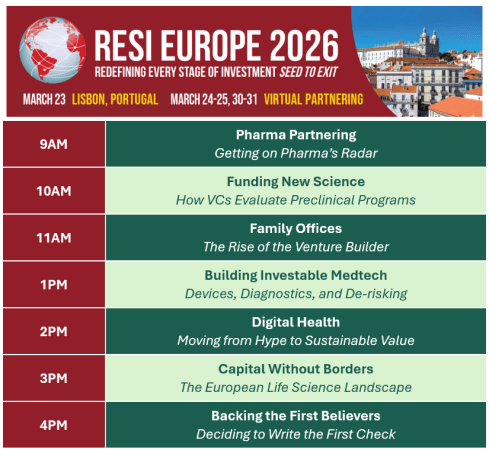
Monday, March 23 – Investor Panels

9:00 – 9:50 AM | Pharma Partnering: Getting on Pharma’s Radar
As large pharmaceutical companies increasingly rely on external innovation, early-stage partnerships are becoming a core driver of pipeline growth. This session explores how pharma evaluates emerging science, which data packages resonate with business development teams, and how founders can structure partnership discussions that align with long-term strategic priorities.

10:00 – 10:50 AM | Funding New Science: How VCs Evaluate Preclinical Programs
With capital efficiency under intense scrutiny, therapeutic investors are rethinking how they assess risk and differentiation at the preclinical stage. Panelists will share how they evaluate programs ahead of clinical data, the milestones that matter most, and what founders must show to compete in today’s Series A environment.

11:00 – 11:50 AM | Family Offices: The Rise of the Venture Builder
Family offices have evolved into active healthcare investors, launching dedicated funds and building internal operating expertise. This discussion examines how these groups source deals, lead early-stage rounds, and make investment decisions differently from traditional institutional venture firms.

1:00 – 1:50 PM | Building Investable Medtech: Devices, Diagnostics, and De-risking
Investors in medtech are focused on solutions that combine technical innovation with clear clinical and regulatory pathways. This panel breaks down current investor interest across devices and diagnostics, highlighting the milestones that signal scalability and commercial readiness.

2:00 – 2:50 PM | Digital Health: Moving from Hype to Sustainable Value
As the digital health sector matures, investors are prioritizing solutions with measurable clinical and economic outcomes. Panelists will discuss where capital is being deployed, including AI-driven diagnostics and data platforms, and how companies can demonstrate long-term viability in real-world settings.

3:00 – 3:50 PM | Capital Without Borders: The European Life Science Landscape
Europe’s research ecosystem continues to produce world-class innovation, while investment dynamics increasingly span borders. This session explores how European life science companies can attract international capital, navigate regional differences, and compete on a global stage.

4:00 – 4:50 PM | Backing the First Believers: Deciding to Write the First Check
Pre-seed and formation-stage investors often commit capital before significant data exists, backing teams, vision, and early signals of execution. This panel examines how first-check investors assess founders, build conviction, and help shape companies into institutional-grade opportunities.

These investor panels are designed to foster meaningful dialogue between capital providers and innovators, creating informed conversations that continue beyond the stage and into partnering meetings.

Join the RESI Speaker Lineup
Are you an investor or strategic partner with valuable insights to share with early-stage life science companies? We are looking for dynamic speakers to join our RESI panels. 
Click here to submit your Speaker Interest Form today!

Registration for RESI Europe is now open.
Register with Super Early Bird rates and save €300. Super Early Bird pricing expires Friday, January 30.

Register for RESI Europe

Innovator’s Pitch Challenge Spotlight: Sania Therapeutics and a Controllable Approach to Gene Therapy 

27 Jan

Interview with Paula Cerqueira, VP of Scientific Strategy

Sania Therapeutics is developing a next-generation gene therapy platform focused on treating neurological symptoms driven by dysfunctional neural circuits. At RESI London, the company was recognized as a Third-Place winner in the Innovator’s Pitch Challenge and received the highest score from the judging panel, underscoring strong investor interest in its controllable and circuit-specific approach to gene therapy. In this interview, Sania Therapeutics shares its therapeutic focus, differentiated platform, and how participation in RESI has helped shape ongoing conversations with investors and strategic partners. 

Paula Cerqueira
CaitiCaitlin Dolegowski

Caitlin Dolegowski (CD): For those just discovering Sania Therapeutics, how do you describe your company and therapeutic focus?
Paula Cerqueira (PC): Sania Therapeutics is developing a new class of controllable gene therapies designed to treat neurological symptoms driven by dysfunctional neural circuits. Our platform combines localized, low-dose AAV delivery that selectively targets specific neuronal subpopulations with patient-controlled activation, allowing us to precisely modulate hyperactive neurons, improving symptoms without adversely and permanently altering normal neural function. 

Our initial therapeutic target is a motor circuit disorder: spasticity. Our broader goal is to expand into additional motor and sensory indications where current treatment options are limited, invasive, or poorly tolerated. 

CD: What unmet medical need are you addressing, and what differentiates your approach?
PC: Millions of people live with debilitating neurological symptoms such as spasticity and pain disorders, yet existing treatments are often temporary, blunt, or invasive. Oral drugs frequently cause systemic side effects, while interventions like Botox or implanted devices require repeated procedures and provide limited relief. Despite the scale of this unmet need, there has been little meaningful innovation in this area for more than a decade. 

Sania’s approach is differentiated in two key ways. First, our proprietary platform enables selective targeting of the neural circuits that drive disease using localized, low-dose AAV delivery. This approach is intended to support a safer, more sustainable, and more scalable path for gene therapy than traditional systemic delivery. 

Second, our therapy is controllable. Patients can adjust the therapeutic effect using an oral activator, allowing symptom modulation over time. This puts patients in control while enabling precise and flexible therapeutic regulation. 

Our mission at Sania is to bring gene therapy into everyday clinical use by meaningfully improving the lives of people living with neurological conditions. While this is an ambitious goal, for patients who struggle daily with basic activities such as holding a child, we believe this approach has the potential to be truly transformative. 

CD: What was your experience participating in the Innovator’s Pitch Challenge at RESI London?
PC: Participating in the Innovator’s Pitch Challenge at RESI London was an extremely valuable experience. The format encouraged clarity and discipline in how we communicated both our science and long-term vision, and the audience questions reflected a high level of engagement from investors and industry leaders. 

Being recognized as a Third Place (First Place among judges in our session) winner among a strong and diverse group of companies was particularly meaningful, and it reinforced that there is a strong interest in approaches that rethink how gene therapy can be applied beyond ultra-rare indications. 

CD: How has the RESI platform influenced conversations with investors or strategic partners?
PC: RESI offered a valuable opportunity to present our work to a broad set of investors and strategic partners and to test our messaging with a highly informed audience. While many groups are understandably focused on later-stage opportunities, the platform helped us refine our positioning and identify areas of alignment for future conversations as the company progresses. 

Following the Innovator’s Pitch Challenge, we also initiated early, informal conversations that we expect to build on as the company continues to mature. 

CD: Where does Sania Therapeutics currently stand in terms of fundraising or partnerships?
PC: Sania Therapeutics is currently focused on advancing its lead spasticity program and platform toward key preclinical and IND-enabling milestones, while continuing to expand the broader platform supporting multiple motor and sensory indications. 

In parallel, we are building relationships with investors and strategic partners aligned with our long-term vision. As the platform matures and data advances, we expect to raise funding to support clinical entry of our lead program and the continued development of additional programs enabled by the platform, and we welcome conversations with groups interested in engaging early. 

CD: What upcoming milestones are most important for the company?
PC: Our near-term focus is on advancing our lead spasticity program across regulatory and manufacturing activities and initiating IND-enabling studies in 2026. Reaching that point will significantly de-risk the program and position us well as we move this innovative approach toward the clinic. 

In parallel, we are making meaningful progress on platform development to support expansion into additional motor and sensory indications. A key goal for the team this year is to validate our first sensory capsid in vivo, leveraging the same delivery and control principles demonstrated in our lead program. 

Applications are now open for the Innovator’s Pitch Challenge at RESI Europe. Life science and health tech companies seeking targeted feedback from a dedicated group of coordinated investors are encouraged to apply to participate in interactive pitching, partnering, and one-to-one meetings at RESI Europe. 

Apply to Pitch at RESI Europe 2026

Proseek Bio claims global bronze in San Francisco, strengthening Brisbane’s MedTech credentials 

27 Jan

Brisbane’s world renowned MedTech sector has again been recognised on the global stage, with local company Proseek Bio securing bronze at the Innovator’s Pitch Challenge during J.P. Morgan Healthcare Week in San Francisco. 

Proseek Bio, a participant in Brisbane Economic Development Agency’sMedTech Global Accelerator, competed against more than 90 international health technology companies and was recognised for its groundbreaking work in non-invasive blood tests aimed at earlier and more accurate detection of ovarian cancer, an area of significant unmet global health need. 

This year’s achievement continues Brisbane’s strong run of podium success at one of the world’s most influential healthcare investor forums, highlighting the city’s growing capability to develop, commercialise and scale life-changing medical technologies. 

Brisbane’s Innovator’s Pitch Challenge podium finishes include: 

  • 2023 Gold: Field Orthopaedics; Bronze: Max Kelsen 
  • 2024 Silver: Convergence Medical; Bronze: Gelomics 
  • 2025 Gold: Kimaritec 
  • 2026 Bronze: Proseek Bio 

BEDA’s MedTech Global Accelerator cohort attended the RESI JPM 2026 Investor Forum, in partnership with Life Science Nation, a leading US investor and life sciences networking platform. 

Lord Mayor Adrian Schrinner said the result was another strong sign of Brisbane’s rising reputation in health and medical innovation. 

“Brisbane’s MedTech talent continues to make waves on the world stage,” Cr Schinner said. 

“Proseek Bio’s bronze finish shows just how much innovation is coming out of our city and that Brisbane can go toe-to-toe with the best in the world – especially in lifesaving areas like women’s health and cancer detection. 

“We’re proud to support our innovators in building the global connections and partnerships they need to turn great ideas into reality.” 

Proseek Bio Founder and CEO, Professor Michelle Hill said the recognition marked a significant milestone for the company. 

“Winning bronze in this highly competitive challenge is a tremendous achievement for us,” Professor Hill said. 

“It validates the potential of our technology to make a real difference in women’s health and accelerates our ability to attract global partners and investment. 

“Support through BEDA’s MedTech Global Accelerator and its international network has been critical to our journey.” 

Now in its fourth year, the accelerator has helped more than 30 visionary companies secure $246 million in capital and create more than 250 jobs in Brisbane.  

BEDA’s FY26 MedTech Global Accelerator cohort included Aptium AI, BiVACOR, Cool Beans Underwear, Fibrosoft, Ketim Technologies, LORAI Health, Proseek Bio, QBiotics Group Limited, STARCO and Talius. 

For more information about the MedTech Initiative, visit https://choose.brisbane.qld.au/business/key-industries/health/medtech 

Winners Announced at RESI JPM 2026 Innovator’s Pitch Challenge 

21 Jan

By Claire Jeong, Chief Conference Officer, Vice President of Investor Research, Asia BD, LSN

RESI JPM 2026 brought together more than 90 innovative life science and healthcare companies over two days, creating one of the most competitive and high-impact RESI conferences to date. A centerpiece of the meeting was the Innovator’s Pitch Challenge (IPC), which provided early-stage companies with a powerful platform to present their technologies, engage directly with investors, and gain visibility within the global life sciences ecosystem.

IPC finalists delivered six-minute pitch presentations, followed by a seven-minute interactive Q&A with a panel of experienced investor judges. Beyond the stage, each participating company showcased its technology at a dedicated table in the RESI Exhibition Hall, enabling deeper conversations during partnering meetings and informal discussions throughout the conference.

A defining element of the Innovator’s Pitch Challenge is its attendee-driven voting model. Registered RESI JPM attendees—including startup executives, venture investors, and industry experts—were given RESI cash at check-in and used it to “invest” in the IPC companies they believed demonstrated the strongest potential. Voting decisions reflected not only pitch performance, but also the companies’ responses during Q&A, one-on-one interactions at their exhibition tables, and follow-up meetings held during the conference.

Life Science Nation is proud to announce the top three winners of the RESI JPM 2026 Innovator’s Pitch Challenge:

1st Place 2nd Place 3rd Place
Oncovita VerImmune Proseek-Bio
Oncovita VerImmune Proseek Bio

Participating companies were organized into 24 sector-focused pitch sessions, each featuring four companies and evaluated by expert judging panels. In addition to the top three overall winners, judges recognized standout companies for exceptional science, compelling business models, and strong execution.

Judges’ Picks:

Looking ahead: Applications are now open for Life Science Nation’s next European conference, taking place in Portugal on March 23, 2026. Companies interested in pitching can apply here. 

Apply to Pitch at RESI Europe 2026

RESI 2026: Sponsorship That Delivers Visibility, Connection, and Real Engagement 

21 Jan

By Max Braht, Director of Business Development, LSN

Max-Braht-Headshot

The RESI (Redefining Every Stage of Investment) Conference Series, produced by Life Science Nation (LSN), has become a cornerstone event series for the early-stage life science ecosystem. Designed to bring together innovators, investors, and strategic partners, RESI offers a highly curated environment where capital formation, partnership development, and brand visibility intersect.

In 2026, the RESI Series continues its global reach through a combination of in-person conferences and structured virtual partnering, offering sponsors year-round exposure and repeated touchpoints with a highly targeted audience.

A Global Series Built for Impact

The 2026 RESI Series includes multiple events across major life science hubs:

  • RESI Europe 2026 – Lisbon, March 23 (with virtual partnering March 24–25)
  • RESI June at San Diego 2026 – June 22 (with virtual partnering June 23–24, 29)
  • RESI Boston 2026 – September 22–23 (with follow-up virtual partnering September 25, 28)

Across these events, RESI convenes companies spanning therapeutics, diagnostics, medical devices, digital health, and enabling technologies, alongside venture capital firms, family offices, strategic investors, and corporate partners. Sponsors benefit from consistent brand presence across the series while engaging with a community focused on early-stage innovation and investment readiness.

Why Organizations Sponsor RESI

RESI sponsorship is structured to go beyond logo placement. Sponsors are integrated into the fabric of the conference experience, with benefits that can include:

  • High-visibility branding across pre-event marketing, onsite signage, and digital platforms
  • Exhibit opportunities in high-traffic networking areas during in-person events
  • Thought-leadership placement, including workshops, moderated sessions, and published articles distributed to LSN’s global audience
  • Targeted networking and partnering, supported by RESI’s proprietary matchmaking platform
  • Post-event attendee access, enabling meaningful follow-up with investors, founders, and decision-makers

Tiered sponsorship options allow organizations to align their level of involvement with specific business development, visibility, or ecosystem-building goals, while optional add-ons provide further customization.

Who Benefits from Sponsoring RESI

RESI sponsorship is designed to support a wide range of organizations across the life science ecosystem. Sponsors consistently report value not only in exposure, but in the relevance and quality of connections made.

Service Providers
CROs, CDMOs, legal, IP, regulatory, manufacturing, data, and commercialization services (e.g., McDermot Will & Emery, Biometas)

  • Direct access to early-stage companies actively building pipelines and seeking partners
  • Visibility among founders, executives, and investors at key decision-making stages
  • Opportunities to demonstrate expertise through workshops, articles, and curated sessions

Organizations such as Medmarc exemplify the value of sustained participation. Their consistent presence across multiple RESI conferences has helped establish familiarity and trust with early-stage companies, positioning them as a known and credible partner as those companies progress from formation through later stages of growth.

Regional Organizations and Innovation Hubs
Economic development groups, accelerators, incubators, trade organizations, and government-backed initiatives (past sponsors include Brisbane Economic Development Agency (BEDA), Kobe Biomedical Innovation Cluster, (KBIC) and Israel Export Institute (IEI))

  • A global platform to showcase regional ecosystems and portfolio companies
  • The ability to host demo days, pitch sessions, or dedicated tracks aligned with regional priorities
  • Increased international exposure to investors and strategic partners

Investors and Strategic and Corporate Partners
Venture capital, corporate venture, family offices, and strategic partners (past sponsors include, Muscular Dystrophy Association (MDA), Johnson & Johnson Innovation JLABS, and Eli Lilly)

  • Targeted visibility among investment- or partnering-ready startups across multiple modalities
  • Access to curated partnering and company intelligence through the RESI platform
  • Opportunities to participate in panels, pitch sessions, and thought-leadership programming
  • Structured environments for scouting, relationship-building, and ecosystem engagement
  • Brand alignment with a trusted, innovation-focused conference series

Sponsor Spotlight: How Organizations Activated Their Presence at RESI JPM 2026

While RESI JPM 2026 has already taken place, it provides a strong example of how sponsors can actively engage with the RESI platform — not just through visibility, but through programming and participation that creates tangible value.

One notable example is Kobe Biomedical Innovation Cluster (KBIC), a Gold Sponsor of RESI JPM 2026. KBIC leveraged its sponsorship to host the Kansai Life Sciences Accelerator Program (KLSAP) Demo Day, a dedicated session that highlighted emerging life science companies from its accelerator cohort.

Through this activation, KBIC provided startups with direct access to international investors and strategic partners, while reinforcing its role as a global connector within the life science innovation ecosystem. Rather than serving as a passive sponsor, KBIC used the RESI platform to advance its mission, support portfolio companies, and foster cross-border collaboration.

Similarly, Trillium BIO capitalized on both the high foot traffic generated by its exhibit booth and RESI’s partnering platform to schedule a large number of targeted meetings for its team. By combining in-person visibility with structured partnering, Trillium BIO maximized engagement efficiency and ensured meaningful conversations with potential clients and partners throughout the event.

What Successful Sponsors Do Differently

Examples from RESI JPM illustrate several effective sponsorship strategies that carry forward across the 2026 Series:

They integrate into the program.
Sponsors that host workshops, demo days, or curated sessions create natural engagement opportunities and attract aligned audiences.

They align sponsorship with strategy.
Whether the goal is pipeline development, geographic expansion, or investor visibility, effective sponsors use RESI to support broader organizational objectives.

They prioritize connection over exposure alone.
By leveraging partnering tools, curated meetings, and live engagement opportunities, sponsors maximize the quality of interactions — not just the quantity.

Looking Ahead

As the RESI 2026 Series continues across Europe and the United States, sponsors can build sustained visibility while actively shaping conversations at the forefront of life science innovation. The success of sponsor activations at past events demonstrates that RESI is not simply a conference series but a platform for meaningful engagement, partnership building, and long-term impact within the global life science community.

For more information about sponsorship opportunities across the RESI 2026 Series, contact us at sales@lifesciencenation.com. We look forward to discussing your needs and exploring how RESI can support your goals.

Myonerv: RESI London Innovator’s Pitch Challenge Winner Advancing Stroke Rehabilitation

21 Jan

Interview with Sam Kamali, CEO of Myonerv

Myonerv is developing a new approach to stroke rehabilitation that aims to expand access to intensive, effective therapy beyond the clinic. Following their recent win at the Innovator’s Pitch Challenge at RESI London, the team is advancing a wearable neurotechnology designed to help patients regain upper-limb movement through intention-driven stimulation and remote clinical support. We spoke with Myonerv to learn more about the problem they are addressing, their technology, and what comes next as they move toward clinical trials and global partnerships. 

Sam Kamali
CaitiCaitlin Dolegowski

Caitlin Dolegowski (CD): For readers who may be new to Myonerv, how do you describe the company’s mission and core technology?

Sam Kamali (SK): Myonerv is a breakthrough British neurotechnology solution designed to transform stroke rehabilitation through an active, remote-operated wearable medical device that restores movement in patients with post-stroke upper-limb paralysis (paresis). A wearable, non-invasive neurostimulator that helps retrain movement after stroke by detecting a patient’s intention to move and delivering targeted electrical stimulation to augment that movement. This “closed-loop” approach is supported by scientific evidence showing that synchronising stimulation with a person’s voluntary effort can enhance neuroplasticity – the brain’s ability to rewire and relearn lost movements.

Unlike traditional electrical stimulators, Myonerv uses flexible bioelectronic materials to create soft, reusable electrodes that conform comfortably to the arm. The system is designed to be lightweight, easy to apply, and suitable for both clinical and home environments. It will also allow therapists to monitor progress and support patients remotely, helping expand rehabilitation capacity without increasing staff burden.

CD: What problem are you addressing, and why is now the right time for your approach?

SK: Partial paralysis after a Stroke affects 70% of all survivors, approximately 900,000 new patients annually in the UK, DACH and USA. Despite clear evidence that intensive, early, and consistent rehabilitation improves outcomes, most patients in the UK receive only 45 minutes of therapy per day in hospital and as little as 1 hour per week after discharge – far below nationally recommended 3 hours per day. We believe the resulting “plateau” in stroke recovery is not biological, but due to the lack of therapy access and intensity.

Myonerv directly addresses this challenge by developing a first-in-class wearable, closed-loop neurostimulator that enables continuous, intention-driven rehabilitation both in-clinic and at home. It combines bioelectronic sensing, software-assisted control loops, reusable polymer electrodes and remote therapist connectivity (capabilities not currently available in NHS or international markets). The innovation advances beyond the state of the art in its miniaturisation, accuracy, sustainability, and ability to extend clinical rehabilitation into the community setting.

CD: What stood out most to you about competing in—and winning—the Innovator’s Pitch Challenge at RESI London?

SK: “It’s so refreshing to hear such a good pitch, after such a long time”. These were the words that stuck with us from our judge, Soyoung Park, General Partner at 1004 Ventures.

This echoed the depth of excitement from investors throughout the event. The judges and audience deeply understood both the clinical problem and the commercial challenge of scaling medical technologies within healthcare systems. People were enthusiastic about the prospect of a remote-controlled rehabilitation device that can exponentially increase the amount of therapy received by patients. Winning wasn’t just validation of the technology - it was validation of the need and our ability to change the state of healthcare worldwide.

CD: How has the exposure from RESI London impacted conversations with investors or strategic partners so far?

SK: RESI London has materially accelerated conversations. Since the event, we’ve seen increased inbound interest from international investors and strategic partners across Europe and the US, particularly those focused on neurotechnology, digital health, and rehabilitation.

The win has acted as a strong credibility signal – shortening diligence cycles and shifting discussions toward clinical milestones, regulatory strategy, and partnership structures rather than basic validation. It has also opened doors to potential manufacturing and healthcare delivery partners who see Myonerv as an international platform, not just a single product.

CD: Where is Myonerv currently in terms of fundraising or partnership strategy?

SK: We have officially opened a £2 million pre-seed priced round. Our strategy is to combine the £215k in non-dilutive funding with targeted private investment to de-risk the technology before scaling. What is promising is that we are receiving non-dilutive funding faster than we can announce it, with a recent admission into the Founders Factory x Innovate UK (Hospital to Home) Biomedical Catalyst Accelerator, which enables a£100k grant for us to perform our first in-patient trials.

This touches on our recent partnership arrangements, as we are working closely with several patient networks and the Cambridgeshire & Peterborough Foundation Trust (CPFT), an NHS Trust overseeing hospital networks across the East of England. CPFT has agreed to sponsor our clinical trials, which fast-tracks the process for trial approvals, recruitment and secure documentation of data. CPFT has shown great enthusiasm in being our first pilot sites for Myonerv. This is only a small part of our partnership arrangements, as we have several more with other hospitals across the UK who have given us Letters of Interest to give Myonerv to 1,200 patients per year once the device is available in the market.

We are now looking to build on the network we have built in Cambridge thanks to the £120k grant won from ARIA as part of Cambridge NeuroWorks, tasked with developing a first-in-class scalable neural interface for the world. Our next step is to visit RESI JPM in San Francisco on January 12th 2026 to create more partnerships with the US network as we look to expand our reach globally.

CD: What milestones are you most focused on over the next 12–18 months?

SK: Our primary focus is delivering on the tech. We are currently finalizing our functional prototype with the Manufacturing Technology Centre, a major UK-based factory, to test on participants with approvals from the University of Cambridge. Our shiny new prototype will be ready in time for an exciting Myonerv demo at RESI Europe in Lisbon, on 23rd March 2026!

We are then looking to build on this to develop a TRL6/7 alpha device and completing a feasibility clinical study in stroke survivors. In parallel, we are advancing our regulatory pathway, quality management systems, and health-economic evidence to support adoption by healthcare providers. Having secured regulatory and commercial partners who will help navigate our pathway through into international markets.

We are simultaneously focused on strengthening manufacturing readiness, expanding our clinical and patient engagement network, and closing our pre-seed round. Together, these milestones position Myonerv for scale - clinically, commercially, and globally.

Apply to Pitch at RESI Europe 2026