Archive | Redefining Every Stage Investments (RESI) RSS feed for this section

Corporate Partnerships On The Rise: The Toronto Opportunity

21 Apr

By Dianne Carmichael, Guest Writer; Managing Director, Health Innovation & Venture Services, MaRS Discovery District

Blog Post Series #2 of 3

Dianne-Carmichael

Toronto is poised to be a super hub of health. The reason: The old in-house research model of big pharma is being augmented by more aggressive partnering and co-development, part of a new outsourcing strategy for everything from drugs to medical devices.

Toronto did not fare well under the old model. In its heyday, labs such as Merck in Montreal had an annual budget of approximately $90 million and employed 300 people in Quebec. Rarely did big pharma engage with the kinds of smaller R&D firms which are plentiful in Toronto’s Discovery District.

That is all changing thanks to the sweeping remodeling of innovation in life sciences. With product pipelines thinning and patent cliffs looming for key money making products, more and more corporations are looking to acquire or invest in regions such as Toronto — where top researchers and nimble, red tape-free startups are the norm.

The new M & A approach to life science research is driving new corporate partnerships in innovation hubs such as MaRS, where the likes of GE Healthcare and Merck are revamping the health sector and investing in early in startups.

Take Johnson & Johnson Innovation and its JLABS brand that has previously set up incubator spaces in San Diego, San Francisco, Boston and Houston. It chose Toronto as the place to build its first lab outside the U.S. due to the MaRS Centre’s location, surrounded by several research hospitals, and its ability to support entrepreneurs looking to develop, scale and market globally by matching them with mentors, other corporations, public, private research institutions, capital and multi-disciplinary convergence opportunities. JLabs@Toronto’s goal is to accommodate up to 50 early-stage health and life sciences startups pushing the state of the art in biotech, pharmaceuticals, medical devices, consumer and digital health technologies in its 40,000 square-foot space.

In another promising example of corporate partnership in the Toronto area, LEO Pharma, the multinational Danish pharmaceutical company, will be launching its first innovation lab in North America, at a total of $100 million in investments. The selling point for LEO was exactly the ability to partner with startups, including investing in them.

Many corporations which have not been historically involved in health innovation are now making bigger bets with the startup community in Toronto. For example, since IBM put its Watson supercomputer to work on health data predictive analysis, the tech giant has closed a number of deals with care providers and technology disruptors, including Medtronic (a Canadian company, supported by the MaRS EXCITE program).

GE Healthcare is another new partner active in the region. It recently announced a joint $40-million investment with the Canadian government to launch a centre for advanced therapeutic cell technologies at MaRS, led by by the internationally renowned Centre for Commercialization of Regenerative Medicine. The centre was launched with the goal of partnering with pharma, biotech and cell therapy companies to offer them access to physical facilities, as well as expertise to help develop and scale the cell volume production required for clinical and commercial use.

Kieran Murphy, the CEO of GE Healthcare’s life sciences business, commented at the launch of the new centre: “Toronto’s concentrated and collaborative clinical infrastructure, combined with the strong guidance of the internationally-renowned CCRM, make it an ideal location for the centre.”

In another example of a new corporate entrant to the health innovation field in Toronto, Autodesk Research is also moving to the MaRS Centre, joining in on the efforts of the groundbreaking Parametric Human Project: a consortium of scientists from 28 research institutions worldwide, tasked with creating a complete biomechanical digital human model, with the promise to revolutionize the future of clinical trials and the commercialization of health innovations.

And additionally, Life Science Nation has added Toronto as the first international destination on the Redefining Early Stage Investments (RESI) conference circuit, bringing a new constituency of global investors to the annual MaRS HealthKick Innovation Challenge.

These are just some of the partnerships that show the ways in which corporate health giants are getting more involved with and supporting the work of health innovators and startups while reinventing their own R&D model along the way.

Also at the launch of the new centre for advanced therapeutic cell technologies at MaRS, the head of CCRM, Michael May, highlighted the view of the Toronto scene:

“We’re making connections that weren’t possible in the past; Bringing together biologists, engineers, clinicians, manufacturing specialists and business professionals,” said May. “We’re building a critical mass that is putting Toronto on the radar as a top-tier biomedical research centre.”

Medical Technology Financing Trends in Texas and Beyond

21 Apr

By Lucy Parkinson, Director of Research, LSN

Everything’s bigger in Texas, and according to one investor’s number-crunching, that includes med tech valuations. Steve Banks (Emeritus Venture Partner, S3 Ventures) has provided LSN with a short presentation that explores the current med tech investment landscape in Texas and the USA as a whole.

The presentation covers med tech financing trends, looking at capital invested, the number of deals made, and some notable investments and exits. While the amount of capital invested in US med tech companies has been stable in the last two years, the number of deals is declining, thus making it more important than ever to ensure that your company is being proactive about connecting with investors who are a good fit.

RESI does Toronto, where health means business. Lots of it.

14 Apr

By Dianne Carmichael, Managing Director, Health Innovation & Venture Services, MaRS Discovery District

Dianne-Carmichael

The Redefining Early Stage Investments (RESI) Conference is going abroad for the first time. RESI on MaRS will take place on June 23rd in Toronto, the heart of Canada’s financial and health industries, where early stage investment in life sciences and digital health is on the cusp of a major breakthrough.

Take the launch of Johnson & Johnson’s JLABS @ Toronto in May — also a first outside the United States, and in the very same building RESI will take place, the 1.5-million-square-foot building that is MaRS Discovery District. Or the recently announced centre for advanced therapeutic cell technologies, the first of its kind in the world, which is also moving into MaRS thanks to a $40-million collaboration between the government of Canada, GE Healthcare and the Centre for Commercialization of Regenerative Medicine (CCRM).

These initiatives offer a glimpse of how major strategic firms and investors in the health sector are recognizing the Toronto area’s resources, including the region’s pool of skilled talent, its recognized high quality of life, its world-class health research institutions, its strong entrepreneurial culture, and the generous tax incentives available for R&D locally.

While local early stage investing in life sciences picked up last year, venture capital players are still few and far between in Canada. Total venture deal activity for Canada’s life sciences sector hit $511 million (all values in Canadian dollars) for the first nine months of 2015 — a jump from $422.5 million the year before. Canadian companies closing major deals during 2015 included Highland Therapeutics ($50 million) and Trillium Therapeutics ($55.2 million). Another three Canadian life sciences companies collectively cut deals worth $114 million in 2015 — Clementia Pharmaceuticals ($60 million), Northern Biologics (US$30 million) and Profound Medical ($24 million).

Early stage investors active in the Canadian health sector are also tapping into medical devices and the digital health sector, which includes consumer apps that help people manage their own health. Toronto, already known as the City of Apps, is particularly poised to take advantage of the crossover between health and digital technologies that is fuelling innovation in wearables. Precision medicine and robotics are some of the other areas gaining traction in the Canadian investment scene.

The intersection between 3D printing and health is also taking off with Autodesk Toronto and their award-winning research division moving to MaRS, the fastest growing technology and medical research community in Canada. There are over 100 researchers at Autodesk global, 60 of them based in Toronto. This team is already breaking new ground using 3D-printing technology to develop low-cost, prosthetic limb sockets and build highly realistic human models for biomechanical simulation and research. Future developments include 3D bioprinting: the production of living cells from simple tissues to complete organs. The market for this is expected to reach $2.84 billion globally by 2022 and Canada is poised to be a leading player.

Canada is also home to a diverse variety of early stage investment sources. In addition to VC firms such as Lumira Capital, Genesys Capital, Versant Ventures Canada and CTI Life Sciences, Canada also has many other types of active investors. The local angel investment community is becoming more active in the health sector, and many institutional investors already have a strong presence. That is the case of the heavyweight Caisse de Dépôt et Placement du Québec, which manages public and private pension funds.

Canada is also experiencing a rise in capital for health startups from the social impact and venture philanthropy investment trend, which Canada is pioneering. Virgin Unite, Richard Branson’s foundation that links innovators and entrepreneurial ideas to challenge tough issues and improve peoples’ lives, has just recently partnered with the MaRS Centre for Impact Investing to launch the MaRS Catalyst Fund. One third of this early-stage, cross-Canada direct investment fund will be put toward the health sector.

As interest ramps up on the early stage investmenet front, MaRS is growing its support for entrepreneurs, including expanding its team of advisors with experience in early stage investment. This includes a health entrepreneur advisory board chaired by Stefan Larsen, CEO of Northern Biologics, to support accelerating companies that can scale globally.

The graph is trending upwards in Toronto’s early stage health investment sector. RESI on MaRS will welcome innovators and investors from around the globe to engage in the heart of Canada’s rising health innovation hub in Toronto.

RESI-Toronto-2016

RESI@TMCx – Houston Texas Delivers BIG Time

14 Apr

By Dennis Ford, Founder & CEO, LSN

dennis-websit

LSN is laser focused on the early stage investment dynamic; the ever changing relationship between buyer and seller, between investor and fundraising CEO/scientist-entrepreneur. LSN staff program the content to be specifically about investors detailing their investment processes to the entrepreneur audience – RESI’s panels and workshops are selected for relevance to early stage investment.

After the investor landscape morphed, LSN created RESI to be a venue to feature all the players in the early stage investment arena.   LSN tries hard to present current state-of-the-state content relevant to the investor marketplace. It’s not just about venture capital firms; there are nine other categories of investor that LSN invites to RESI, including Angels, Corporate VCs, Family Offices, Large Pharma/Med Device corporations, and Foundations. With VCs turning toward later-stage, derisked opportunities, it’s important for early stage companies to meet a broader group of investors that still have appetite for preclinical assets.

RESI is a hub in this new landscape, and while VCs are still an important part of this ecosystem, RESI aims to tell a wider story. I’ve received great feedback from attendees from throughout this ecosystem; LSN is proud to have created an event that yields a positive response from such a wide variety of early stage companies and investors.

Metrics for RESI @ TMCx

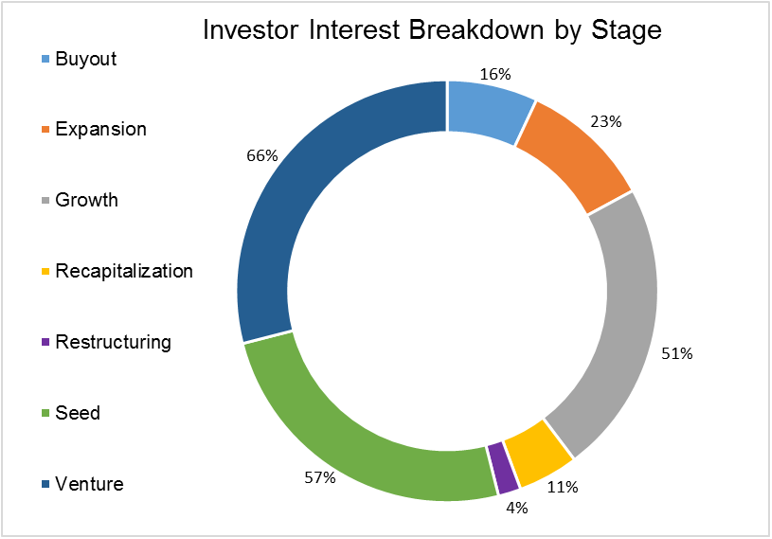
Breakdown of investors at RESI @ TMCx

w1

w2

w3

740 scheduled meetings through the partnering system

68% between entrepreneurs and investors – the game is afoot!

15% between investors and other investors – syndicates are a growing trend and investors source syndication partners at RESI

12% between service providers and investors – CRO relationships are becoming more important to investors

5% between entrepreneur and entrepreneur – it’s a very small CEO universe

Quotes I heard at the event

Family Offices

A VP from a large family office (they invest up $100 million per deal) based in the Mid-Atlantic region who has been to last 5 of our conferences, stated he had 16 partnering meetings. The one thing he appreciated most was that the majority were from the Texas region – that’s why RESI was great for him. He has seen enough companies from Boston and the Bay Area. He was impressed that most Texas companies were far more realistic on valuations than those elsewhere.

An investor from a California-based family office who had never been to RESI before said “I go to many conferences across various industries and this was a great combination of useful topics and the kind of opportunities I want to see.”

Corporate VC

A corporate VC investor said he made one investment in a company he met at RESI@TMCx last year, and this year he found 2-3 he said he was very interested in pulling the trigger on.

A new corporate venture fund from the insurance industry said he needs venues like TMCx and RESI where he can find next generations solutions for all future applications, and also meet investors and strategic partners for corporate initiatives.

A VP of new technology at a corporation, who funded a company sourced from a previous RESI, described RESI@TMCx as a great venue for finding technology assets.

Seed Fund

Funded by two Chinese Pharma and a Chinese CRO looking for early stage investments, this fund’s founding came to TMCx to see what kind of regional technology she could find.

Pharma

A U.S. Pharma BD and Licensing lead said “RESI @ TMCx is great for showing what great resources are in regions like Houston. I have met several companies at RESI that I will continue to investigate.”

A VP of Outsourced Technology said “I need to find companies before they get tied up with long term VC relationships. RESI Houston enables me to broaden my view of companies in a region I need to canvass. I need to get to know these companies at an early stage.”

MaRS Collaborates with Life Science Nation and Johnson & Johnson Innovation to Host RESI in Toronto

12 Apr

TORONTO – April 12, 2016 – MaRS Discovery District (MaRS) is collaborating with Life Science Nation (LSN) and Johnson & Johnson Innovation, JLABS (JLABS) to bring the Redefining Early Stage Investments (RESI) Conference to Toronto on June 23, 2016.

The RESI Conference series brings together fundraising CEOs and early stage investors from around the globe, providing the opportunity for dialogue and relationship building, with the goal of eventual capital allocations.

“MaRS supports over 250 Canadian-grown early stage health technology startups,” said Dianne Carmichael, managing director, health innovation & venture services at MaRS. “Our goal is to provide these young emerging ventures with the best connections to investors and industry to help them scale internationally. The Redefining Early Stage Investment (RESI) conference series has a strong track record of attracting global early stage investors. We’re delighted to bring them to MaRS this summer to build on the success of our HealthKick conferences.”

RESI on MaRS will connect cutting-edge health technologies with a broad audience of investors and industry leaders, including: angel syndicates, private wealth firms, corporate venture capitalists, venture philanthropy groups, foundations and endowments, big pharma and virtual pharma companies, mid-level private equity firms, government organizations, and venture capital investors. The conference will also include 16 panel sessions with pharmaceutical, medical device, biotech, consumer health and healthcare IT investors.

The annual MaRS HealthKick Innovation Challenge will happen this year as part of RESI on MaRS. The Dragons’ Den-like Challenge sets 30 selected companies up to demonstrate their technology and business while competing for prizes in a full-day exhibition to investors and potential partners.

“The MaRS Centre in Toronto represents the 4th venue for our North American RESI Conference series. Now fundraising CEOs and scientist entrepreneurs can meet investors every 90 days — Boston took place in September (RESI Boston), San Francisco in January (RESI @ JPM), Houston is in April (RESI @ TMCx) and now Toronto in June (RESI on MaRS),” said Dennis Ford, CEO at LSN and creator of the RESI Conference Series.

Speakers and participating health ventures will be announced in April.

About MaRS Discovery District

MaRS Discovery District in Toronto is one of the world’s largest urban innovation hubs, supporting a new generation of makers and innovators who aim to make the world a better place by creating solutions that address key societal challenges. It is a community that encourages entrepreneurial thinking through education programs and events, and helps startups launch, grow and scale. MaRS supports over 1,000 ventures.

About Life Science Nation

Life Science Nation (LSN) accelerates the funding of early stage life science firms through its Match.com-like sourcing platform for private investment and enables CEOs to be more efficient in their capital-raising efforts. LSN owns and operates the Redefining Early Stage Investments (RESI) conference series.

For more information, please contact the RESI Team at resi@lifesciencenation.com or 617-600-0668

RESI@TMCx – Program Guide

7 Apr

By Nono Hu, Director of Marketing, LSN

With 4 days to go, RESI@TMCx is getting ready to roll. We’re looking forward to being back in Houston and filling Texas Medical Center’s TMCx accelerator space with meetings, panels and new health technology ideas. With over 150 investors ready to meet with early stage companies, RESI attendees have already booked over 500 meetings. If you’re ready to plan out your day at RESI, check out the RESI@TMCx Program Guide below.

wp

RESI Panel Announcement: Large Pharma Firms Looking Externally For New Assets

7 Apr

By Christine A. Wu, Research Analyst, LSN

chrsitine

Large pharma companies are increasingly looking to early stage companies to fill their future pipelines. These firms have a variety of means of engaging with early stage companies, including in-licensing, collaborations, equity investments, and M&A. At RESI@TMCx, four senior external sourcing staff from the pharma world will explain what their firms are looking for, how they work with early stage companies, and how an emerging biotech company can position themselves to make a big pharma deal.

Moderated by Bill Kohlbrenner, CSO, Life Science Nation, the panelists are:

  • Marc Schwabish, US Head, Pharma Business Development & Licensing, Bayer
  • Barbara Araneo, Innovation Sourcing Director, Novo Nordisk
  • Joseph Simeone, Director, Business Development & Licensing, Merck
  • Mark Day, Executive Director, Head of External Research & Scouting, Alexion

RESI-Houston-2016_600