Archive | Redefining Every Stage Investments (RESI) RSS feed for this section

California, Here We Come: LSN Announces RESI San Francisco

18 Sep

By Dennis Ford, Founder & CEO, LSN

Dennis bookLSN has been beseeched by many scientist-entrepreneurs and investors asking us to bring the Redefining Early Stage Investments (RESI) Conference to California to coincide with the well-known JP Morgan Healthcare Conference. Many CEOs of private biotech and medtech startups attend the JP Morgan event hoping to meet strategic pharma business development folks as well as investors who may be contemplating funding early stage development as part of a buy low, sell high strategy. Mid-level private equity, virtual pharma, and corporate venture investors are all in the mix.

Hosting our event to coincide with the JP Morgan conference makes good sense, as RESI is strictly focused on these same two groups: private early stage biotech and medtech scientist-entrepreneurs, who are primarily translational scientists and newly minted entrepreneurs developing devices or drug treatments, and early stage investors who are seeking emerging opportunities.

This is why at our third RESI Conference, we announced that our next event will be in San Francisco on January 13, 2015. Bringing RESI to San Francisco will be a great opportunity for all the early stage players to connect and form some dynamic relationships. California, here we come!

RESI-4-ONE-PAGER

RESI Attracts Industry Players

18 Sep

By Michael Quigley, Director of Research, LSN

mike-2

On September 17th, more than 450 startup CEOs, investors, and service providers across 16 countries in the life science industry gathered for a day of partnering and compelling panel discussions in Boston’s historic Fenway Park. With more than 600 meetings booked, 14 panels focused on cutting-edge investing and fundraising, and 4 workshops, the stadium was buzzing with energy. However, the main factor that made RESI such a powerful event was the ratio of companies to active early stage investors. Exhibit 1 breaks down the types of attendees at the event.

Exhibit 1

Exhibit 1

Investors made up the largest single category of attendees, followed by biotech companies. The ratio of companies to investors was nearly 1 to 1, something that has become the norm at all RESI conferences. Service providers, including contract research organizations, I-banks, lawyers, and consultants, were also well represented, complementing the event’s strong investment focus. The number of companies developing devices and diagnostic equipment was also significant.

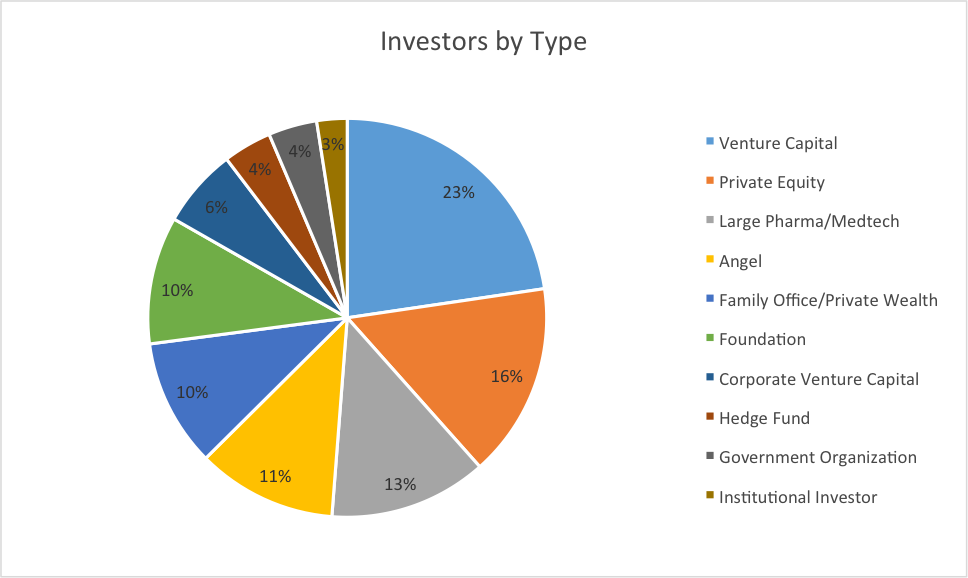
Analyzing the types of investors that attended RESI helps to further understand just what sets this event apart. Exhibit 2 highlights the diversity of capital providers that RESI brings to the table.

Exhibit 2

Exhibit 2

With venture philanthropy, foundations, and family offices representing the two largest investor classes, it is clear that RESI is an extremely effective venue for meeting and forming relationships with these highly sought-after investors.

Other more traditional investors, such as large pharma, venture capital, and corporate venture capital, were also well represented, diversifying the pool of capital available to the entrepreneurs that attended.

Angels and government organizations represented the smallest investor classes at RESI, as the majority of fundraising entrepreneurs are seeking to raise rounds larger than these investors can provide. However, as angels continue to syndicate for larger financing rounds and become longer term investors, they will represent an increasingly valuable opportunity for early stage companies.

During the conference, many fundraising executives and investors reported that the people they were meeting and the information they were gathering were well worth their time. We look forward to hearing more reports in the coming weeks so we can continue to make RESI an outstanding event for the industry.

If You’re Serious About Raising Capital, Check Out The RESI Program

11 Sep

By Dennis Ford, Founder & CEO, LSN

Dennis bookLife Science Nation saw a glaring need to create a Redefining Early Stage Investment Conference (RESI) and launched it just a few years ago.  If you are raising capital or contemplating raising capital, then next week’s RESI conference is a great opportunity to get in front of investors.

This is a genuine opportunity to get feedback on your company and gauge how you are doing with your corporate pitch and positioning .  If you are looking for capital in the next 9-18 months this represents a gem of an opportunity. RESI has over 120 investors signed into the partnering system as of today and we expect another 50 to sign up this week and next. 

Why is RESI Unique? What Is the Differentiation?

RESI has accomplished a few tasks that other conferences haven’t. RESI actually delivers a significant number of global early stage investors to this venue.  The investor mix comprises 10 categories of investors, and RESI has created compelling content around each of these categories through dynamic panel discussions.  Last but not least, RESI offers a one-of-a-kind partnering system that really aids both startups and investors (through profile matching) to easily search and connect with each other based on fit.  This means that the partnering meetings are spot on in terms of actually connecting with an interested party as opposed to the hit or miss approach (text search) of other partnering events.

Click here to check out the RESI Program!

Who’s Meeting Whom at RESI?

11 Sep

By Lucy Parkinson, Senior Research Manager, LSN

lucy 10*10

With less than a week to go until LSN’s Redefining Early Stage Investments (RESI) conference, attendees are using our online partnering system to set up meetings during the event. Registered RESI attendees have sent more than 1,300 meeting requests to each other, resulting in hundreds of partnering meetings already scheduled. As we go into the last week before the conference, there’s still bandwidth available for newly registered startups and investors to book meetings. Each attendee is able to book up to 18 meetings, so it’s not too late to register and begin filling up your schedule.

All attendees belong to one of three broad categories: investors; biotech and medtech companies; or service providers and consultants. With three categories of attendees, the meetings booked fall into six groups. (See Exhibit 1.)

Exhibit 1

Exhibit 1

While meetings are booked among all categories, 60% of all meetings scheduled thus far are between investors and biotech and medtech companies. This has always been the central mission of RESI: to provide a venue for life science entrepreneurs to discuss their research and how it’s going to change the world in face-to-face meetings with investors.

As RESI has developed we’ve been surprised to note that many investors like to book meetings with fellow investors; as RESI is such a large and robust gathering of life science investors, these investors take the opportunity to network with each other, discuss synergies, and find potential co-investors for deals that they’re interested in.

But we’re encouraged to see that RESI facilitates meetings between all possible constituencies. RESI provides a forum for every stakeholder in the early stage life science world to reach out to others and build the relationships that will carry new technologies towards commercialization. We hope to see you there on September 17th.

RESI Workshop: The Life Sciences Legal Landscape Funding Boot Camp

11 Sep

legal landscape

Your company is growing and seeking funding-you have great science that addresses an unmet need and a compelling value proposition!  Your product is better, faster and cheaper! But is your legal house in order? The McDermott team will discuss how to navigate through the life sciences legal landscape to help you avoid the common pitfalls experienced by too many life sciences entrepreneurs.  From formation and founder issues, to the big three of intellectual property, regulatory and reimbursement, to the complexities of raising capital through crowdfunding and initial public offerings, we will provide you with insights into the latest funding trends and a virtual checklist to assure you are building your company on a firm foundation that will facilitate access to capital and future growth.

SPEAKERS

Robert H. Cohen, Partner, McDermott Will & Emery LLP

Todd Finger, Partner, McDermott Will & Emery LLP

Richard B. Smith, Partner, McDermott Will & Emery LLP

AGENDA

  • Formation of a Start-up
  • Founders: Good relationships amongst founders tend to drive a company’s success
  • Early Stage Financing
  • Later Stage Financing/Initial Public Offering
  • Non-Traditional Financings
  • Intellectual Property Issues
  • Regulatory Issues
  • Reimbursement Issues
  • Resources
    • Legal Documents/Terms
    • Investor Questionnaire/Checklist
    • Life Sciences Entrepreneurs Acceleration Program

RESI3

RESI Panel Announcement: Patient Groups

11 Sep

By Michael Quigley, Director of Research, LSN

mike-2Few people, if any, have stronger motivations for the advancement of innovative and effective new therapies than the affected patients and their families and friends. Patient groups are established as a way for these individuals to band together around a particular indication or branch of medicine to help move science forward. Formed by patients and for patients, these groups are looking to improve the standard of care by pooling their capital, scientific resources, and networks to aid in both academic and commercial-stage research.

The upcoming RESI Conference will host a patients group panel moderated by Steve Perrin of the ALS Therapy Development Institute. The panel will include the following speakers:

Joe Camaratta, Board Member, Founders Affiliate, American Heart Association

Annette Bakker, President & CSO, Children’s Tumor Foundation

Steven Young, President & COO, Addario Lung Cancer Medical Institute

Monica Gow, Executive Director, Wake Up Narcolepsy

How do these organizations help bridge the gap between the early discovery interests of academia and the late-stage clinical development expertise required by the pharmaceutical industry? How do these groups support high-risk programs and, at the same time, de-risk opportunities so that they become tractable commercial assets for partnership? What strategies do these organizations use to finance translational research through IND-enabling studies and POC clinical trials, and what do they expect in return from potential partners downstream?

Learn the answers to these questions and others by attending this panel at the RESI Conference next week.

RESI3

RESI Panel Announcement: Family Offices Investing Direct

4 Sep

By Michael Quigley, Director of Research, LSN

mike-2

In recent years, family offices and private wealth investors have become an increasingly important pool of capital for fundraising entrepreneurs in the life science space. Unlike angels or high-net-worth individuals who generally have up to $100 million in capital and opportunistic investment mandates, family offices and private wealth groups represent families and individuals who have $100 million to $1 billion or more in total assets and who use a more institutional investment approach.

The amount of capital these groups manage enables them to have a dedicated staff for screening, due diligence, deal selection, and portfolio management. Many family offices have taken a keen interest in the financial returns and the potential social impact that investments in the life science sector can bring.

This panel aims to spotlight six family offices and investor groups, many of which have historically remained very quiet about their activity in the space. Moderated by Bill Brah, Founder & Executive Director of UMASS Venture Development Center, the panel includes the following speakers:

John Nelson, Managing Director, Genrich Inc.

Melissa Krauth, Principal, Claria Bioscience

Meredith Fisher, Director and Partner Investments, Private Investment Office

Chris DeSouza, Director, Broadview Ventures

Alejandra Paredones, CEO and Founder, BSI Capital Group

Todd Holmes, Director, Gurnet Point Capital

What are their particular motivations to invest in the space? How are deals generally structured, and how do they differ from terms of other investor classes? What, in addition to capital, can these groups bring to the table for an early stage company? How does an entrepreneur find a family office and get in touch, and what information do they look for in the initial correspondence? All these questions and more will be answered on September 17th.

RESI3