Archive | Redefining Every Stage Investments (RESI) RSS feed for this section

Technical Risk – From Belief to Evidence 

7 Apr

By Dennis Ford, Founder & CEO, Life Science Nation (LSN)

DF-News-09142022

In the first article, The Problem Is Not the Science, Life Science Nation established that investability begins with defining a real, urgent market need. But once that foundation is clear, the next question becomes unavoidable: does the product actually work, and can that be demonstrated in a way others trust?

The next focus is technical risk, where belief must become evidence. It outlines how companies move from early signals to reproducible, credible, and translatable results—covering mechanism of action, proof of concept, reproducibility, safety, and scalability.

Once market risk is clear, the next question becomes unavoidable: does the product work, and can that be demonstrated in a way that others trust?

This is where many companies overestimate their position. Early data, promising signals, or strong academic foundations often create internal confidence. But investors are not evaluating belief; they are evaluating evidence. The distance between those two states defines technical risk.

Technical risk is not simply about whether something works once. It is about whether it works consistently, whether the mechanism is credible, and whether the results can survive the transition from controlled environments into real-world use.

The first layer of clarity comes from the mechanism of action. There must be a coherent explanation of how the biology or technology produces the intended effect. This is not a description of experimental outcomes; it is a causal story. Without it, data is difficult to interpret and harder to trust.

Proof of concept establishes that the signal exists. This can take the form of in vitro data, animal models, early human data, or a working prototype, but it must be observable and measurable. Reproducibility then determines whether that signal can be relied upon. A single experiment is not enough. Results must hold across time, cohorts, and independent attempts.

Translatability introduces another layer of complexity. What works under ideal conditions does not always work in patients, clinics, or real-world settings. Understanding how findings extend beyond the initial model is critical, particularly in biologically complex indications.

Safety, performance, and durability define the product profile. Even if effective, a product must be safe enough for its intended use, deliver a meaningful effect, and sustain that effect over time. A transient or marginal benefit rarely justifies the cost and risk of development.

Finally, manufacturability, scalability, and data integrity complete the picture. A product that cannot be produced consistently and at scale cannot become a company. Data that is poorly designed, uncontrolled, or selectively presented undermines confidence, even when the underlying science is strong.

Technical risk is resolved when the product moves from an interesting idea to something that consistently works, can be trusted, and can be translated into real-world use.

Core Elements of Technical Risk

  • Mechanism of action
  • Proof of concept
  • Reproducibility
  • Translatability
  • Safety
  • Performance and durability
  • Manufacturability and scalability
  • Data quality and integrity

Next in the series: Regulatory Risk — Navigating the Path to Approval

How Early-Stage Companies Should Think About June in San Diego 

7 Apr

By Max Braht, VP of Business Development, LSN

Max-Braht-Headshot

Whether in San Diego, Philadelphia, or Boston, there are a handful of weeks each year when the life science industry gathers in force. Founders, investors, pharma, and advisors all show up at once. Multiple events run in parallel, each with its own programming, audience, and purpose. From the outside, it looks like one opportunity.

It is not.

Each event is designed to serve a specific audience. Some programs are intentionally broad and inclusive. They bring together large numbers of participants across the ecosystem and create a wide surface for interaction. Others are more focused. They are designed to reach a narrower audience with a specific objective.

The challenge for early-stage companies is that it is not always obvious which environment they are actually entering.

Most of the broader convention programming is built around partnering between established biotech companies and large pharma. These conversations assume a certain level of maturity. The data has been prepared for external review. Development paths are clearer. The work is far enough along for a downstream buyer to evaluate.

For companies at that stage, the environment works. For earlier-stage companies, the situation is different.

They enter the same system, but the conversations are not always aligned with what they need. Licensing discussions can be premature. Data packages are still forming. Investor meetings are possible, but they are not the primary function of the week. Competition for attention is high, and much of that attention is directed toward later-stage opportunities.

Nothing is wrong with the environment. It is doing exactly what it is designed to do.

The issue is alignment.

Early-stage companies are not primarily seeking licensing outcomes. They are seeking capital. Capital behaves differently. It requires a higher concentration of relevant investors, a structure built around evaluation, and conversations that lead to funding decisions. Seed rounds up to two million, Series A up to ten million, and Series B up to fifty million are fundamentally different conversations than late-stage programs discussing Phase III data, scaling, and commercial expansion with pharma. They are different buyers, different expectations, and different decision processes.

During that same week, RESI operates as a separate market focused on early-stage capital formation. The investor base is concentrated around seed through Series A and early Series B. The conversations are centered on investment. The environment is designed to match companies with investors who are actively deploying capital into emerging opportunities.

This creates a different dynamic.

Instead of competing for limited attention in a broad, later-stage environment, companies operate in a setting where the density of relevant investors is higher, and conversations are aligned with their stage. This is not a question of which event is better.

The question is whether you are in the right room.

If your objective is licensing or a strategic partnership with large pharma, the broader convention environment is the right place to spend your time. If your objective is to raise capital at the early stage, the question becomes more direct. Where are the investors actively deploying to companies like yours, and how concentrated are they? Many companies try to do both. Some can. Most dilute their effort. The cost is not just the registration fee. It is time, focus, and missed opportunity. In weeks like this, the difference between being in the right room and the wrong one is not subtle. Please choose a room that fits your stage.

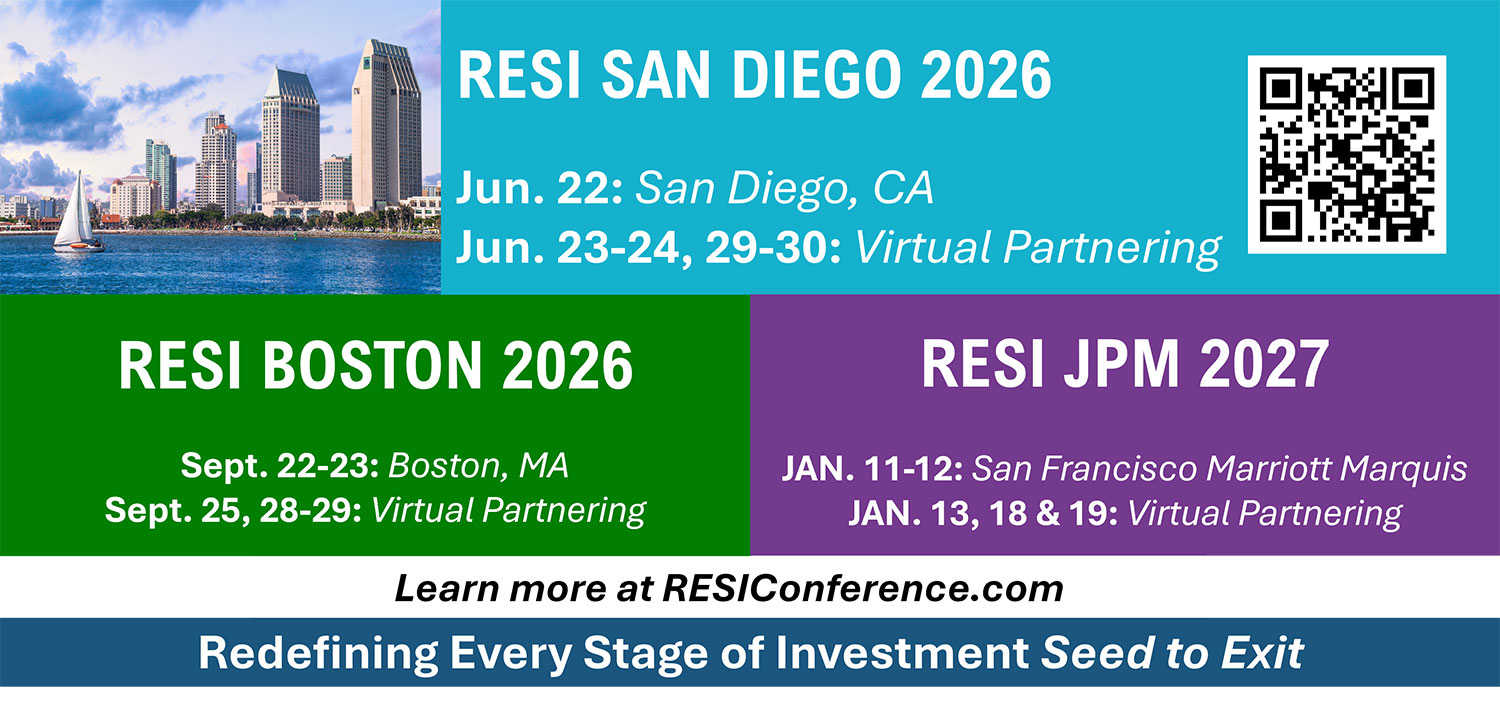
Register for RESI San Diego

Extend Your Reach Across Two Key Life Science Markets 

7 Apr

By Matt Stanton, VP Sales US West, Central and South America, LSN

For companies navigating fundraising or business development, timing and consistency matter as much as the initial introduction. The RESI San Diego 2026 and RESI Boston 2026 bundle is structured to support both, offering a coordinated approach to investor and partner engagement across two high-activity windows. 

By combining these events, organizations can move beyond one-off meetings and build sustained momentum with the same network of investors and strategic partners over time. 

Two Events. One Continuous Engagement Strategy 

The bundle includes full 5-day access to both conferences: 

RESI San Diego 2026
June 22 (in-person during Convention Week) followed by four days of virtual partnering 

RESI Boston 2026
September 22–23 (in-person during Biotech Week Boston) followed by three days of virtual partnering 

Positioned three months apart, these events create a natural progression—from initial outreach and early conversations in San Diego to deeper follow-up and potential deal advancement in Boston. 

Built for How Deals Actually Happen 

Fundraising and BD are iterative processes. Initial meetings rarely lead directly to outcomes; they require follow-up, validation, and continued visibility. This bundle is designed with that reality in mind. 

Participating in both RESI events allows organizations to maintain continuity by: 

  • Re-engaging investors and partners across multiple touchpoints  
  • Strengthening credibility through consistent presence  
  • Advancing discussions with greater context and traction  

Rather than restarting conversations, companies return to Boston with warmer leads and clearer positioning. 

Limited-Time Bundle Pricing 

Discount rates are available for a limited time: 

  • Startups: From $3,490 (regularly $4,490)  
  • Service Providers: From $4,490 (regularly $5,490)  

Savings of up to $1,000 are available through April 17. 

A More Effective Way to Build Pipeline 

The RESI ecosystem is built on repeated, data-driven engagement across a global network of investors, innovators, and partners. The San Diego & Boston bundle aligns with this model—providing a structured way to build pipeline, maintain visibility, and convert conversations into outcomes. 

To register, select the bundle ticket option within the RESI San Diego registration portal.

Register for RESI San Diego and Boston Bundle

The Problem Is Not the Science: A Seven-Part Series on De-Risking, Signal, and Investability 

31 Mar

By Dennis Ford, Founder & CEO, Life Science Nation (LSN)

DF-News-09142022

Early-stage life science companies do not fail because the science is weak. They fail because the science never becomes investable. Across therapeutics, devices, diagnostics, and digital health, failure rates approach ninety percent. The default explanation is technical risk. The data did not hold. The biology did not translate. The product did not perform. That is not what usually happens. What happens is structural. Companies are built without a system for converting discovery into something capital can evaluate, compare, and act on. They generate data before defining the problem. They raise capital before removing uncertainty. They move forward without knowing what the next decision-maker needs to see. Capital does not fund ideas. It funds signal.

Signal is what allows an investor or partner to act with confidence. It is produced when specific forms of uncertainty are systematically removed. Without signal, even strong science remains interesting but unfundable. With it, capital moves. Over the next six articles, we will break down how that signal is created. Not through storytelling, but through the systematic reduction of risk across a defined stack. Each layer represents a different barrier to action. Each must be addressed in sequence. Investability emerges when enough of this stack has been reduced to a level that supports a decision.

  • Market
  • Technical
  • Regulatory
  • Execution
  • Economic
  • Financing
  • Exit

The series begins where it should: with market risk. Market risk sits at the foundation. Before anything else, a real and meaningful problem must be established. It is not enough to have a promising technology. The problem must be precise, urgent, and actionable within a real system.

The clarity of the unmet need defines the problem. Urgency determines whether action is required. Identification of the buyer clarifies who decides and who pays. The current standard of care provides context for change. Differentiation defines why the product matters. Adoption friction determines how difficult implementation is. Path to payment ensures the product can be funded. If these elements are not clear, the company is not ready. It is undefined. Most companies move past this step too quickly. They begin with the science and assume the market will follow. By the time they realize it has not, they have already consumed time, capital, and credibility. When market risk is resolved, everything else begins to align. Technical work becomes purposeful. Regulatory paths become clearer. Economic value can be measured. Capital has something to anchor to. Signal begins to form.

This is where the series starts. In the articles that follow, we will move layer by layer through the stack, showing how each dimension of risk is defined, reduced, and translated into investable signal. The objective is not to simplify science. It is to make the path from discovery to capital legible and executable. The challenge in life science is not discovery.

It is the disciplined conversion of discovery into investable signal.

Market Risk

Defining Whether a Real Problem Exists

At the foundation of the De-Risk Stack is market risk. Before a founder thinks about technical validation, regulatory pathway, or fundraising strategy, there is a more basic question: does this company solve a real problem in a form the market will recognize and respond to?

This is where many early-stage life science ventures begin to drift. A founder may have compelling science, a large disease category, and years of academic work behind the technology, yet still fail to define the problem in commercial terms. Capital does not fund scientific possibilities in the abstract; it funds opportunities where a specific problem is understood, urgent, and attached to a buyer who has a reason to act.

Market risk is therefore not a question of size alone. A very large indication can still represent a weak opportunity if the unmet need is vague, the current standard of care is acceptable, or the path to payment is unclear. By contrast, a narrowly defined indication with a highly specific unmet need can be highly investable when urgency is high, the buyer is identifiable, and the product’s advantage is obvious. What matters is not breadth, but clarity.

In practice, market risk begins with the definition of unmet need. The problem must be described precisely enough that an investor, clinician, or partner can understand exactly what is broken and for whom. Urgency follows. Some conditions create pressure for action because they are life-threatening, progressive, poorly managed, or economically burdensome. Others do not. That distinction shapes adoption, tolerance for risk, and willingness to pay.

Once need and urgency are clear, attention shifts to the buyer and the system. In life science, the user, decision maker, and payer are often different actors. If you cannot identify who decides and who pays, you do not yet have a real market thesis. At the same time, every product enters an existing standard of care. You must understand how patients are currently treated, where those approaches fail, and why change is justified.

Differentiation, adoption friction, and path to payment complete the picture. A product must be better in a way that matters—not just marginally improved in a way that is difficult to notice. It must fit into real workflows, incentives, reimbursement structures, and budget constraints. If the system cannot absorb the product, market risk remains unresolved, no matter how attractive the science appears.

Market risk is resolved when a clearly defined and urgent problem exists, a real buyer is identified, the current approach is inadequate, and the product has a credible path to adoption and payment.

Core Elements of Market Risk

  • Clarity of unmet need
  • Urgency
  • Identification of the buyer
  • Current standard of care
  • Differentiation
  • Adoption friction
  • Path to payment

Market risk is the first layer of the De-Risk Stack, but it is only the beginning. Resolving whether a real, urgent problem exists establishes the foundation for everything that follows. Without it, progress elsewhere does not translate into investability.

This series examines each layer of the stack in sequence, outlining how risk is systematically reduced to convert scientific innovation into something capital can evaluate and fund.

In the next installment, the focus shifts to technical risk: how companies demonstrate that their product works, and how to de-risk the underlying technology in a way that builds investor confidence.

Check back next week for Technical Risk: De-Risking the Stack.

RESI Europe 2026 Innovator’s Pitch Challenge Winners 

31 Mar

By Claire Jeong, Chief Conference Officer, Vice President of Investor Research, Asia BD, LSN

At RESI Europe 2026 in Lisbon, more than 20 innovative companies participated in the Innovator’s Pitch Challenge (IPC), showcasing cutting-edge technologies across drugs, devices, diagnostics, and digital health. The IPC continues to serve as a powerful platform for early-stage life science companies to engage directly with active investors and strategic partners. 

Each finalist delivered a 6-minute pitch followed by a 7-minute live Q&A with a panel of investor judges, creating a dynamic and interactive evaluation process. Beyond the stage, participating companies also connected with attendees through dedicated poster presentations and 1:1 partnering meetings, maximizing visibility and investor engagement throughout the event. 

A defining feature of the IPC is the RESI cash voting system. Registered attendees, including investors, startup executives, and industry experts, allocated their RESI cash to the companies they found most compelling. Voting was based on pitch performance, Q&A responses, and direct interactions during partnering meetings and networking sessions. 

Life Science Nation is proud to announce the top three winners of the RESI Europe 2026 Innovator’s Pitch Challenge: 

1st Place 2nd Place 3rd Place
StimOxyGen Amets Biotechnology You2Yourself

These companies stood out for their strong scientific foundations, clear value propositions, and ability to engage investor interest. 

Applications are now open for upcoming Innovator’s Pitch Challenges. Companies can apply to pitch at RESI San Diego 2026 and take the stage in front of a global network of investors and partners. 

Apply to Pitch at RESI San Diego

Best Practices for Cap Table Management: What Founders Need to Know Before Their Next Raise 

31 Mar

By Sougato Das, President and COO, LSN

Sougato-Das

Early-stage companies often focus heavily on product development, market traction, and investor outreach—but one of the most critical foundations of long-term success lies in how equity is structured from the very beginning. A well-managed cap table is not just an administrative tool; it is a strategic asset that can influence fundraising outcomes, talent acquisition, and overall company growth.

To help founders navigate this essential aspect of building a company, J.P. Morgan and Polsinelli are hosting an upcoming webinar, “Best Practices for Cap Table Management.” This practical, founder-focused session is designed to equip early-stage leaders with the knowledge needed to make informed equity decisions and avoid costly mistakes down the road.

Register for the Webinar

The session will cover key fundamentals every startup team should understand, beginning with how to approach founder equity splits. Establishing fair and strategic ownership early on can prevent misalignment and friction as the company scales. From there, the discussion will move into dilution—an inevitable part of fundraising—and how founders can plan for and manage it effectively.

Another critical topic is the use of SAFE notes, which have become increasingly common in early-stage financing. While they offer flexibility, they can also introduce complexity if not fully understood. This webinar will break down how SAFE notes work and how they impact future equity distribution.

Importantly, the session will also explore how cap table structure directly affects fundraising outcomes. Investors often scrutinize ownership distribution, and a poorly structured cap table can create hesitation or even derail a deal. In addition, speakers will highlight the importance of building a thoughtful stock option pool, an essential tool for attracting and retaining top talent in competitive markets.

This webinar is particularly relevant for founders, CEOs, and CFOs who are looking to strengthen their financial strategy, prepare for upcoming funding rounds, and build companies that scale responsibly.

The session will take place on April 14, 2026 at 11:00 AM ET and will feature insights from industry experts Vanessa Blanco (J.P. Morgan), Alan Gould (J.P. Morgan), Sara Dauber (J.P. Morgan), Jeremy Arak (Polsinelli), and Sougato Das (Life Science Nation).

Attendees should note that this webinar will not be recorded and will be available exclusively to live participants, making attendance especially valuable for those looking to gain actionable insights in real time.

Sign Up Webinar

RESI Europe 2026 Program Guide Released

17 Mar

By Dennis Ford, Founder & CEO, Life Science Nation (LSN)

DF-News-09142022

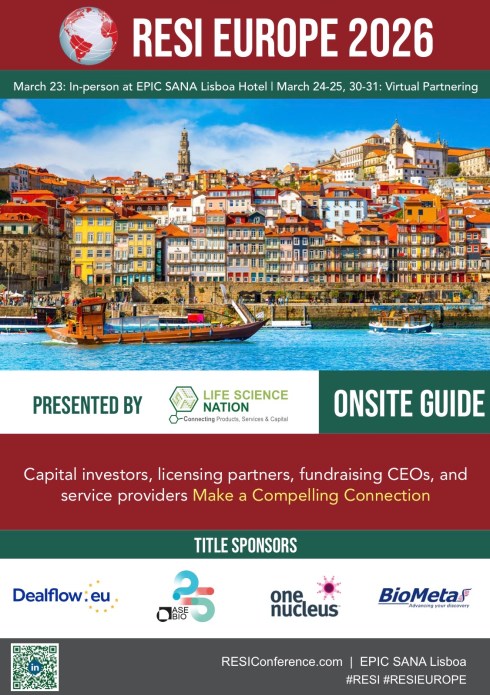
Life Science Nation (LSN) has released the official Program Guide for RESI Europe 2026, taking place March 23 in Lisbon, Portugal, followed by four days of virtual partnering on March 24–25 and March 30–31.

The hybrid conference will bring together early-stage life science and healthcare innovators with a global network of investors and strategic partners actively sourcing opportunities across drugs, devices, diagnostics, and digital health.

A central highlight of the event is the Innovator’s Pitch Challenge (IPC), where more than 20 emerging companies will present their technologies directly to investor judges and the broader RESI partnering community. These presentations offer founders the opportunity to gain visibility, receive investor feedback, and initiate conversations that can lead to future funding and strategic collaborations.

The program also features investor panels, partnering meetings, and networking opportunities designed to help founders better understand the current investment landscape and build relationships with active investors and strategic partners.

With hundreds of one-on-one partnering meetings expected to take place across the hybrid format, RESI Europe provides a focused environment for early-stage companies to connect with capital and advance their fundraising and partnership strategies.

Registration is still open, and attendees can view the full conference program in the official Program Guide.

Register for RESI Europe